
[ad_1]
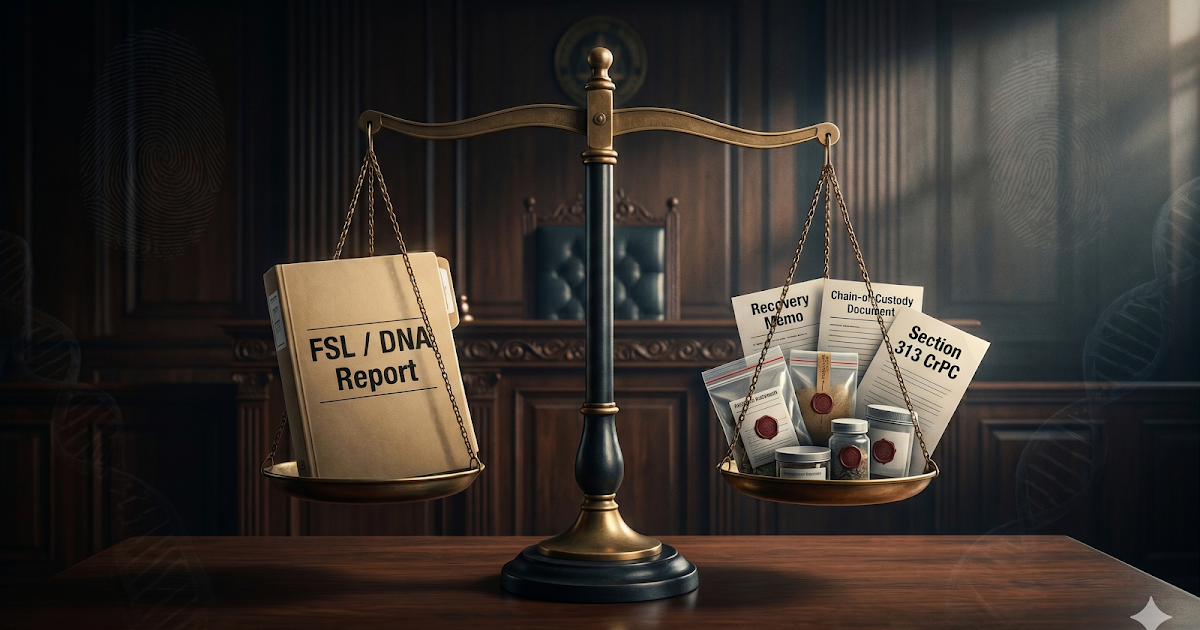
A forensic report often enters the courtroom with an aura of certainty. Once the Chemical Analyser or FSL states that blood matches, DNA corresponds, or a sample confirms a prosecution theory, the natural temptation is to treat the report as near-conclusive proof. The decision of the Allahabad High Court in Najeeruddin v. State of U.P. is a powerful reminder that criminal courts must resist that temptation. A forensic report may be on record, and may even be formally admissible under Section 293 CrPC, yet it may still be legally unsafe to rely upon if the prosecution has not proved the source material, the chain of connection, and the accused has not been confronted with the incriminating contents under Section 313 CrPC.

This distinction is of immediate importance to every Sessions Judge. In trial practice, three questions must be kept separate: whether the report is receivable in evidence, whether the report is reliable, and whether the report can fairly be used against the accused. The judgment shows that unless all three conditions are satisfied, a conviction resting on scientific evidence may become vulnerable to reversal.
The case that raised the issue
The case arose out of a gruesome prosecution involving multiple murders, injuries to surviving children, and allegations of rape and aggravated sexual assault. The trial court convicted the accused on several serious charges and imposed the death penalty under Section 302 IPC, along with other major sentences. On appeal, however, the High Court found that the manner in which the forensic evidence was brought and used in the trial raised grave concerns of admissibility, reliability, and fairness.
The prosecution relied on a DNA report dated 07.11.2020 and a fingerprint expert report. Those reports were intended to connect articles allegedly recovered from the spot and at the instance of the accused with the accused’s blood sample and other incriminating circumstances. But the crucial problem was that the accused’s statement under Section 313 CrPC had already been recorded on 16.12.2019, long before the reports came on record, and the reports were never put to him thereafter.
The High Court’s central message
The High Court held that all incriminating circumstances appearing in the prosecution evidence must be put to the accused under Section 313 CrPC. Since the trial court relied upon the DNA report even though it had been received after the Section 313 examination and was never put to the accused, the Court found that real prejudice had been caused. The accused was denied the opportunity to explain the report, challenge its basis, or lead evidence in rebuttal.
That finding is crucial because it shifts the conversation from procedural formality to substantive fairness. The issue was not merely that one more question should have been asked. The issue was that scientific evidence, often the most persuasive part of the prosecution case, had been used without giving the accused a meaningful chance to respond.
Section 293 CrPC: what it does, and what it does not do
One of the most useful aspects of the judgment is its clear explanation of Section 293 CrPC. The section permits the report of a Government Scientific Expert to be read in evidence without the need for formal proof by examining the expert as a witness. That rule helps avoid delay and unnecessary technicality. But the section does not make the report self-proving in every sense, nor does it immunize the report from challenge by the defence.
A Sessions Judge must therefore remember that Section 293 deals only with the mode of proof of the report. It does not prove the seizure, collection, identity, integrity, or continuity of the sample. Nor does it override the defence’s right to dispute the very foundation of the report by challenging the recovery, seizure memo, collection process, or chain of custody.
Admissibility is not reliability
The judgment’s enduring value lies in one basic doctrinal lesson: admissibility is not the same thing as reliability. A document may be receivable in evidence and yet carry little or no evidentiary weight if the underlying facts are not proved. In forensic cases, the laboratory can only speak to the sample it received; it cannot prove on its own that the sample was correctly collected, safely preserved, honestly transmitted, or genuinely connected with the crime.
That connection must be established in court through foundational evidence. If the prosecution fails to show what exactly was recovered, who recovered it, under what memo, under what seal, through which custody, and how that very article reached the laboratory, then the forensic opinion becomes detached from the facts in issue. In criminal law, a detached opinion cannot become the foundation of guilt merely because it appears scientific.
Why the forensic report failed in this case
The High Court found multiple defects in the prosecution’s treatment of the forensic material. The Field Unit Team allegedly collected blood swabs, hair, blood-soaked clothing, a condom wrapper, a scissor, and lifted fingerprints from the scene. Yet the Field Unit report dated 25.11.2019 was not exhibited, and the officer who prepared it, Vijay Kumar, was not examined. That meant the very collection of the source material was not properly proved in evidence.
The Court also noticed that the articles allegedly recovered from the scene and at the instance of the accused were not produced before the court as material exhibits. No prosecution witness identified those articles in court as the same objects recovered during investigation. In that background, the High Court observed that once neither the seized article nor any portion of it had been produced in court, and the seizure itself had not been admitted, the forensic report in relation to those articles remained a “waste paper.”
What does “waste paper” really mean?
The expression used by the Court is striking, but its meaning is precise. It does not suggest that every unproved forensic report is literally inadmissible in the technical sense. Rather, it means that where the prosecution fails to prove the source article and the connecting chain, the report loses effective evidentiary utility. The report may exist in the file, but it cannot safely support a finding of guilt.
For trial judges, this is the practical lesson: do not confuse presence on record with probative value. A report lying in the paper book is not the same thing as a report legally fit to be acted upon.
The foundational facts a trial court must insist upon
Every Chemical Analyser or FSL report rests on a series of preliminary facts, and unless those facts are proved, the report stands on sand. The court must know from evidence:
-
What was seized or collected.
-
From where it was seized or collected.
-
Who seized or collected it.
-
Whether the seizure or collection memo was proved.
-
Whether the article was sealed and how the seal was preserved.
-
Where the article remained in custody before dispatch.
-
How the article was sent to the laboratory.
-
Whether the seal was intact at the time of receipt and examination.
-
Whether the witness in court identified the article or sample as the one connected with the case.
If these links are weak, absent, or disputed without adequate proof, a scientifically worded opinion cannot repair the evidentiary gap.
Section 313 CrPC: the indispensable safeguard
The second major lesson of the case concerns Section 313 CrPC. The High Court emphasized that the stage of Section 313 comes after the prosecution evidence and before the defence is called upon. That is not an empty ritual. It exists so that the accused may answer the incriminating case against him and decide whether to adduce defence evidence in response.
Accordingly, if an FSL or Chemical Analyser report is received after the accused has already been examined under Section 313, and the court still proposes to rely upon it, the accused must be recalled and questioned on the incriminating contents of that report. If this is not done, prejudice is obvious, because the accused is denied the chance to explain, rebut, or challenge one of the most damaging parts of the prosecution case.
The error of over-hasty trial management
The High Court did not view the forensic lapse in isolation. It noticed that the case had proceeded with unusual speed: charges were framed quickly, numerous witnesses were examined within days, the accused was examined under Section 313 before all forensic evidence had arrived, and the trial court later relied upon reports that had not been put to the accused. The Court regarded this as part of a larger failure to ensure a real and meaningful opportunity of defence.
This part of the judgment carries institutional significance. Sessions trials, especially those involving life imprisonment or death sentence, cannot be managed on the assumption that speed alone equals efficiency. Expeditious disposal is valuable, but not at the cost of fairness, completeness, and evidentiary discipline.
The precedents relied upon
The High Court referred to Nar Singh v. State of Haryana 2015 AIR SC 310 to explain that where incriminating material is not put to the accused under Section 313 and prejudice results, the proper course may be retrial from the stage at which the irregularity occurred. It also referred to Jitendra v. State of M.P.[(2004) 10 SCC 562 : 2004 SCC (Cri) 2028 to reiterate that the best evidence of seizure is the production of the seized articles themselves as material objects, while noting State of Rajasthan v. Sahi Ram (2019) 10 SCC 649, that where seizure is otherwise clearly proved and not disputed, it may not be necessary in every case to physically produce the entire bulk material before the court.
This doctrinal balance is important. The law is not insisting on empty ritualism. It is insisting on evidentiary assurance. Where the seizure is admitted or independently proved, and the chain is intact, strict physical production of every bulk item may not always be essential. But where seizure is disputed, collection is unproved, the source material is not exhibited, and the incriminating report is not put to the accused, the court cannot safely proceed on the strength of the report alone.
Why this judgment matters to Sessions Judges
For a Sessions Judge, the decision serves less as an appellate criticism and more as a trial-management manual. It tells the trial court exactly where forensic evidence can go wrong and how to prevent that error before judgment. The safest judicial approach is not to ask only whether the FSL report is exhibited, but whether the prosecution has established the report’s evidentiary foundation and whether the defence has had a fair chance to answer it.
This makes the judgment especially useful in cases involving DNA profiling, serology, blood grouping, ballistic examination, toxicology, narcotics, poison analysis, semen analysis, and any other form of laboratory opinion. The rule is constant: forensic opinion derives strength from proved facts, not the other way round.
A practical courtroom checklist
Before relying on a Chemical Analyser or FSL report, a Sessions Judge would be well advised to verify the following:
-
Has the seizure or collection been proved by a competent witness?
-
Has the source article or a representative sample been produced, identified, or otherwise linked through cogent evidence?
-
Is the chain of custody established through seals, forwarding memos, deposit records, and laboratory receipt?
-
Does the report clearly relate to the same item allegedly recovered in the case?
-
Has the incriminating conclusion of the report been specifically put to the accused under Section 313 CrPC?
-
If the report arrived later, has the accused been re-examined and allowed to rebut it?
-
Is expert examination necessary because the defence has raised a substantial challenge to the report or its foundation?
If the answer to any of these is doubtful, the court should cure the defect before judgment by recalling witnesses, summoning the expert, directing production of material exhibits, or conducting a supplementary Section 313 examination.
The article’s central proposition
The legal position emerging from the judgment may be stated with clarity: a Chemical Analyser or FSL report of a Government Scientific Expert is formally receivable under Section 293 CrPC without formal proof, but its reliability and probative value depend on proof of the foundational facts connecting the report to the seized or collected material, and the report cannot be fairly used against the accused unless its incriminating contents are put to him under Section 313 CrPC.
Where the source articles are not proved, the collection or seizure is not established, the field report is not exhibited, or the accused is denied the opportunity to answer the report, reliance on such scientific evidence becomes unsafe and may vitiate the trial.
Final word
The great strength of forensic science is precision. The great strength of criminal law is fairness. A Sessions trial remains just only when both work together. The lesson of Najeeruddin is therefore simple but profound: an FSL report is not a shortcut to conviction. It is only one piece of evidence, and like every other incriminating circumstance, it must be legally connected, properly proved, and fairly put to the accused before it can be used to sustain guilt.
For courts conducting serious criminal trials, that approach does not weaken the prosecution. On the contrary, it protects the integrity of conviction by ensuring that scientific evidence rests on tested legal foundations rather than assumption.
Optional short blurb
A forensic report may be admissible under Section 293 CrPC, but a Sessions Court cannot safely rely on it unless the prosecution proves the source articles, the chain of custody, and the accused is confronted with the incriminating contents under Section 313 CrPC. That is the lasting lesson of Najeeruddin v. State of U.P.
[ad_2]
Source link

