

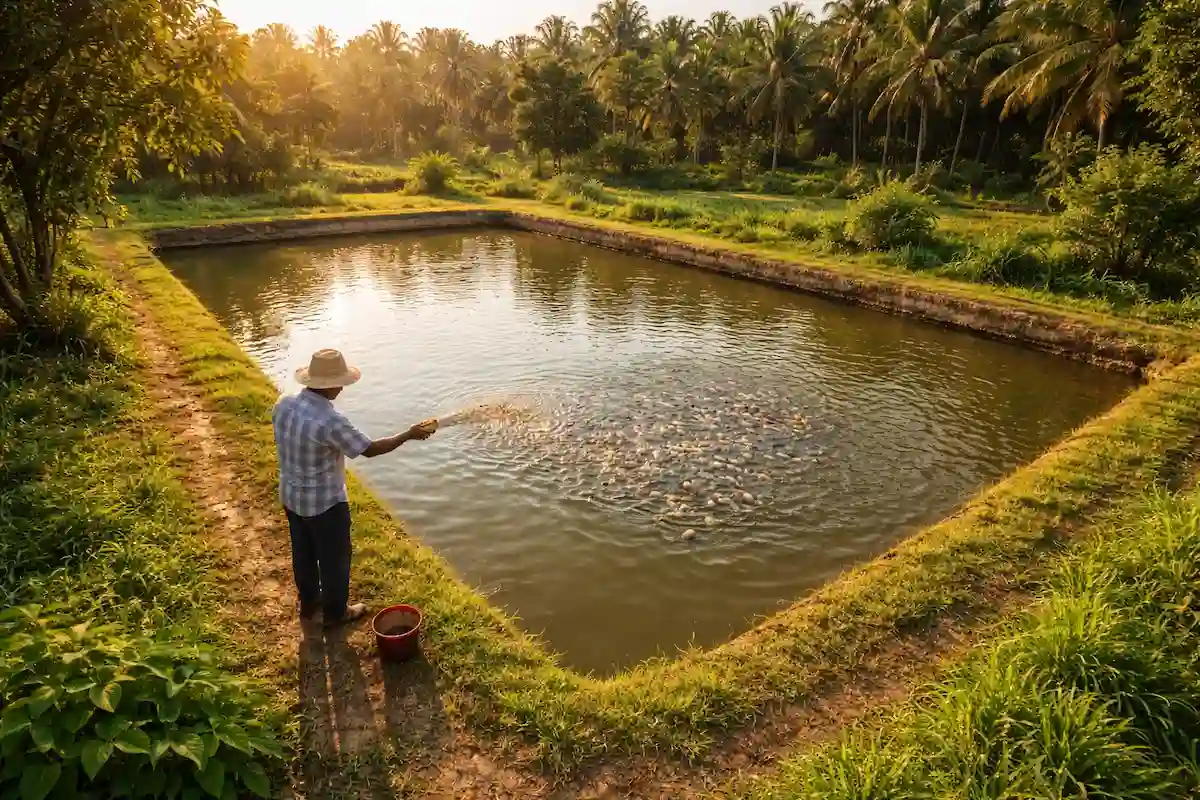
If you run a tilapia pond and still guess how much feed to throw in each morning, you are almost certainly wasting money or leaving growth on the table. A practical tilapia feeding guide closes that gap from the first week. Whether you manage a backyard tank, a small family pond, or a commercial grow-out system, one rule drives everything: feed rate must track fish biomass, not habit.
The correct tilapia feeding rate is typically 1.5% to 15% of body weight per day, depending on fish size. Small fingerlings need the highest feed percentage, while market-size fish require much less.
This tilapia fish feeding guide covers daily feed amounts by pond size, how those amounts shift as fish grow, how temperature shuts down appetite, and what a working feeding schedule looks like over a full production cycle. The tilapia feeding chart sections below give hard numbers. The tilapia pond feeding guide tables break those numbers down by surface area so you can apply them the same day.
Every figure here comes from peer-reviewed aquaculture research and verified pond management practice across tropical, subtropical, and temperate tilapia-farming regions. A tilapia feeding schedule that ignores fish size, water temperature, or stocking density will consistently underperform, regardless of feed quality. This guide is designed to be usable today, not just informative.

Real farm observation: In many small operations, feed waste of 10 to 20 percent is common simply because nobody recalculates amounts after fish pass 150 grams. That single habit costs more than most equipment upgrades.
Why Feed Rate Controls Everything in Tilapia Production
Feed is the biggest single cost in tilapia farming. In most operations it reaches 40 to 60 percent of total production expenses. Overfeeding wastes money directly and degrades water quality, triggering disease, oxygen crashes, and collapsed tilapia feed conversion efficiency. Underfeeding slows growth and stretches the production cycle, pushing cost-per-kilogram higher even when feed looks like it is being saved.
In practical terms, everything comes back to one number: Feed Conversion Ratio, or FCR. FCR measures how many kilograms of feed it takes to produce one kilogram of fish weight. A well-managed tilapia pond hits FCR of 1.5 to 2.0. To put that in financial terms: with feed at USD 0.50 per kilogram and an FCR of 1.8, your feed cost per kilogram of fish produced is USD 0.90. Push FCR to 3.0 through poor tilapia feeding management and that cost jumps to USD 1.50, a 67 percent increase with no change in feed price.
From practical farm experience, three things consistently destroy FCR: feeding fixed amounts regardless of fish growth stage, failing to adjust for temperature changes, and ignoring actual stocking density when estimating biomass. All three are preventable.
The Core Rule: Feeding Tilapia by Percentage of Body Weight

Most reliable tilapia feeding programs start with one method: feeding by body weight percentage. You feed tilapia a set percentage of their total estimated live weight each day. That percentage steps down as fish grow, because a 5-gram fingerling burns energy at a completely different rate than a 400-gram grow-out fish does.
The tilapia feed calculation formula runs like this: Daily Feed (kg) = Total Biomass (kg) x Feeding Rate (%). A 100-gram tilapia eating at 4 percent body weight gets 4 grams of feed per day. A 400-gram fish at 2.5 percent gets 10 grams. Multiply those individual amounts by your fish count to get the pond total. Full breakdown by size class is below:
| Fish Weight (g) | Feeding Rate (% BW/day) | Feeding Frequency | Feed Type |
| 1 – 5 g | 10 – 15% | 4 – 6x per day | Starter crumble (45% protein) |
| 5 – 50 g | 6 – 10% | 3 – 4x per day | Starter/grower (35-40% protein) |
| 50 – 150 g | 4 – 6% | 3x per day | Grower (32% protein) |
| 150 – 300 g | 3 – 4% | 2 – 3x per day | Grower (28-32% protein) |
| 300 – 500 g | 2 – 3% | 2x per day | Finisher (25-28% protein) |
| 500 g+ | 1.5 – 2% | 2x per day | Finisher (25% protein) |
To apply the table: if you have 200 kg of fish in the 150 to 300 g range, daily feed = 200 x 0.035 (using 3.5%) = 7 kg, split across 2 to 3 meals. Tilapia fingerlings between 1 and 10 grams need the highest rates, 10 to 15 percent of body weight per day, across 4 to 6 feedings using a 40 to 45 percent protein starter crumble distributed evenly across the full water surface.
Many backyard producers notice measurable growth improvement within two weeks after switching from fixed daily amounts to biomass-based feeding. The shift is that immediate.
Tilapia Feeding Chart by Pond Size
The tables below combine the body weight percentage method with typical stocking densities so you can read off a working daily feed range directly for your pond size. Small to medium ponds assume 3 to 5 fish per square meter; intensive aerated systems run 20 to 30 fish per square meter.

To put that in perspective: if you stock 1,000 fish averaging 200 grams each, total biomass is 200 kg. At 3.5 percent body weight, daily feed is 7 kg split across 2 to 3 meals. Scale the same calculation to a 1-hectare pond carrying 3 fish per m2 at 300 grams each and you are looking at roughly 1,100 kg of feed per day at peak density. There is no universal rate per hectare; everything runs through biomass first.
Small Pond Feeding Guide (up to 500 m2)
Small ponds used for family production or backyard aquaculture typically hold 300 to 2,500 fish. Feeding accuracy matters more here because small water volumes respond to overfeeding within hours, not days.
| Pond Size | Stocking (fish) | Avg Fish Wt | Total Biomass | Daily Feed |
| 100 m2 | 300 – 500 | 50 g | 15 – 25 kg | 0.75 – 1.5 kg |
| 200 m2 | 600 – 1,000 | 100 g | 60 – 100 kg | 2.4 – 5.0 kg |
| 300 m2 | 900 – 1,500 | 200 g | 180 – 300 kg | 5.4 – 12 kg |
| 500 m2 | 1,500 – 2,500 | 300 g | 450 – 750 kg | 11 – 26 kg |
Medium Pond Feeding Guide (500 m2 to 2,000 m2)
Medium grow-out ponds are the backbone of community-scale tilapia operations across Southeast Asia, sub-Saharan Africa, and Central America. Paddlewheel aeration becomes important at these densities to sustain dissolved oxygen levels needed for good feed conversion.
| Pond Size | Stocking (fish) | Avg Fish Wt | Total Biomass | Daily Feed |
| 500 m2 | 2,500 – 5,000 | 200 g | 500 – 1,000 kg | 15 – 40 kg |
| 1,000 m2 | 5,000 – 10,000 | 250 g | 1,250 – 2,500 kg | 37 – 100 kg |
| 1,500 m2 | 7,500 – 15,000 | 300 g | 2,250 – 4,500 kg | 56 – 180 kg |
| 2,000 m2 | 10,000 – 20,000 | 350 g | 3,500 – 7,000 kg | 87 – 280 kg |
Commercial Pond Feeding Guide (above 2,000 m2)
At commercial scale, feed management logs, monthly biomass sampling, and automatic feeders are not optional extras. The figures below reflect intensive aerated systems where dissolved oxygen is actively managed.
| Pond Size | Stocking (fish) | Avg Fish Wt | Total Biomass | Daily Feed |
| 0.5 ha | 25,000 – 50,000 | 300 g | 7,500 – 15,000 kg | 190 – 600 kg |
| 1.0 ha | 50,000 – 100,000 | 350 g | 17,500 – 35,000 kg | 350 – 1,400 kg |
| 2.0 ha | 100,000 – 200,000 | 400 g | 40,000 – 80,000 kg | 800 – 3,200 kg |
Note: The ranges are wide because feeding rate percentage shifts with growth stage. Sample fish every month and recalculate biomass each time. Feed amounts can double between month 2 and month 4 if growth is on track.
How Water Temperature Affects Tilapia Feed Rate

Tilapia have a tight optimal temperature range. Between 25 and 30 degrees Celsius they eat aggressively and convert feed efficiently. Below 20 degrees, intake drops sharply. Below 15 degrees, they essentially stop eating entirely. Above 32 degrees, appetite also falls and dissolved oxygen in the water declines simultaneously, reducing the fish’s ability to process what feed it does eat.
| Water Temperature | Feed Rate Adjustment | Practical Action |
| Below 15°C | Stop feeding | Hold feed until temp rises |
| 15 – 18°C | Reduce by 50 – 70% | Feed once per day, small amounts |
| 18 – 22°C | Reduce by 25 – 40% | Feed twice per day |
| 22 – 25°C | Reduce by 10 – 20% | Feed 2 – 3x per day |
| 25 – 30°C | Full rate (baseline) | Normal feeding schedule |
| 30 – 32°C | Reduce by 10% | Monitor dissolved oxygen closely |
| Above 32°C | Reduce by 20 – 30% | Feed early morning and evening only |
In lowland tropical climates, temperature is rarely a limiting factor year-round. In highland areas of East Africa, the Andes, southern China, or the southern United States, winter months demand real feed reductions. Feeding at full rate when fish are not eating produces nothing but ammonia.
Seasonal Tilapia Feeding Adjustments: Summer vs Winter
Seasonal tilapia feeding management is one of the most overlooked areas in practical guides, especially for producers running ponds that span cooler months. The schedule that works in peak summer can actively harm a pond in January if adjustments are not made.
Summer and Hot-Season Feeding
- Shift all feedings to early morning (before 8 am) and late afternoon (after 4 pm)
- Cut midday meals when water temperature exceeds 30 degrees Celsius
- Reduce total daily feed by 20 to 30 percent on days when dissolved oxygen drops below 4 mg per liter before sunrise
- Run aeration for at least one hour before morning feeding to pre-oxygenate the water
- Fish surfacing or gasping before feeding signals oxygen stress, not hunger; do not feed into this condition
Winter and Cold-Season Feeding
- Drop to two feedings per day once water temperature falls below 22 degrees Celsius
- Reduce total daily feed by 10 to 20 percent for every 2-degree drop below 25 degrees
- Stop feeding entirely below 15 degrees Celsius; resume only after temperature has held above 18 degrees for two consecutive days
- In rainy season, delay morning feeding by 1 to 2 hours after heavy overnight rain to allow dissolved oxygen to recover from overnight depletion
- In subtropical climates, winter is the practical window to thin stocking density before the next grow cycle
Field observation: In highland ponds in the Philippines and East Africa, producers who keep feeding at summer rates through winter consistently report FCRs of 3.0 or above and elevated ammonia events by mid-season. The feed went in; the fish just stopped processing it.
Building a Practical Daily Tilapia Feeding Schedule
Feeding frequency is not a minor detail. Spreading the same daily feed amount across multiple smaller meals consistently beats single daily feeding on both growth rate and FCR. Tilapia stomachs are small. Multiple meals improve digestion and leave less feed sinking uneaten to decompose on the pond floor.
Twice daily feeding consistently outperforms single daily feeding. Three times daily improves results further for fish under 150 grams. The total daily amount is the primary driver, but how that amount is split matters, especially in the fingerling and juvenile phases.
Feeding Schedule by Growth Stage
| Stage | Times per Day | Recommended Feeding Times |
| Fingerling (1 – 10 g) | 4 – 6x | 6am, 9am, 12pm, 3pm, 6pm |
| Juvenile (10 – 100 g) | 3 – 4x | 7am, 12pm, 5pm (+ 9am if 4x) |
| Grow-out (100 – 300 g) | 2 – 3x | 7am, 1pm, 6pm |
| Pre-harvest (300 g+) | 2x | 7am, 5pm |
During hot periods, restrict all feeding to the cooler parts of the day. Early morning and late afternoon align with the highest dissolved oxygen levels and peak fish activity. Midday feeding in summer is largely expensive waste.
How to Apply Feed Correctly
- Broadcast evenly across the full water surface, never into one corner
- Watch fish response for 10 to 15 minutes after each feeding
- If floating pellets remain uneaten after 20 minutes, cut the next meal by 10 to 20 percent
- Never feed into areas with visible surface film, foam, or dead zones of poor water circulation
- Automatic feeders delivering small amounts every 30 to 60 minutes consistently outperform hand-broadcasting twice daily at the same total feed amount
Signs You Are Feeding Tilapia Too Much or Too Little

Good tilapia feeding management is part numbers, part daily observation. Fish and water quality signal feeding problems well before they become costly. These are the most reliable indicators.
| Indicator | Signs of Overfeeding | Signs of Underfeeding |
| Water quality | Cloudy or brown water, strong ammonia odour, algae blooms | Water stays unusually clear, fish pale or slow |
| Fish behaviour | Fish ignore feed at surface, lethargic near bottom | Fish rush feed aggressively, may nip each other |
| Feed visibility | Floating pellets remain after 20 minutes | Feed disappears in under 5 minutes, fish still active |
| Growth rate | Slow growth despite heavy feeding, high FCR | Slow growth, visible thinning around the spine |
| Body condition | Pot-bellied, fin erosion from poor dissolved oxygen | Sunken belly, protruding spine, head appears oversized |
| Pond floor | Heavy sludge layer, decomposing pellets visible | Clean floor, minimal organic accumulation |
| Morning DO | Dissolved oxygen crashes before dawn, fish gasping at surface | DO stays normal, no surface activity except at feeding |
Quick field rule: If floating pellets are still visible at the surface 20 minutes after feeding, you overfed that meal. If fish are still breaking the surface after all feed is gone in under 5 minutes, they are underfed. Both are free, real-time signals that cost nothing to read.
When tilapia stop eating, the cause is almost always environmental before it is biological. Check water temperature first, then dissolved oxygen, then look for signs of disease or parasite load. Handling stress and overfeeding from previous meals also suppress appetite significantly. Feeding through a stop-eating event compounds every problem already present in the pond.
Underfeeding carries its own long-term damage. Growth slows, fish reach harvest undersize, and market value drops. Severe underfeeding causes immune suppression, making fish far more vulnerable to parasites and bacterial infections later in the cycle.
Overfeeding is one of the fastest ways to destroy a small pond. A single heavy overfeeding event can crash dissolved oxygen overnight. It is not a gradual problem.
Persistent overfeeding is one of the fastest triggers for algae problems in earthen ponds, and if you are already seeing green water or surface blooms, this guide on controlling algae overgrowth in tilapia ponds walks through the practical fixes.
How to Estimate Pond Biomass for Feed Calculation

The tilapia feed calculation formula only works if your biomass estimate is reasonably close to reality. Guessing gets expensive fast. The standard method is periodic net sampling, repeated every two to four weeks.
Step-by-Step Biomass Sampling
- Use a cast net or seine to sample 50 to 100 fish from different zones of the pond
- Weigh the sample group together, then divide by fish count to get average individual weight
- Estimate surviving fish count: starting stock number minus observed or estimated mortality percentage
- Total biomass = average weight x estimated surviving fish count
- Apply the correct body weight percentage from the feeding table above to get your daily feed amount
Worked example: 5,000 fish stocked. At day 45, a sample of 80 fish weighs 4.4 kg total. Average = 55 g. Estimated survival 95%, so 4,750 fish remain. Total biomass = 4,750 x 0.055 kg = 261 kg. At 5% body weight: daily feed = 261 x 0.05 = 13.1 kg per day, split across 3 meals.
Fish growth is fastest between weeks 4 and 16. Feed amounts can double within a single month during this phase. Producers who sample monthly and adjust feed accordingly hit harvest weight in 5 to 6 months at water temperatures above 27 degrees Celsius. Those running fixed amounts from stocking frequently take 9 to 12 months for the same target weight.
Producers who sample monthly consistently achieve lower FCRs than those who set feed once at stocking and never revisit it. The sampling itself is the management tool.
For a well-referenced overview of tilapia pond production standards including stocking, nutrition, and water quality benchmarks, Mississippi State University Extension publishes a practical tilapia farming resource used as a reference point across commercial operations in the United States and beyond.
Feed Type and Protein Requirements by Growth Stage
Feed composition changes across the production cycle. Fingerlings need high protein to build muscle rapidly. As fish approach harvest, lower-protein finisher diets cut costs without slowing growth meaningfully and produce better flesh texture for market.
| Growth Stage | Protein % | Pellet Size | Feed Form | Duration |
| Fry (1 – 5 g) | 45 – 50% | 0.5 – 0.8 mm | Micro crumble | Weeks 1 – 3 |
| Fingerling (5 – 30 g) | 35 – 40% | 1 – 2 mm | Crumble/mini pellet | Weeks 3 – 8 |
| Juvenile (30 – 150 g) | 30 – 35% | 2 – 3 mm | Floating pellet | Weeks 8 – 16 |
| Grow-out (150 – 400 g) | 28 – 30% | 3 – 4 mm | Floating pellet | Weeks 16 – 24 |
| Pre-harvest (400 g+) | 25 – 28% | 4 – 6 mm | Floating pellet | Weeks 24+ |
A floating pellet with 32 to 35 percent protein, strong lysine and methionine content, consistently produces the fastest growth in the 50 to 300 gram size range. Feed quality and schedule consistency matter as much as the protein percentage printed on the bag. Protein digestibility is a better indicator of feed value than crude protein alone; ask suppliers for digestibility data if available.
Floating vs Sinking Pellets
Floating pellets are the standard for grow-out phases because they let you see exactly how fish are eating. When appetite drops from poor water quality or early disease, uneaten floating pellets give you a visual warning well before the situation becomes critical.
Sinking pellets are used in polyculture ponds, cage systems with bottom feeders, or specific species-mixing scenarios. In most commercial tilapia monoculture, floating pellets dominate because the observation advantage outweighs any cost difference.
If you want to go deeper on what actually goes into a quality tilapia diet, this guide on tilapia fish feed formulation and feed ingredients breaks down protein sources, binding agents, and how to evaluate a feed formula before committing to a supplier or mixing your own.
Can Homemade Feed or Local Ingredients Work?
Formulated homemade feed works if protein levels and amino acid balance are correct. Common local ingredients include soybean meal, fish meal, rice bran, and corn. Pelletizing improves uptake and reduces waste significantly compared to raw mash. Rice bran, cassava, and vegetable matter can supplement commercial feed at 20 to 30 percent of feed volume in low-intensity systems. At commercial stocking densities, they cannot replace formulated feed; protein and energy levels will be too low for target growth rates.
Commercial Tilapia Feed Brands by Region
Feed brand selection depends heavily on location, as import costs and local manufacturing capacity vary enormously. The brands below are widely used in commercial tilapia operations globally and have documented FCR performance data available from their manufacturers.
| Brand | Origin | Common Markets | Noted For |
| Cargill Aqua Feeds | USA / Global | Americas, Asia | Consistent protein spec, wide pellet size range |
| Skretting | Norway / Global | Asia, Latin America | High FCR performance, research-backed formulas |
| Charoen Pokphand (CP) | Thailand | Southeast Asia, Africa | Affordable, widely available, strong grow-out range |
| BioMar | Denmark / Global | Americas, Africa | Sustainability focus, good finisher options |
| Grobest | Taiwan | Southeast Asia | Popular for cage tilapia, reliable floating pellets |
| Nutreco / Skretting Affiliates | Netherlands | Africa, Americas | Technical support, integrated seed-to-feed programs |
| Local / Regional Mills | Country-specific | Varies by region | Lower cost; test FCR before scaling up volume |
Note on local feed: Where branded international feed is too expensive, local mills producing 28 to 32 percent protein floating pellets with fish meal or soy concentrate as the primary protein source are a practical alternative. Run a controlled test on a single pond before committing to large volumes, and track FCR carefully for the first 30 days.
Tilapia Feed Storage Best Practices

Even the best feed becomes harmful if stored incorrectly. Mold growth in bagged feed is one of the most underreported sources of slow growth and disease in small tilapia operations. Aflatoxins produced by Aspergillus mold in warm, humid feed stores are toxic to fish liver and suppress immune function significantly.
Storage Rules That Protect Feed Quality
Most small farms ignore storage completely until mold shows up. By then, an entire batch is usually compromised. These basics prevent that.
- Store bags on wooden pallets at least 15 cm off a concrete floor to prevent moisture absorption from below
- Keep storage in a dry, ventilated building, not in open sheds or against outdoor walls exposed to humidity
- Maintain storage temperature below 30 degrees Celsius where possible; humidity above 70 percent accelerates mold
- Do not stack bags more than 10 high; compressed bottom bags crack pellets and create dust that jams automatic feeders
- Rotate stock on a first-in, first-out basis; do not mix new bags with older stock in the same pile
- Use open bags within 2 to 4 weeks in humid tropical conditions; sealed bags last 3 to 6 months in dry storage
- Discard any feed that smells sour, shows visible mold, or has clumped pellets that crumble under finger pressure
Signs of spoiled feed: white or green mold patches on pellet surfaces, a sour or musty smell when the bag is opened, pellets that break easily rather than snapping cleanly, and clumping inside sealed bags. Never mix spoiled feed into the pond at a reduced rate; discard the entire affected batch.
A practical rule from Philippine cage farms: if any single bag in a delivery shows visible mold, treat the entire batch as suspect and test fish response carefully on a small portion before continuing to use it.
Common Tilapia Feeding Mistakes That Damage Growth and FCR
Feeding Fixed Amounts Without Adjusting for Growth
This is the most common tilapia feeding management error in small and medium operations. A feed amount set at week 4 is dramatically wrong by week 12. Fish grow fast. If you are not recalculating every two to three weeks based on current biomass estimates, the numbers have already drifted far from the optimum and growth is paying the price.
Not Checking Water Quality Before Feeding
Low dissolved oxygen suppresses appetite significantly. Feeding into a pond with DO below 3 mg per liter means most of that feed sinks uneaten, rots, and further depletes oxygen. Check DO early each morning before the first feeding. A basic DO meter costs less than one week of wasted feed.
Feeding During Disease or Stress Events
When fish are stressed, appetite drops hard. Pushing normal feed amounts during a disease event, an ammonia spike, or a heat wave creates heavy waste loads that compound the existing problem. Cut feed by 30 to 50 percent whenever fish appear lethargic, cluster near water inlets, or gather at the surface without feeding interest. Resume normal amounts only after fish behaviour returns to normal.
Ignoring Natural Food in Fertilized Ponds
Organic fertilization grows phytoplankton and zooplankton, which can supply 30 to 50 percent of nutritional needs at lower stocking densities. Producers managing fertilized ponds who feed at the same rate as an unfertilized system are consistently overfeeding, especially in the early grow-out phase. Reduce supplemental feed proportionally in actively fertilized ponds and monitor water clarity as a proxy for natural food availability.
Feeding Tilapia Across Different Production Systems

Feeding needs vary significantly across production systems, and if you run or are considering an aquaponics setup, the nutrient dynamics work differently enough that you should read this dedicated tilapia aquaponics farming guide alongside the pond-based figures below.
Earthen Pond Systems
Earthen ponds with organic fertilization are the dominant global system, most common across sub-Saharan Africa, Southeast Asia, and Latin America. At low stocking densities below 1 fish per square meter in well-managed fertilized ponds, tilapia can survive on natural food alone. A well-fertilized 1,000 m2 pond can carry 500 kg of fish on phytoplankton and zooplankton without supplemental feed. At commercial densities of 3 to 30 fish per square meter, supplemental feed is essential. Natural food alone at those densities only delays harvest and stretches the production cycle.
Cage Culture Systems
Tilapia in cages receive 100 percent of their nutrition from supplemental feed since there is no access to pond productivity. Feed rates typically run 10 to 20 percent higher than equivalent pond benchmarks to account for pellets lost through cage mesh. Use feeding rings or trays inside cages to catch uneaten feed, and switch to slightly smaller pellet sizes to reduce mesh passage losses.
Recirculating Aquaculture Systems (RAS)
RAS allows precise feeding control because temperature and oxygen are held constant. The main risk is overloading the biofilter: uneaten feed breaks down into ammonia faster in warm, enclosed systems than in open ponds. Feed only what fish consume within 15 minutes per meal. Reduce amounts at the first sign of ammonia or nitrite elevation, as water quality in RAS degrades rapidly once the biofilter is overwhelmed.
For a full breakdown of how RAS systems are set up and managed, including water quality targets and stocking protocols, the tilapia RAS farming guide covers everything you need before dialing in your feed schedule.
Backyard and Small Container Systems
A 1,000-liter IBC tote holding 20 fish averaging 150 grams each carries 3 kg of biomass. At 3.5 percent body weight, that is 105 grams of feed per day across two or three feedings of about 35 grams each. Use a kitchen scale. Guessing volume at this scale is consistently inaccurate and causes more water quality problems in small tanks than in large ponds simply because there is less water to buffer the mistake.
If you are just starting out with a small setup, the complete breakdown of equipment, stocking, and management in this tilapia fish farming in tanks guide will help you get the basics right before focusing on feed rates.
Common Questions for Tilapia Fish Feed
1. How much should I feed 1,000 tilapia per day?
Start with their average weight. That number determines everything. If 1,000 fish average 200 grams each, total biomass is 200 kg. At 3.5 percent body weight for this size class, daily feed is 200 x 0.035 = 7 kg, split across 2 to 3 meals. Recalculate every two to four weeks as fish grow, because this number increases significantly month to month.
2. What is the best tilapia feed for fast growth?
A floating pellet with 32 to 35 percent protein and high lysine and methionine content consistently produces the fastest growth in the 50 to 300 gram range. Feeding schedule consistency matters as much as protein level. A high-protein feed fed irregularly will underperform a standard feed fed precisely and on time.
3. How do I reduce feed waste in a tilapia pond?
Floating pellets are the first thing to switch to if you have not already, because uneaten feed is immediately visible at the surface. Beyond that: feed small amounts frequently rather than large amounts twice daily, never feed when dissolved oxygen is below 3 mg per liter, and install feeding rings or trays in cages to catch drift. Automatic feeders set to small frequent broadcasts cut waste significantly compared to manual twice-daily feeding.
4. Is it better to feed tilapia once or twice a day?
Twice daily consistently outperforms single daily feeding on growth rate and FCR. Three times daily improves results further for fish under 150 grams. The total daily amount drives most of the result, but spreading it across multiple meals reduces pond loading from decomposing uneaten feed and improves digestion across all size classes.
5. What is the correct tilapia feeding rate per hectare?
No such number exists, and any source quoting one is cutting a corner. Pond surface area tells you stocking capacity, not feed rate. Feed rate comes from total biomass: fish count multiplied by average weight, then multiplied by the body weight percentage for the current size class. Surface area is just the starting point for estimating fish count.
6. How do I adjust tilapia feeding during the rainy season?
Rainy season brings lower temperatures, reduced light penetration, and algae crashes that cut natural food availability. Reduce feed proportionally when water temperature drops below 25 degrees Celsius. After heavy overnight rain, delay morning feeding by 1 to 2 hours to allow dissolved oxygen to recover. Monitor water clarity after rain events since sediment runoff can stress fish and suppress appetite for 24 to 48 hours.
7. How should I store tilapia feed to prevent spoilage?
The two enemies are moisture and heat. Keep bags on wooden pallets off a concrete floor, store in a dry ventilated building rather than an open shed, and maintain humidity below 70 percent with temperature below 30 degrees Celsius. Open bags in humid tropical conditions should be used within 2 to 4 weeks. Sealed bags in dry storage last 3 to 6 months. Any feed that smells sour, shows mold, or has clumped pellets goes in the bin, not the pond.
8. What is a practical way to check if my tilapia feeding management is working?
Sample fish every two to four weeks and track average weight against expected growth curves. FCR should stay between 1.5 and 2.0. If growth is below 1 to 2 grams per day in warm water during grow-out, revisit biomass calculations and adjust feed upward. If FCR is above 2.5, reduce feed and check water quality before increasing it again.
Summary: The Numbers That Drive Results
Good tilapia feeding management is not complicated, but it is precise. These are the habits that separate ponds with FCR of 1.6 from ponds with FCR of 3.0.
- Feed 1.5 to 15 percent of body weight per day, scaled to current fish size
- Sample fish every 2 to 4 weeks and recalculate biomass before changing feed amounts
- Reduce feed proportionally when water temperature drops below 25 degrees Celsius
- Split daily feed across 2 to 6 meals depending on fish size class
- Target FCR of 1.5 to 2.0 as the efficiency benchmark
- Never feed into low-oxygen or stressed conditions
- Store feed in dry, ventilated conditions and discard spoiled bags
- Adjust feeding rate seasonally, not just by fish size
The principle that runs through every section of this tilapia feeding guide is the same: feed is not about what goes into the pond, it is about what converts into fish weight. Measure that conversion, adjust accordingly, and the economics follow.
This article is for educational purposes. Feed requirements vary by species strain, local climate, feed quality, and management system. Consult a local aquaculture extension officer or nutritionist for region-specific guidance.
This guide consolidates feeding practices drawn from smallholder and commercial tilapia farming operations in Asia, Africa, and Latin America, cross-referenced against published aquaculture nutrition research.

