
[ad_1]


By Annunthra Rangan
The killing of Iran’s Supreme Leader, Ayatollah Syed Ali Khamenei, on the opening day of coordinated strikes by the United States and Israel has pushed West Asia into one of its most volatile moments in decades. Iran has signalled that retaliation will not be symbolic or delayed through quiet diplomacy. The Islamic Republic has framed the confrontation as existential, suggesting that its response will be designed to demonstrate resolve rather than restraint.
While the immediate theatre of conflict lies in and around Iran, the implications stretch far beyond its borders. For India, the crisis is neither distant nor abstract. It is structural, immediate and deeply consequential.
What is often overlooked in the analysis of war is the burden borne by countries that have spent years building carefully balanced relationships with competing powers. India stands at precisely such a crossroads. It has deepened defence and technology ties with the United States, expanded security cooperation with Israel, and maintained historically important connectivity and energy links with Iran.
A war of this magnitude tests not only diplomatic language, but the architecture of strategic relationships. Across Asia, policymakers are bracing for economic turbulence, and New Delhi must prepare for cascading shocks rather than rely on rhetorical caution.
ENERGY: INDIA’S IMMEDIATE VULNERABILITY
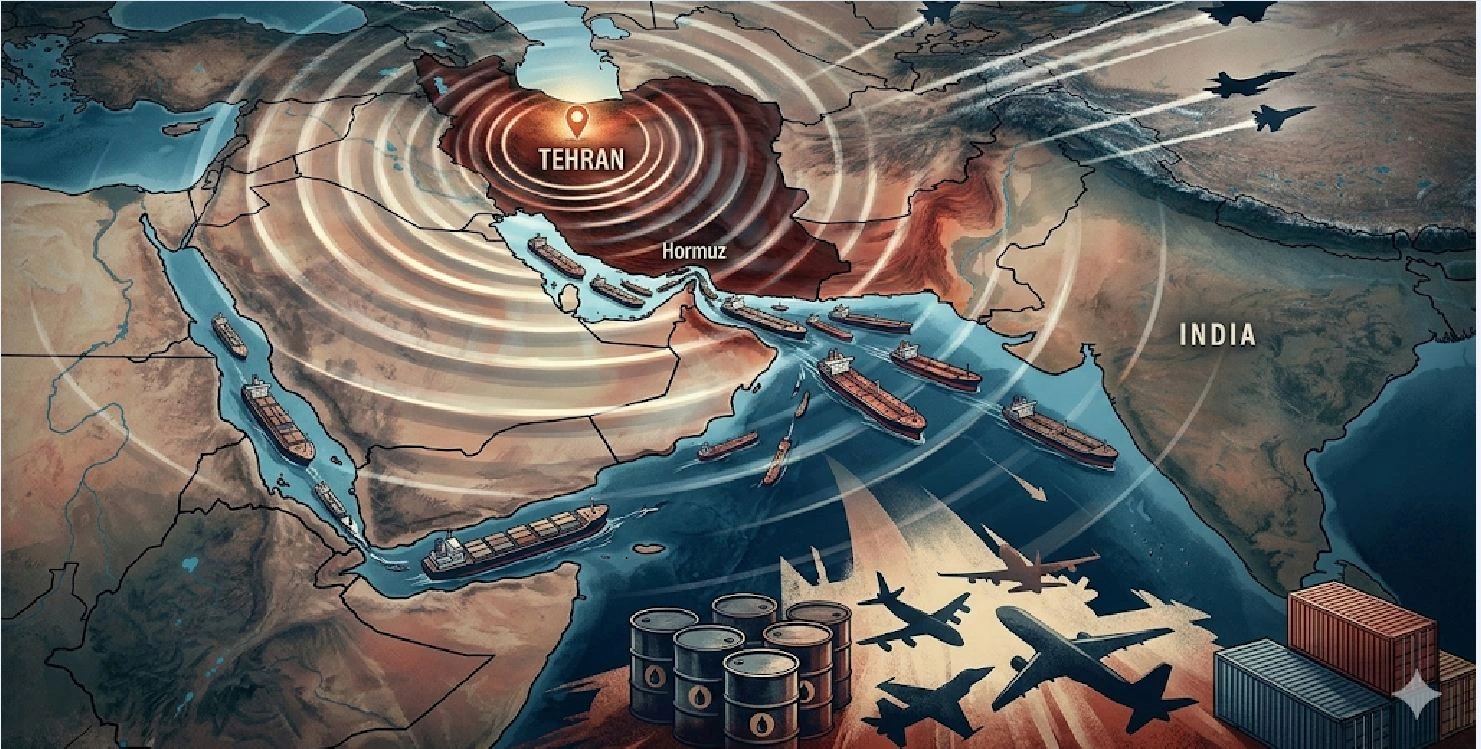
Energy represents the most immediate fault line. India is the world’s third-largest consumer of crude oil and imports (more than 80 percent of its requirements). A large share of this supply originates in the Gulf and passes through the Strait of Hormuz, one of the most sensitive maritime energy corridors in the world. More than 40 percent of India’s crude imports transit this narrow waterway.
Even the perception of risk in Hormuz has historically triggered sharp price spikes. A direct military confrontation magnifies that vulnerability exponentially. Although oil tankers can theoretically divert to alternative routes, those options usually involve longer transit times and sharply higher freight costs. In several cases, viable substitutes do not exist.
The situation is further complicated by instability near the Bab el-Mandeb Strait, which connects the Red Sea to the Gulf of Aden and has already seen disruption from attacks by Yemen’s Houthi movement. If both corridors experience sustained tension simultaneously, the result could be a choke point for global shipping and energy flows.
MARKET ANXIETY AND MACROECONOMIC PRESSURE
Markets have already begun to reflect this uncertainty. Following the escalation, Brent crude futures surged sharply, briefly crossing US$82 per barrel before moderating. Trading volatility suggests that markets are pricing in outcomes ranging from temporary disruptions to sustained prices in the US$90-100 range if tensions persist. For India, these numbers translate directly into macroeconomic pressure.
Higher crude prices widen the trade deficit, strain the current account balance and increase input costs across sectors from transportation to manufacturing. Even without a physical supply disruption, sustained price increases can complicate fiscal planning.
Estimates suggest that every US$10 increase in oil prices could widen India’s current account deficit by roughly 40-50 basis points. With the deficit projected near 1-1.2 percent of GDP, such shifts are far from marginal. Across Asia, economists estimate that a sustained US$10 increase could trim 20-30 basis points from regional GDP growth.
LIMITED CUSHION FROM ALTERNATIVE SUPPLY
India’s capacity to cushion the shock through alternative sourcing is limited. Discounted Russian crude offered partial insulation in recent years. However, geopolitical sensitivities and the strategic importance of India’s relationship with Washington constrain how far New Delhi can rely on that option under heightened scrutiny.
Russian imports had already declined in recent weeks, falling to around 1.16 million barrels per day from an earlier average closer to 1.71 million barrels per day in 2025. West Asian suppliers had been filling that gap just as the region entered a period of escalating instability. This convergence narrows India’s room for manoeuvre.
SHIPPING COSTS AND INFLATION RISKS
Beyond crude prices, shipping insurance premiums are likely to rise sharply. War-risk coverage in contested maritime zones significantly increases operating costs for tankers and cargo vessels. These additional expenses eventually feed through to domestic markets as higher consumer prices.
Inflationary pressure may intensify, complicating monetary policy decisions and potentially weakening the rupee. While India’s foreign exchange reserves provide a buffer, prolonged volatility would test economic resilience.
AVIATION UNDER STRAIN
The aviation sector offers another window into the ripple effects of conflict. West Asia is India’s most critical westbound aviation corridor for both passenger and cargo traffic. With parts of regional airspace affected—and Pakistani airspace already closed to Indian carriers—flight operations have become longer, more expensive and operationally complex.
Airlines have already suspended or rerouted services to key destinations, including the United Arab Emirates, Saudi Arabia, Israel and Qatar. Several Europe-bound flights have been cancelled while others are being redirected.
Alternative routes are adding up to four hours to certain westbound journeys. Higher fuel consumption, extended crew duty hours and increased insurance costs are driving up operational expenses.
Analysts estimate the weekly financial impact on airlines operating to and from India could reach roughly Rs 875 crore (around US$96 million). These pressures inevitably flow through to ticket prices, trade logistics and overall connectivity.
MARITIME TRADE AND SECURITY
India’s westward sea lanes carry a large share of merchandise exports and imports to Europe, Africa and the Americas. Escalation in the Gulf could expose commercial vessels to missile, drone or mine threats. Insurance costs would surge, transit times could lengthen and freight charges would climb.
The Indian Navy has expanded its presence in the western Indian Ocean in recent years and may need to strengthen escort operations and maritime surveillance. Such measures, however, must be calibrated carefully to avoid perceptions of direct alignment in an active conflict.
THE DIASPORA DIMENSION
The crisis also carries a human dimension. Millions of Indian nationals live and work across West Asia, and their remittances are a critical component of India’s foreign exchange inflows. In a conflict scenario involving retaliatory strikes on states hosting US military facilities, civilian anxiety could escalate rapidly. Airspace closures and port disruptions complicate evacuation logistics, raising questions about contingency planning and emergency response.
A DELICATE DIPLOMATIC BALANCE
India’s diplomatic position is uniquely complex. Prime Minister Narendra Modi has in recent years expressed strong solidarity with Israel, reflecting deepening defence and strategic cooperation. At the same time, Iran has historically supported India in multilateral forums on issues such as Kashmir and has facilitated regional trade connectivity through projects like the Chabahar Port.
In wartime, diplomatic optics carry lasting consequences. Tehran will inevitably evaluate New Delhi’s posture once the conflict subsides. Whether India’s calibrated statements are viewed as strategic necessity or political choice remains to be seen.
PREPARING FOR THE AFTERSHOCKS
Oil shocks historically hit emerging economies with particular force. Higher import bills can weaken currencies, fuel inflation and reduce fiscal flexibility. Governments may respond through temporary tax adjustments on fuel, tighter monetary policy and measures to stabilise capital flows. Yet, genuine resilience requires structural changes—diversifying energy suppliers, strengthening supply chains and expanding strategic reserves.
The crisis illustrates the depth of global interconnection. A strike in Tehran can reverberate through fuel stations in Mumbai, airline balance sheets in Delhi and shipping lanes off India’s western coast.
Strategic infrastructure investments such as Chabahar were designed to reduce dependence on vulnerable corridors and expand access to Central Asia. Conflict complicates those calculations and forces a reassessment.
Ultimately, the question confronting India is not whether it can shape the course of the war, but whether it can shield itself from its aftershocks. Preparedness must be anticipatory rather than reactive. Expanding strategic petroleum reserves, diversifying suppliers, strengthening maritime security, protecting diaspora networks and maintaining calibrated diplomacy are no longer optional. They are structural necessities.
In an interconnected world, wars rarely remain confined to their immediate geography. The shadow of this confrontation now stretches across West Asia and into South Asia’s economic core. For India, prudence today will determine whether the country absorbs the shock with resilience—or faces deeper structural strain in the months ahead.
—The writer is a Senior Research Officer at Chennai Centre for China Studies. Her research interests constitute China-WANA (West Asia and North Africa) relations and human rights
[ad_2]
Source link

