
The Indo-Pacific has become one of the most strategically significant regions in the contemporary geopolitical landscape, as it connects the western Pacific and the Indian Ocean that covers more than half of the globe’s trade. This region also brings together the major powers like the United States, China, India, and Japan. However, among them, China, over the past decades, has steadily blocked the freedom of navigation in the region and expanded its maritime presence through the nine-dash line, the construction of artificial islands in the international water, increasing pressure on Taiwan, and via the Belt and Road Initiative it is significantly reshaping the Indo-Pacific security environment. In response to these developments, the Quadrilateral Security Dialogue was revived in 2017. During the COVID-19 pandemic, the grouping further widened its engagement with countries such as New Zealand, South Korea, and Vietnam, an emerging framework often referred to as the “QUAD Plus”. Let us understand how relevant the Quad Plus is today to counter China’s growing influence, maritime assertiveness, strategic ambitions, and the challenge it poses to a Free and Open Indo-Pacific .
Quad Plus in the Indo-Pacific: A Strategic Response to China’s Rising Influence

Before moving forward, it is important to first understand how China’s rise began to create challenges in the Indo-Pacific? However, China believes in the philosophy of “setting aside dispute and pursuing joint development”, which led China to have one of the largest maritime sectors in the world, leading globally in ships owned, fleet value exceeding $255 billion, and port and logistics capacity . But why do we see it as a threat? The reason is that it gives Beijing leverage to control global supply chains, monopolise international logistics, and project economic and military power across the oceans without restraint. Now, through projects like Belt and Road Initiative (BRI) it has expanded its maritime presence across 26 countries involving 56 port projects in the Indo-Pacific region . For instance, through ports at Gwadar, Hambantota, Chittagong, and Sittwe, along with an overseas military base in Djibouti and expansion through The Forum on China-Africa Cooperation (FOCAC) further consolidated the region. Another major reason to view China as a threat especially through the lens of Quadrilateral Security Dialogue is the dictates of China in the South China Sea (SCS) via nine-dash line. As Quadrilateral Security Dialogue works with Association of Southeast Asian Nations centrality and China is controlling the Exclusive Economic Zone (EEZ) , their members. For example, when the Philippines went to the Permanent Court of Arbitration (PCA) to protect their sovereignty and also got judgement in their favour (2016), Beijing defied international law, continuing land reclamation, island militarisation, and aggressive tactics against the Philippines. During early 2020s China intensified pressure on the Philippines to give up one of its nine outposts in the Spratly Islands in the South China Sea (SCS) and tried to block Philippine vessels from accessing areas in the Philippines’ exclusive economic zone (EEZ) that China claims as its own . In addition, China has been steadily putting grey-zone pressure on Indonesia in the North Natuna Sea. The strategy employed involves a combination of civilian vessels, coast guard ships, and diplomatic initiatives aimed at enhancing influence without starting open conflict. This issue emerged again in 2017, when Indonesia renamed the sea area north of the Natuna Islands i.e., the North Natuna Sea to defend its claims under international law. China objected to that name change and claimed that it would destabilize the region. The presence of Chinese incursions has only increased in boldness since the end of 2024. Between May and September 2025, Chinese research vessels and Chinese Coast Guard vessel presence in this area were reported many times. Evidence demonstrates that Chinese presence is constant pressure on the Indonesian government.This type of incident brought the demand of Free open Indo Pacific into the forefront by the QUAD members. However, it was seen the members are digressing from the core aspect of Free and Open Indo Pacific and they thought of expansion of the QUAD i.e., QUAD plus. QUAD Plus includes countries like Vietnam, South Korea and New Zealand. But some ideas could not transform on the ground. However, the expansion is necessary for the functioning of QUAD itself. How will QUAD plus contribute to the achievement of Free and Open Indo Pacific?
New Zealand plays a prominent role in the Five Eyes intelligence network alliance and as a long-standing partner of Australia and the United States, Wellington enjoys deep security ties with Quad state and its tech industry alone contributes 8 percent to GDP. This makes New Zealand a key strength for expanding the Quad’s cybersecurity and digital influence throughout the South Pacific whereas Vietnam, Vietnam is one of the fastest growing economies at present it is growing at around 7% annually also Vietnam’s maritime geography adjacent to China’s coastal hubs makes it a strategic wild card, enabling expanded naval surveillance in the South China Sea. Therefore Vietnam could play the responsible role in QUAD plus. On the other hand, South Korea’s semiconductor sector delivered $141.9 billion in exports in 2024 making up 20.8% of the country’s total exports South Korea accounts roughly 13% of the total global semiconductor market share. This positions South Korea as a central player in the Quad’s primary objective of reducing dependence on Chinese technology supply chains in the Indo-Pacific. With these three nations working together, the Quad Plus evolves into a comprehensive Indo-Pacific framework that encompasses intelligence, technology, maritime security, and digital governance, making it significantly more challenging for China to assert its control in the region.
Even though there are opportunities for formation of QUAD plus we have some limitations with these nations:
The primary challenge involves economic vulnerabilities and the risk of Chinese retaliation. Beijing has consistently utilized economic coercion toward countries viewed to have too close of a relationship with its rivals. An obvious example is South Korea, which was subjected to economic damage due to Chinese authorities implementing informal sanctions in response to the deployment of the THAAD missile in 2017. Similarly situated potential partners like Vietnam and New Zealand also experience limitations because of their close ties to China. Security cooperation for Vietnam will often be limited due to economic dependency on Chinese trade, as well as due to ongoing territorial disputes particularly concerning the Paracel Islands taken by China in 1974 (Nguyen Hoang Anh, 2024). On the other hand, New Zealand depends greatly on the Chinese market for its agricultural products and experienced economic setbacks when Beijing restricted several New Zealand lawmakers from visiting Taiwan in 2026. This kind of economic pressure create difficulty for these nations to engage more deeply in security cooperation
The second major challenge is regional multipolarity and the importance of ASEAN. Countries in Southeast Asia are cautious about minilateral frameworks such as Quad Plus because they see potential for these frameworks to diminish the role of ASEAN in regional leadership and diplomacy. If these initiatives start to look like competition rather than backing ASEAN-led efforts, they might just end up splitting the region. The combination of economic risks and regional variables accentuates the necessity of carefully managing diplomatic relations if Quad Plus is going to become a solid framework for the region. Does China fear from the expansion of QUAD? Indeed! As we have seen in the case of Bangladesh when the U.S expressed a strong interest in drawing Bangladesh into its broader Indo-Pacific and Quad-aligned security matrix and China worried about it and warned Bangladesh about joining the group.
To sum up, the expansion of QUAD plus will put more pressure on China in terms of the world being less dependent on Chinese exports, more channels of industry 4.0 will be supplied by QUAD plus members among themselves and the rest of the world. Then QUAD plus can force China to Free and Open the Indo Pacific. The Quad Plus expansion makes sense precisely because all these nations share common security concern about China’s behavior, and the recognition that none of these states are in a position to effectively challenge China on a bilateral basis, making minilateral cooperation with like-minded partners a more viable approach this will provide a pragmatic path to greater security cooperation via a Quad-Plus arrangement. However, none of these nations has formally joined Quad plus which somewhere weakens Quad Plus ability to achieve FOIP.
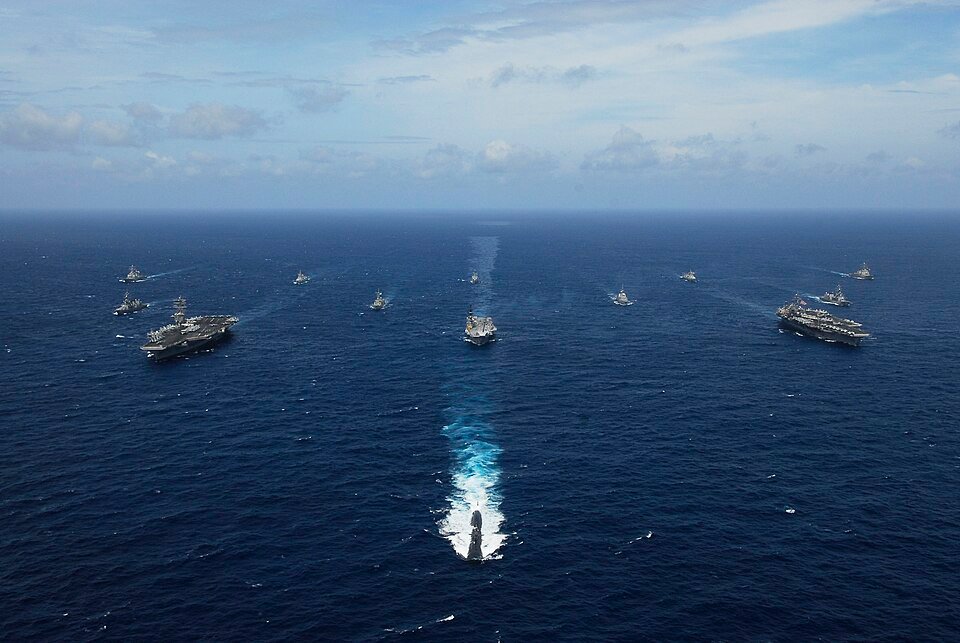
[Photo by the US Navy / Public Domain]
Dr. Madhukar Shyam is Assistant Professor of International Relations at Christ (Deemed to be University), Delhi NCR, Fellow at the Centre for Social and Policy Research, and Advisor to the Indosphere Think Tank.
Kanika Rawal is an independent researcher and a graduate of CHRIST (Deemed to be University), Delhi NCR, with research interests in foreign policy, maritime affairs, and strategic studies. The views and opinions expressed in this article are those of the authors.

