


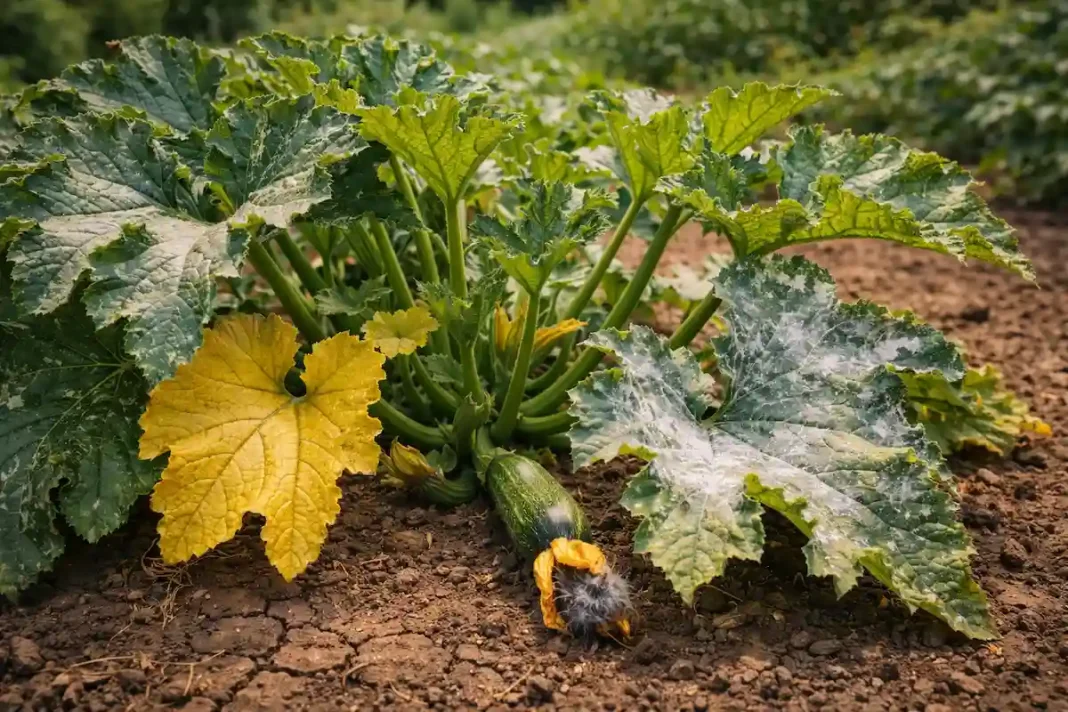

After growing zucchini across multiple seasons — in raised beds, containers, and open garden rows — I noticed most plant failures come back to just a few repeat mistakes. The same patterns keep showing up: overwatering seedlings, planting too early into cold soil, ignoring early signs of pollination failure, and missing pest damage until it is too late. These are not rare or unlucky problems. They are predictable, and most are preventable.
This guide covers 20 zucchini plant problems with specific fixes for each — including courgette plant problems for UK and Australian growers, heat stress management for tropical climates, and common zucchini growing problems that show up regardless of where you garden. Some of these are quick fixes. A few are not fixable at all. Knowing which is which saves a lot of wasted effort. Whether you are dealing with zucchini leaves turning yellow, a plant wilting despite watering, or fruit rotting before harvest, the cause and fix are here.
Start with the quick navigation below to jump straight to your symptom, or read through for full context on each issue.
Most of Zucchini Plant Problems
These are the zucchini problems people face for most — each one is covered in full detail below:
- Zucchini leaves turning yellow
- Zucchini plant wilting despite watering
- Zucchini flowers falling off without fruiting
- Zucchini plant not growing fruit
- White powder on zucchini leaves (powdery mildew)
- Zucchini leaves curling
- Zucchini fruit rotting on the vine
- Bitter zucchini fruit
- Zucchini seeds not germinating
- Courgette plant not producing
Common Zucchini Problems by Category (Quick Navigation)
Use this to jump to the problem group that matches what you are seeing.
| Category | Problems Covered |
|---|---|
| Pests | Aphids (#10), Cucumber Beetles (#11), Squash Vine Borer (within #2) |
| Fungal Diseases | Downy Mildew (#6), Fusarium Crown Rot (#8), Plectosporium Blight (#9), Fruit Rot (#5) |
| Bacterial Diseases | Bacterial Wilt (#2), Bacterial Leaf Spot (#7) |
| Pollination & Fruiting | No Fruit (#3), Blossom Drop (#4), Deformed Fruit (#14), Bitter Fruit (#16) |
| Environmental Stress | Yellow Leaves (#1), Heat/Leaf Curl (#15), Transplant Shock (#13), Germination Failure (#12) |
| Growing Mistakes | Watering Errors, Fertiliser Problems, Sunlight Issues, Spacing Problems |
Top 5 Most Dangerous Zucchini Plant Problems
Not all problems carry the same risk. These five can kill a plant within days and spread to neighbouring plants:
- Bacterial wilt — no cure, spreads via cucumber beetles, kills rapidly
- Squash vine borer — internal stem damage, plant collapses with no external warning
- Fusarium crown and root rot — persists in soil for years, no chemical cure once established
- Mosaic virus — spread by aphids, causes permanent distortion, no treatment
- Plectosporium blight — frequently misdiagnosed, girdles stems, causes sudden collapse
These five problems share one prevention strategy: controlling aphids and cucumber beetles early, before they can spread disease. Everything else on this list is manageable. These five are not once they take hold.
Common Mistakes Gardeners Make With Zucchini (Before Any Disease Starts)
Most of the 20 problems below are made worse — or triggered entirely — by a handful of setup errors that beginners repeat season after season. University extension horticulture programmes consistently flag these as the leading causes of zucchini crop failure in home gardens:
- Overwatering seedlings — the single most common cause of damping off and root rot
- Planting too early into cold soil — seeds rot; transplants stall and become disease-prone
- Ignoring pollination — assuming fruit will set without checking for female flowers or bee activity
- Excess nitrogen feeding during flowering — pushes leaf growth at the direct expense of fruit
- Overhead watering — keeps foliage wet and drives every major fungal and bacterial disease on this list
- Planting too close together — eliminates the airflow that prevents mildew, rot, and bacterial spread
What Does a Healthy Zucchini Plant Look Like?
Ideal Leaf Color, Stem Strength, and Fruit Shape
A healthy zucchini plant has large, deep green leaves — sometimes with silvery-white markings that are completely natural and often mistaken for powdery mildew by beginners. Stems are thick, firm, and upright. Fruit grows straight or slightly curved, with consistent coloring from tip to stem. Flowers open in the morning and close by midday. New leaves unfurl smoothly without twisting or distortion.
Zucchini Problem Diagnosis: How to Identify Issues by Symptom
| Symptom | Likely Cause | See Problem # |
|---|---|---|
| Leaves turning yellow | Nutrient deficiency, overwatering | #1 |
| Wilting despite watering | Bacterial wilt, vine borer | #2 |
| Flowers but no fruit | Poor pollination, male-only flowers | #3 |
| Flowers dropping off | Temperature stress, blossom drop | #4 |
| Fruit rotting on vine | Fungal rot, excess humidity | #5 |
| Yellow-grey patches on leaves | Downy mildew | #6 |
| Brown water-soaked leaf spots | Bacterial leaf spot | #7 |
| Stem base turning brown-orange | Fusarium crown rot | #8 |
| White diamond lesions on stems | Plectosporium blight | #9 |
| Curled, sticky, distorted leaves | Aphids | #10 |
| Chewed leaves and stunted fruit | Cucumber beetles | #11 |
| Seeds not sprouting | Cold soil, damping off | #12 |
| Seedlings drooping after transplant | Transplant shock | #13 |
| Deformed or stunted fruit | Watering issues, excess nitrogen | #14 |
| Leaves curling upward | Heat stress, herbicide drift | #15 |
| Fruit tastes bitter | Cucurbitacin buildup, cross-pollination | #16 |
Zucchini Plant Problem #1 — Zucchini Leaves Turning Yellow

Nutrient Deficiency vs. Overwatering: How to Tell the Difference
Yellow leaves on zucchini have two main causes, and they look slightly different. Nitrogen deficiency causes older, lower leaves to turn uniformly pale yellow while newer growth stays green — this usually shows up 3 to 4 weeks after planting when initial soil nutrition is exhausted. In most cases, this is the first visible sign of a nutrition problem, and it almost always starts on the oldest leaves before moving inward. Overwatering causes yellowing that starts at leaf edges and spreads inward, often alongside soft, limp stems and soggy soil.
Many beginners mistake overwatering yellowing for a nutrient problem and apply fertiliser to a waterlogged plant, which makes things worse. I have seen this cycle play out more than once — the plant deteriorates further, the gardener fertilises again, and the roots never recover. Check soil moisture 5cm down before doing anything. If the soil is still damp, hold off watering entirely and let it dry before reassessing.
Iron or magnesium deficiency shows as interveinal chlorosis — yellow between the leaf veins while the veins themselves stay green. This appears most often in alkaline soils above pH 7.5. A foliar spray of diluted liquid seaweed or Epsom salt (magnesium sulphate at 1 tablespoon per 4 litres of water) can produce visible improvement within 4 to 5 days.
How to Fix Yellow Leaves on Zucchini Plants Naturally
- Test soil pH — zucchini performs best between 6.0 and 7.0
- Cut back watering and improve drainage if soil stays wet for more than 2 days
- Side-dress with compost or apply a nitrogen-rich organic fertiliser if lower leaves are yellowing on dry, well-drained soil
- Remove severely yellowed leaves to reduce disease pressure and improve light penetration
Yellow leaves from nitrogen deficiency or overwatering follow the exact same pattern in cucumbers — if you grow both in the same bed and are seeing the same yellowing across both plants, the full breakdown in why cucumber leaves turn yellow covers every cause including soil pH, interveinal chlorosis, and watering mistakes in the same level of detail.
Zucchini Plant Problem #2 — Zucchini Plant Wilting Despite Watering
Bacterial Wilt in Zucchini: Symptoms and Control
A zucchini wilting with moist soil is one of the most alarming sights in the vegetable garden. Bacterial wilt is a strong suspect here. Spread by cucumber beetles, it blocks the plant’s vascular system so water simply cannot move from roots to leaves. Most gardeners first notice this after a period of warm weather when cucumber beetle populations spike. To confirm it, cut a wilted stem near the base, press the two cut ends firmly together, hold for 10 seconds, and pull apart slowly. Thin, thread-like strands stretching between the cut faces confirm bacterial wilt. There is no cure. Remove and bag affected plants immediately.
Squash Vine Borer: The Hidden Cause of Sudden Zucchini Wilting
Squash vine borer larvae tunnel into the base of the stem and feed from the inside, leaving the outside looking completely normal until the plant collapses. Look for a small entry hole near the soil line with sawdust-like frass around it. This damage typically shows up in midsummer, about 4 to 6 weeks after transplanting — often overnight, which is why it catches gardeners off guard.
I have seen plants recover after slitting the stem, removing the larvae, and mounding moist soil over the damaged section. It does not always work, but often enough to be worth trying on an otherwise healthy plant. Cover young plants with row covers from transplanting until female flowers appear to prevent initial attack.
Zucchini Plant Problem #3 — Zucchini Flowers But No Fruit

Male vs Female Zucchini Flowers: What You Need to Know
Zucchini produces separate male and female flowers on the same plant. Male flowers appear first — sometimes up to two weeks before the first female — and have a thin straight stem. Female flowers have a small, immature zucchini at the base of the bloom. That tiny fruit at the base is the easiest way to tell them apart.
If your plant has been flowering for 10 days or more with no fruit forming, check whether any female flowers have appeared yet. Beginners often panic at week two when it is simply still the male-flower-only phase.
Why Male Flowers Fall Off Zucchini — Is It Normal?
Yes, completely normal. Male flowers open, release pollen, and drop — that is their entire job. This is not a sign of a sick plant. It becomes a concern only if female flowers are also dropping before the mini-fruit at their base has begun to swell.
Why Female Flowers Drop Before Fruiting
Female flowers drop when they are not successfully pollinated within 4 to 8 hours of opening. This usually happens when bee activity is low due to cold or rain, when high temperatures above 38°C (100°F) render pollen sterile, or when there are no open male flowers at the same time. A single unpollinated female flower will shrivel and drop within 24 hours of opening. In many cases, the problem is simply timing — a female opens when no male is ready, and that window closes fast.
Poor Pollination in Zucchini: How to Hand Pollinate Step by Step
- Identify a fully open male flower between 7am and 10am
- Remove the petals to expose the pollen-covered stamen
- Gently rub the stamen directly onto the centre of an open female flower
- Repeat with 2 to 3 male flowers per female for best results
- The base of the female should begin swelling within 24 to 48 hours if pollination succeeded
Zucchini and cucumbers hit the exact same pollination wall — only male flowers for weeks, female flowers dropping before setting, bees absent on bad weather days — and if you grow cucumbers alongside your zucchini, every fix in this guide on cucumber plants flowering but not producing fruit applies directly to your zucchini too.
Zucchini Plant Problem #4 — Blossom Drop in Zucchini
Temperature Extremes and Stress That Cause Zucchini Blossoms to Fall
Blossom drop happens when the plant is under stress and redirects energy away from reproduction. The most common triggers are daytime temperatures above 35°C (95°F), night temperatures below 10°C (50°F), drought stress, or inconsistent watering. In very hot climates this is among the most frustrating zucchini growing problems because the plant looks otherwise healthy. Field trials show that soil temperature swings of more than 10°C between day and night are enough to trigger sustained blossom drop without any other visible stress signs.
How to Encourage Stable Flowering and Fruit Set in Zucchini
- Water deeply and consistently — aim for 2.5cm (1 inch) per week at minimum
- Mulch heavily to stabilise soil temperature and reduce moisture swings
- In extreme heat, use 30–40% shade cloth during the hottest part of the afternoon
- Once flowering begins, switch from high-nitrogen fertiliser to a lower-nitrogen, higher-phosphorus and potassium feed
Zucchini Plant Problem #5 — Zucchini Fruit Rotting on the Vine

Choanephora Fruit Rot and Fungal Causes
Choanephora fruit rot starts at the blossom end and spreads rapidly, turning the tip soft and fuzzy with dark, pin-headed fungal growth. It is triggered by warm, humid conditions — especially when old flower petals cling to developing fruit rather than falling away cleanly. Remove spent petals as they wither and thin planting to improve air circulation. This rot spreads fast in monsoon conditions and in polytunnel environments with poor ventilation.
How Humidity and Overhead Watering Cause Fruit Rot in Zucchini
Overhead watering leaves fruit sitting in prolonged surface moisture. Switch to drip irrigation or water only at soil level in the morning so foliage dries before nightfall. Space plants at least 90cm to 1 metre apart. In humid climates, remove any fruit showing early softening before rot spreads. Horticulture extension data consistently shows drip irrigation reduces fungal disease pressure on zucchini by 50 to 60% compared with overhead systems.
Zucchini Plant Problem #6 — Downy Mildew on Zucchini

How to Tell Downy Mildew Apart from Powdery Mildew on Zucchini
These two diseases are regularly confused, including by experienced gardeners. Powdery mildew produces a white, powdery surface coating on the top of leaves and thrives in dry, warm conditions — it can actually be rubbed off the leaf surface. Downy mildew causes yellow angular patches on the top of leaves with grey or purple fuzzy sporulation on the underside, and spreads fastest in cool, wet weather. Treating downy mildew with a powdery mildew remedy will not work.
Yellow Angular Patches and Grey Fuzz: Downy Mildew Symptoms Explained
The angular shape of downy mildew lesions is diagnostic — the disease spreads between leaf veins and cannot cross them, producing sharply bounded yellow patches rather than irregular blotches. Spots start pale yellow, turn bright yellow, then brown as tissue dies. In my experience this tends to show up first on older, lower leaves closest to the soil, usually after 2 to 3 days of wet or overcast weather. Always flip the leaf over: visible grey or purple fuzz on the underside confirms downy mildew rather than a nutrient or environmental problem.
Organic and Chemical Control of Downy Mildew in Zucchini
- Organic: Copper-based sprays applied preventively before symptoms appear; potassium bicarbonate; improved plant spacing
- Chemical: Mancozeb or metalaxyl-based fungicides as preventives in high-risk, wet periods
- Cultural: Avoid evening watering, remove and bag affected leaves, never compost infected material
Zucchini Plant Problem #7 — Bacterial Leaf Spot on Zucchini
Xanthomonas Bacterial Leaf Spot: Symptoms, Spread, and Prevention
Bacterial leaf spot caused by Xanthomonas species appears as small, water-soaked spots that turn brown with yellow halos. Spots may eventually fall out of the leaf tissue, leaving a ragged, shot-hole appearance. The bacteria spreads through splashing water and contaminated tools. There is no chemical cure — management is entirely preventive. Avoid overhead watering, sanitise tools between plants, and remove infected leaves as soon as spots appear.
How Wet Weather and Overhead Irrigation Trigger Bacterial Leaf Spot
The bacteria spreads when rain or irrigation splashes soil particles onto leaves. Once on the leaf surface, it multiplies rapidly when leaves stay wet for more than 4 hours. Space plants with adequate gaps, water only at the base, and apply copper bactericide spray as a preventive during prolonged wet spells.
Zucchini Plant Problem #8 — Fusarium Crown and Root Rot in Zucchini
How to Identify Fusarium Rot vs. Overwatering Root Damage
Both cause yellowing and wilting, but Fusarium crown rot has a distinctive tell: brown to orange discolouration at the stem base at or just below the soil line. Overwatering damage turns roots dark brown or black with a slimy, foul smell. Fusarium discolouration has a dry, corky texture — pull the plant and look for orange-brown internal staining in the crown tissue. That staining usually confirms Fusarium rather than simple waterlogging, though in early stages the difference can be subtle.
Soil Drainage, pH, and Crop Rotation to Prevent Fusarium in Zucchini
Fusarium persists in soil for 3 to 5 years. Once a bed is confirmed infected, avoid planting any cucurbit there for at least 3 to 4 seasons. Improve drainage by incorporating organic matter, raising beds, and maintaining soil pH between 6.0 and 6.5. Since cucumber beetles spread Fusarium wilt as they feed, controlling beetles is a direct part of Fusarium prevention.
Zucchini Plant Problem #9 — Plectosporium Blight in Zucchini
White Diamond-Shaped Lesions on Zucchini Stems and Leaves
Plectosporium blight produces distinctive white, diamond-shaped lesions on stems, leaf petioles, and fruit. As lesions multiply and enlarge, they girdle the stem and the plant collapses from that point outward. This disease is frequently confused with powdery mildew — in most gardens where it appears, the first response is to spray for powdery mildew, which does nothing. The diamond shape on stems and the fact that lesions are sunken into tissue (not a surface coating) are the key distinguishing features. It also appears on fruit, which powdery mildew rarely does in the same way.
Why Plectosporium Blight Is Often Misdiagnosed and How to Confirm It
If you have been spraying for powdery mildew with no improvement on the white markings on stems, switch your suspicion to Plectosporium. Try scraping a lesion — powdery mildew comes off with fingernail pressure; Plectosporium lesions are fixed in the tissue. Fungicides containing chlorothalonil or mancozeb help when applied early in infection. Remove and dispose of infected stems rather than composting.
Zucchini Plant Problem #10 — Aphids on Zucchini Plants

Why Aphids Cause Zucchini Leaves to Curl and Distort
Aphids feed by inserting mouthparts into leaf tissue and extracting sap. This causes cells on the affected surface to collapse unevenly, which is why leaves curl downward and inward rather than lying flat. Often the first thing you notice is not the insects themselves but the curled leaves — the aphids are usually hiding on the underside, well out of sight. Heavy infestations leave sticky honeydew deposits that develop into black sooty mould. Beyond direct feeding damage, aphids transmit zucchini yellow mosaic virus (ZYMV) and cucumber mosaic virus (CMV) — a single aphid can introduce these viruses while probing leaves before feeding begins, making early control critical.
How to Identify and Manage Aphid Infestations on Zucchini
Look for clusters of soft-bodied green, yellow, or black insects on the undersides of young leaves and near growing tips — this is where they concentrate first. A strong jet of water removes most in early infestations. For persistent colonies, apply insecticidal soap or neem oil spray at 5-day intervals, targeting leaf undersides. Encourage ladybirds, lacewings, and parasitic wasps — they are highly effective in garden-scale aphid management and significantly outperform chemical control over time.
Zucchini Plant Problem #11 — Cucumber Beetles Damaging Zucchini
Zucchini Pest Identification: Spotted vs Striped Cucumber Beetle
| Feature | Spotted Cucumber Beetle | Striped Cucumber Beetle |
|---|---|---|
| Size | ~6mm | ~6mm |
| Colour | Yellow-green with 12 black spots | Yellow-green with 3 black stripes |
| Primary damage | Leaf and flower feeding | Leaf, flower, and fruit feeding |
| Disease vector | Fusarium wilt | Bacterial wilt (primary vector) |
| Risk level | Moderate | High — primary bacterial wilt carrier |
| Larval damage | Root feeding | Root feeding |
How Cucumber Beetles Spread Fusarium Wilt in Zucchini
When cucumber beetles feed on an infected plant and then move to a healthy one, they transfer bacteria and fungal spores through feeding wounds. A single beetle can infect multiple plants in one day. This is why managing beetles before disease pressure builds is more effective than treating disease after it has spread — by the time symptoms appear, the vector has already moved on.
Preventing Cucumber Beetles Using Row Covers and Crop Rotation
Cover seedlings with floating row covers immediately after transplanting and remove only when female flowers appear. Rotate cucurbits to a new bed annually — cucumber beetles overwinter in soil residue and return to the same planting areas season after season. Yellow sticky traps placed at plant height help monitor population build-up before damage becomes severe.
Zucchini Plant Problem #12 — Zucchini Seeds Not Germinating
Cold Soil, Incorrect Depth, and Damping Off in Zucchini Seedlings
Zucchini seeds rot readily in cold, wet soil. Below 15°C (60°F), germination stalls or fails entirely — and gardeners waiting impatiently often add more water to soggy, cold compost, accelerating the rot. Seeds planted deeper than 3cm are also less likely to emerge successfully. Damping off kills seedlings that have germinated but then collapse at the soil line — it is a fungal condition triggered by overwatering in cool conditions. Use a free-draining seedling mix, not heavy garden soil, and water from below the pot rather than overhead.
Ideal Soil Temperature for Zucchini Germination by Climate
| Climate Zone | Best Sowing Time | Min Soil Temp | Optimal Soil Temp |
|---|---|---|---|
| Temperate (UK, Europe) | Late April to June | 15°C (59°F) | 21–29°C (70–84°F) |
| Tropical (India, SE Asia) | Post-monsoon or dry season | 18°C (64°F) | 24–30°C (75–86°F) |
| Arid (Middle East, Australia) | Autumn or early spring | 18°C (64°F) | 24–29°C (75–84°F) |
| Continental (North America) | After last frost, soil warm | 16°C (60°F) | 21–29°C (70–84°F) |
Zucchini Plant Problem #13 — Zucchini Transplant Shock
Why New Zucchini Seedlings Droop and Collapse After Transplanting
Zucchini has large, soft leaves that lose water rapidly — so even mild root disturbance during transplanting causes dramatic wilting within hours. This alarms new gardeners into overwatering, which then compounds the problem. In many cases, if you transplant in the morning and check at midday, the plant looks genuinely terrible — then by the following morning it has largely recovered. If the roots are intact and the soil is moist, most healthy seedlings bounce back without any extra intervention within 3 to 5 days.
How Long Does Transplant Shock Last in Zucchini?
With minimal root disturbance and good aftercare, transplant shock in zucchini typically resolves within 3 to 7 days. If wilting persists beyond 10 days, examine the stem base and roots for rot or damage. Transplanting on an overcast day or in the evening — when transpiration demand is lowest — reduces shock significantly compared with midday transplanting in direct sun.
How to Harden Off Zucchini Seedlings and Reduce Transplant Stress
- Begin hardening off 7 to 10 days before transplanting date
- Place seedlings outdoors in a sheltered spot for 1 to 2 hours on day one, extending the period daily
- Reduce watering slightly in the final 2 days before transplanting to encourage root extension
- Transplant into pre-moistened soil and water immediately at the root zone
- Apply diluted seaweed extract or mycorrhizal inoculant at transplant time to support root establishment
Zucchini Plant Problem #14 — Stunted Growth and Deformed Zucchini Fruits
Irregular Watering and Soil pH as Causes of Misshapen Zucchini
Zucchini fruit that is narrow at one end and swollen at the other, or that has pinched waists, is almost always the result of incomplete pollination or irregular soil moisture. When only part of the ovary was pollinated, only that section develops. Inconsistent watering causes uneven cell expansion during the rapid growth phase of fruit development. Deep, consistent watering beats shallow, frequent watering every time for fruit quality.
Excess Nitrogen and Its Effect on Zucchini Fruit Development
Plants fed too much nitrogen after flowering begins produce impressive, dark green foliage and very little fruit. The plant redirects energy into vegetative growth at the direct expense of reproduction. Switch to a lower-nitrogen, higher-potassium fertiliser (look for NPK ratios like 5-10-10 or 4-12-12) once the first flowers open. Many growers see fruit production double simply by changing the fertiliser at this stage.
Why Zucchini Fruit Turns Yellow and Stops Growing
Small zucchini fruits that yellow and shrivel before reaching harvest size are almost always the result of failed pollination — the embryo fails and the plant reabsorbs the fruit. This is different from yellow-fruited varieties. Check whether the yellowing is happening at under 5cm in size to confirm pollination failure. Hand pollination at the next flower cycle typically resolves this entirely.
Zucchini Plant Problem #15 — Zucchini Leaves Curling and Heat Stress
Heat Stress and Water Deficit Causing Leaf Curl in Zucchini
When soil moisture drops and temperatures rise above 35°C (95°F), zucchini leaves curl upward at the edges to reduce exposed surface area and slow water loss. This is a protective stress response, not a disease. The practical test: if leaves uncurl in the evening after temperatures drop, heat stress or water deficit is the cause. Deep morning watering and 7 to 10cm of straw mulch can reduce soil temperature by 5 to 8°C and largely prevent heat-triggered leaf curl.
Growing Zucchini in Hot Climates: Managing Heat, Monsoon, and Humidity
In tropical and subtropical climates, the main zucchini growing problems shift from cold and short seasons to heat, excessive rain, and fungal pressure. Raised beds improve drainage during monsoon. Afternoon shade significantly extends productive growing periods in climates above 38°C (100°F). Heat-tolerant varieties like Cavili and Magda perform considerably better than standard varieties under sustained heat. Preventive copper spray from early in the season reduces the fungal disease load that builds during humid periods.
Herbicide Drift and Chemical Burn on Zucchini Leaves
Leaf curling with a cupped, downward-turning shape — particularly following nearby lawn treatment or weed control — may indicate herbicide drift. Broadleaf herbicides like 2,4-D cause twisted, strappy new growth and distorted leaves in zucchini. There is no treatment, but a plant with mild, one-time exposure may grow through the distorted phase and recover normal growth after 2 to 3 weeks.
Zucchini Plant Problem #16 — Bitter Zucchini Fruit (Cucurbitacin Toxicity)
Why Your Zucchini Tastes Bitter: Cucurbitacin Explained
Cucurbitacins are naturally occurring bitter compounds present in all cucurbits at low levels. Modern zucchini varieties are bred to minimise them — but plant stress causes cucurbitacin levels to spike. Irregular watering, extreme heat, poor soil nutrition, and leaving fruit too long before harvest all push levels up. The stem end of the fruit tends to have higher concentrations than the blossom end.
Is Bitter Zucchini Dangerous to Eat? Toxic Squash Syndrome
Mildly bitter zucchini is unpleasant but generally not dangerous in small amounts. Severely bitter fruit — typically from cross-pollination with ornamental gourds or wild cucurbits — can cause toxic squash syndrome: nausea, vomiting, diarrhoea, and in documented extreme cases, temporary hair loss. The practical rule is absolute: if a raw piece of zucchini or courgette tastes noticeably bitter, discard the entire fruit. Do not taste more, and do not cook it assuming heat will remove the bitterness — cucurbitacins are heat-stable compounds.
How Cross-Pollination with Wild Cucurbits Causes Bitter Zucchini Fruit
If bees carry pollen from ornamental gourds, wild squash, or cross-species cucurbits to your zucchini flowers, the resulting fruit can carry elevated cucurbitacin levels. This risk is highest in gardens growing multiple cucurbit species within bee-foraging range — roughly 1km. Always buy fresh, named-variety seed from reputable sources rather than saving seed casually from season to season, where genetic drift increases bitterness risk.
What to Do If Your Zucchini Is Bitter: UK, Australia, and Global Advice
- Taste a small piece of raw fruit before cooking — if bitter, discard the whole fruit
- Never eat noticeably bitter courgette or zucchini in any quantity
- Cooking does not remove cucurbitacins — they are heat-stable
- Remove all plants producing bitter fruit from the garden immediately
- Source fresh F1 hybrid seed each season to avoid cumulative cross-pollination risk
Zucchini Watering Mistakes That Cause Most Problems

Watering errors drive more zucchini problems than any other single factor. Poor watering does not just stress the plant directly — it creates conditions where disease and pests move in faster and recovery becomes harder.
How Much Water Does a Zucchini Plant Need?
Zucchini needs approximately 2.5cm (1 inch) of water per week, delivered deeply and infrequently rather than in shallow daily applications. Deep, infrequent watering drives roots down into cooler, moister soil layers. Shallow daily watering keeps roots near the surface where they are most vulnerable to heat, drought, and soil temperature swings.
| Watering Mistake | Problem It Causes | Fix |
|---|---|---|
| Watering overhead in the evening | Downy mildew, bacterial leaf spot, fruit rot | Switch to morning drip irrigation at soil level |
| Watering daily in shallow amounts | Shallow roots, heat stress, inconsistent fruit | Water deeply twice a week instead |
| Overwatering seedlings | Damping off, root rot, stem collapse | Let soil surface dry slightly between waterings |
| Inconsistent watering during fruiting | Misshapen fruit, blossom end issues, blossom drop | Use mulch to stabilise moisture between waterings |
| Underwatering in heat | Leaf curl, blossom drop, bitter fruit | Deep water in early morning; apply 10cm straw mulch |
Zucchini Fertiliser Problems: Over-feeding and Under-feeding
Signs of Over-Fertilising Zucchini
Over-fertilising — particularly with nitrogen-heavy feeds — is a common and underappreciated cause of zucchini problems. Symptoms include very lush, dark green foliage with few or no flowers, soft and susceptible leaf tissue that attracts aphids, and fruit that either does not set or grows poorly shaped. Excess nitrogen also increases plant susceptibility to aphid colonies because it produces softer, more palatable tissue.
Signs of Under-Fertilising Zucchini
Pale, small leaves, slow growth, lower leaf yellowing from the base up, and poor fruit size all indicate nutrient deficiency. Zucchini is a heavy feeder and exhausts average garden soil faster than most vegetables. A baseline application of well-rotted compost at planting, followed by a balanced liquid feed every 2 to 3 weeks through the growing season, covers most nutritional needs without over-feeding.
| Growth Stage | Fertiliser Type | Why |
|---|---|---|
| At planting | Compost + balanced granular (NPK 10-10-10) | Establishes roots and early growth |
| Vegetative growth (pre-flower) | Moderate nitrogen feed | Supports leaf and stem development |
| At first flower | Switch to low-N, high-K (e.g. 5-10-10) | Redirects energy to fruit development |
| Active fruiting | Potassium-rich liquid feed every 10–14 days | Sustains fruit quality and plant vigour |
Zucchini Sunlight Problems: Too Much or Too Little
How Many Hours of Sun Does Zucchini Need?
Zucchini needs a minimum of 6 hours of direct sunlight daily. 8 hours is optimal for reliable fruit production. Below 6 hours, plants grow slowly, flower less, and are more susceptible to fungal disease — shade keeps foliage damp and reduces plant vigour at the same time. Full shade causes etiolated (stretched, pale, weak) growth within 10 to 14 days of transplanting.
Can Too Much Sun Damage Zucchini?
Yes, in specific circumstances. In climates regularly exceeding 38°C (100°F), intense afternoon sun combined with heat causes leaf curl, blossom drop, and fruit scorch on exposed fruit. Afternoon shade — either from shade cloth, companion plants, or taller crops to the west — protects plants during peak heat hours without reducing morning light. Fruit exposed directly to intense sun can develop sunscald: white, papery patches on the skin that do not affect edibility but reduce quality.
Zucchini Spacing Problems: What Happens When Plants Are Too Close
What Is the Correct Spacing for Zucchini Plants?
Zucchini plants should be spaced 90cm to 1 metre apart in rows, with at least 1 metre between rows. Bush varieties can often manage at 60 to 75cm, but anything tighter tends to create problems once the plants reach full size at 5 to 6 weeks. In practice, the most common spacing mistake is planting at half the recommended distance to fit more plants into a small bed — usually with perfectly good intentions — and then watching disease build through the dense canopy from week four onward.
Problems Caused by Planting Zucchini Too Close Together
- Powdery and downy mildew — poor airflow between plants traps moisture on leaf surfaces
- Bacterial leaf spot and fruit rot — wet, crowded canopies create ideal bacterial conditions
- Pollination failure — bees find it harder to navigate dense planting; flowers overlap and damage each other
- Nutrient competition — closely spaced roots exhaust local soil nutrition faster, accelerating yellowing and stunted growth
- Pest build-up — aphids and cucumber beetles spread more rapidly through a dense canopy than through spaced planting
Zucchini Plant Problems in Containers and Raised Beds
Why Container-Grown Zucchini Faces More Problems Than Garden Zucchini
Zucchini in containers is more vulnerable to nearly every problem on this list. Restricted roots mean less buffer against watering mistakes. Heat builds faster in pots than in ground soil — particularly in dark-coloured containers. Nutrients deplete faster with no surrounding soil to draw from. The minimum practical container size for zucchini is 40 litres (approximately 10 gallons). Anything smaller creates compounding problems from the start of the season.
Root Rot, Drainage Failure, and Heat Buildup in Zucchini Containers
Dark-coloured pots absorb solar radiation and can raise root zone temperatures by 8 to 12°C above air temperature on sunny days. Use light-coloured or fabric grow bags, ensure at least 4 to 6 large drainage holes per container, and mix 20 to 25% perlite into potting compost to prevent compaction and improve drainage. Container zucchini typically needs watering daily in summer — check by pushing a finger 5cm into the compost. Feed every 10 to 14 days with a balanced liquid fertiliser once the plant begins fruiting.
Courgette Plant Problems: UK, Australia, and European Growers
Courgette Plant Problems: Are They Different from Zucchini Problems?
Courgette and zucchini are the same plant — Cucurbita pepo — with different regional names. UK and Australian growers call them courgettes; North Americans call them zucchini. All 16 problems in this guide apply equally to both. The practical difference is climate: UK and northern European growers deal primarily with cool, wet conditions, short growing seasons, slug damage on young seedlings, and pollination failure during poor summers.
Cool Climate Challenges: Pollination Failure, Mildew, and Slug Damage in Courgettes
In the UK and cool-temperate climates, the top courgette growing problems are: poor pollination when bees are inactive during cold or rainy spells, powdery and downy mildew in late summer humidity, and slug damage that kills seedlings overnight. Hand pollination is often necessary through a poor British summer. Wool pellets or copper tape around containers and beds reduce slug damage reliably. Choose mildew-resistant varieties like Soleil F1 or Astia F1 for UK growing conditions.
When to Pull a Zucchini Plant That Cannot Be Saved
Signs Your Zucchini Plant Is Beyond Recovery
- Bacterial wilt confirmed by the thread test — no recovery is possible
- Crown completely rotted at or below soil level
- Vine borer damage throughout the main stem with no viable re-rooting point
- Mosaic virus infection: mottled, distorted, yellow-green patterned leaves throughout the whole plant
- Main stem has collapsed and the plant has stopped producing entirely
How Many Zucchini Problems Can One Plant Have at Once?
Several, unfortunately. A plant already stressed by poor soil or inconsistent watering is significantly more susceptible to pests and pathogens. Aphid feeding wounds provide entry points for mosaic virus. Cucumber beetles spread both bacterial wilt and Fusarium simultaneously. This is why managing the basics — water, drainage, nutrition, and spacing — prevents multiple problems at once rather than requiring individual treatments for each one separately.
How to Prevent Zucchini Plant Problems Before They Start

Best Disease-Resistant Zucchini Varieties for Home Gardens Globally
| Variety | Key Resistance / Strength | Best For |
|---|---|---|
| Dunja F1 | Powdery mildew, WMV, ZYMV resistance | All climates, disease-prone gardens |
| Cavili F1 | Parthenocarpic (no pollination needed), heat-tolerant | Hot climates, containers, low-bee areas |
| Soleil F1 | Powdery mildew resistance | UK and cool temperate climates |
| Astia F1 | Compact, container-optimised | UK, balconies, small raised beds |
| Magda | Heat tolerance, compact pale-green fruit | Middle East, South Asia, tropics |
Crop Rotation, Mulching, and Drip Irrigation for Zucchini
- Crop rotation: Do not grow cucurbits (zucchini, cucumber, squash, melon) in the same bed more than once every 3 to 4 years — Fusarium and cucumber beetles both persist in soil between seasons
- Mulching: Apply 7 to 10cm of straw or shredded leaf mulch to retain moisture, suppress weeds, and prevent soil splash that spreads bacteria and fungal spores
- Drip irrigation: Keeps foliage dry, reduces fungal and bacterial disease pressure by 50 to 60% compared with overhead watering — the single highest-return infrastructure investment for zucchini
- Companion planting: Nasturtiums draw aphids away from zucchini; marigolds deter root nematodes; borage attracts pollinators and improves fruit set
The same watering, spacing, fertiliser timing, and heat stress problems that affect zucchini show up almost identically in okra when grown in the same vegetable garden — the okra growing problems guide is worth reading alongside this one if both crops are in your rotation, since fixing one often fixes the other.
Quick Diagnosis Table: Zucchini Symptom, Cause, and Fix
| Symptom | Most Likely Cause | Fix |
|---|---|---|
| Lower leaves yellowing uniformly | Nitrogen deficiency | Apply nitrogen fertiliser or compost |
| Yellowing with soggy soil | Overwatering | Improve drainage; reduce watering frequency |
| Wilting with moist soil | Bacterial wilt or vine borer | Thread test; remove plant if wilt confirmed |
| Flowers but no fruit (first 2 weeks) | Only male flowers present | Wait — female flowers follow within days |
| Female flowers dropping off | No pollination / heat stress | Hand pollinate; manage temperature |
| Fuzzy dark rot at blossom end | Choanephora fruit rot | Remove spent petals; improve airflow |
| Yellow angular spots, grey underside | Downy mildew | Copper spray; reduce leaf wetness |
| Brown shot-hole spots on leaves | Bacterial leaf spot | Remove leaves; copper bactericide |
| Brown-orange stem base, corky texture | Fusarium crown rot | Remove plant; improve drainage; rotate crops |
| White diamond lesions on stems | Plectosporium blight | Chlorothalonil; remove infected stems |
| Curled, sticky young leaves | Aphids | Neem oil; water jet; encourage ladybirds |
| Chewed leaves, wilting spread plant-to-plant | Cucumber beetles | Row covers; pyrethrin if severe |
| Seeds not sprouting after 10+ days | Cold soil / damping off | Check soil temp; reduce watering; improve drainage |
| Seedlings collapsing after transplant | Transplant shock | Shade; water at base; wait 3 to 7 days |
| Misshapen or pinched fruit | Incomplete pollination / inconsistent watering | Hand pollinate; deep consistent watering |
| Leaves curling upward, uncurl at night | Heat stress / water deficit | Mulch deeply; water in morning; use shade cloth |
| Bitter-tasting fruit | High cucurbitacin — stress or cross-pollination | Discard entire fruit; do not eat; remove plant |
| Lush leaves, no fruit | Excess nitrogen after flowering | Switch to low-N, high-K feed immediately |
| Pale leaves, slow growth | Under-feeding or soil pH too high | Compost application; balanced liquid feed; test pH |
| Severe mildew across all leaves | Powdery mildew — poor airflow, dry conditions | Potassium bicarbonate spray; thin planting; milk spray |
For a university-verified visual reference of squash disease and pest symptoms — including photo comparisons of powdery mildew, downy mildew, bacterial wilt, vine borer damage, and Choanephora rot — the University of Maryland Extension squash problems guide is worth bookmarking alongside this article if you want a second opinion on what you are looking at in your garden.
Common Questions About Zucchini Plant Problems
1. Why are my zucchini plants dying suddenly?
Sudden collapse is most commonly caused by bacterial wilt — spread by cucumber beetles — or squash vine borer damage inside the stem. Both block water transport and cause dramatic wilting despite moist soil. Check the stem base for entry holes with frass around them (vine borer), or cut the stem and do the thread test (bacterial wilt). Neither is reversible — remove and replace affected plants. Do not compost them.
2. What is wrong with my zucchini plant?
Match the primary symptom to the diagnosis table above. Yellowing points to nutrition or watering. Spots and fuzzy growth indicate disease. Wilting with moist soil means a vascular or root problem. Curling leaves in heat usually recover by evening and indicate water or temperature stress. The table covers 20 symptom-cause-fix combinations — use it as your first stop before taking any action.
3. Why is my zucchini plant wilting but the soil is moist?
Wilting with moist soil means water is present but cannot reach the leaves — the transport system is blocked or broken. Bacterial wilt, Fusarium crown rot, squash vine borer damage, and severe root rot all produce this symptom. Examine the stem base for discolouration or entry holes. Perform the thread test on a cut stem. If the test is positive for bacterial wilt, the plant cannot be saved.
4. Why do zucchini flowers fall off without fruiting?
Male flowers always fall off naturally after opening — this is expected. Female flowers fall when pollination fails within 4 to 8 hours of opening. Causes include low bee activity, rain during flowering, extreme heat, or no open male flowers at the same time. Hand pollinate in the morning using a freshly opened male flower to solve this reliably.
5. How do I know if my zucchini has bacterial wilt?
Cut a wilting stem near the base. Press the two cut ends firmly together, hold for 10 seconds, then slowly pull them apart. If thin, thread-like strands stretch between the cut faces as you separate them, bacterial wilt is confirmed. There is no treatment. Remove and bag the entire plant immediately and do not compost it.
6. Can zucchini plants recover from powdery mildew?
Yes — powdery mildew rarely kills a zucchini plant outright if caught before it covers more than 30 to 40% of the leaf area. Remove the most heavily infected leaves, improve airflow between plants, and apply potassium bicarbonate spray or a 1:9 dilution of milk in water every 5 to 7 days.
I have seen plants with moderate mildew on the lower half continue producing fruit for several more weeks once airflow was improved and overhead watering was stopped. Plants often keep going with moderate mildew as long as sufficient healthy leaf area remains to support photosynthesis. Switch to drip irrigation if you have not already — this alone usually slows the spread noticeably.
7. Why is my courgette plant not producing fruit?
The most common reasons are: only male flowers are present (normal in the first 1 to 2 weeks), pollination is failing in cold or rainy weather, or the plant is stressed by heat, drought, or excess nitrogen. In UK climates, hand pollination is often necessary through poor summers. If the plant produced earlier and has now stopped, check the stem base for vine borer damage or crown rot.
8. Is it safe to eat bitter zucchini or courgette?
Mildly bitter zucchini is generally safe in very small amounts, but noticeably bitter fruit should not be eaten. Significant bitterness — especially in plants that may have cross-pollinated with ornamental gourds — can cause toxic squash syndrome with nausea, vomiting, and diarrhoea. The safest rule: if raw fruit tastes bitter, discard the entire fruit and any others from the same plant. Cooking does not remove cucurbitacins.
Final note on zucchini plant problems and solutions:
Most failures trace back to three things — inconsistent watering, poor spacing, and late detection. A plant checked every 2 to 3 days will catch any problem while it is still manageable. Get the basics right — drainage, spacing, nutrition timing, and pollination — and most of the 20 problems above will never materialise. For those that do appear despite good care, use the diagnosis table to match the symptom and act early.