


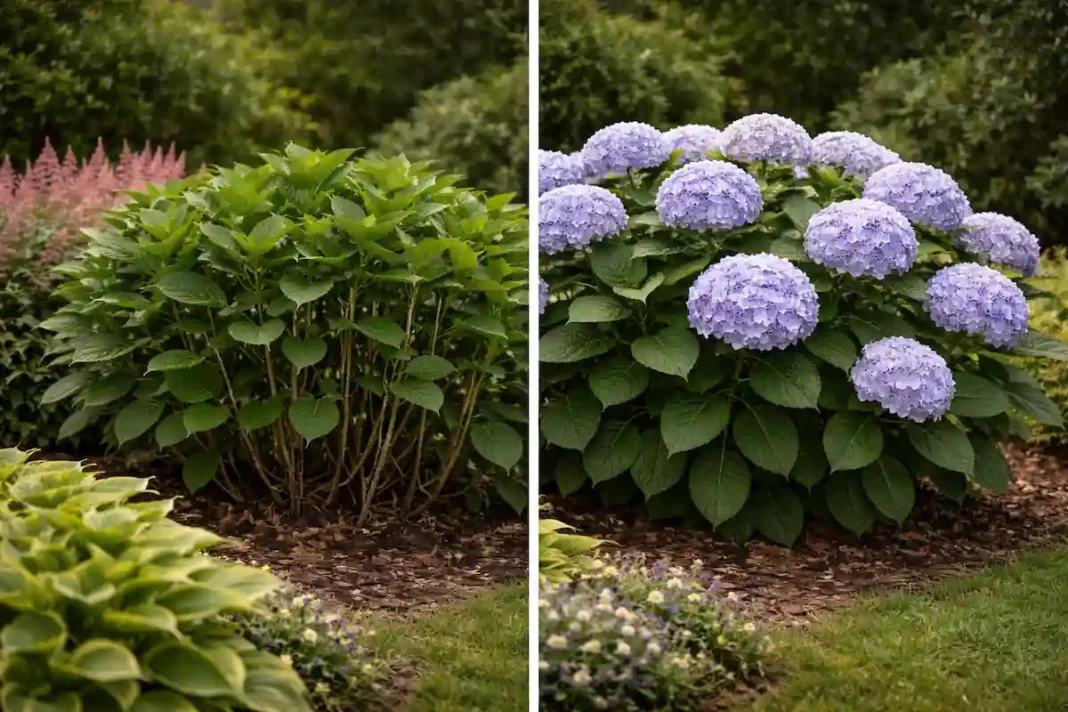

Topic: Why is My Hydrangea Not Blooming – Causes and Fixes
Written by: Garden Research Team
Reviewed by: Agrifarming Editorial Board
Sources: University Extension Programs, Horticulture Research Publications
Last Updated: April 2026
Your hydrangea has leaves. It looks healthy. But no flowers — again.

If your hydrangea looks healthy but refuses to bloom, you’re almost certainly making one of these mistakes — and the good news is every single one is fixable.
If you’re wondering why your plant won’t flower despite looking perfectly fine, the answer is almost always a pruning error made months earlier on the wrong type of hydrangea.
Here’s how to find out which problem you’re dealing with, and exactly how to make hydrangeas bloom again.
Short answer: The main reasons hydrangeas don’t bloom are pruning errors on old-wood varieties, frost damage killing buds before they open, or excess nitrogen shifting the plant’s energy entirely into leaves. Which one applies depends on your species — and that’s the first thing to figure out.
Why hydrangeas don’t bloom (simple):
- Pruned at the wrong time
- Frost killed the buds
- Too much nitrogen (leaf growth instead of flowers)

Most Common Reason Hydrangeas Don’t Bloom (Start Here)
If you had to bet on one cause, bet on this: pruning an old-wood hydrangea at the wrong time of year.
Most people tidy up their hydrangeas in autumn or early spring. The stems look dead and scraggly. Cutting them back seems responsible.
Here’s the catch: those “dead-looking” stems are carrying the embryonic flower buds for next summer, set the previous season. Cut them in October or March, and you’ve removed every bloom for the coming year — without any warning, and with no way to fix it until the following season.
This single mistake is behind the majority of hydrangea bloom problems. It’s entirely avoidable once you know which type of hydrangea you have. That’s where this guide starts.
For a broader overview of common issues beyond blooming, see our complete guide to how to fix hydrangea problems.
Quick Diagnosis in 30 Seconds
Work through this before reading further. Top causes of no blooms on hydrangeas, in order of likelihood:
No blooms this year?
│
├─ Did you prune last autumn or early spring?
│   └─ If yes → You likely cut off old-wood buds. See pruning section.
│
├─ Did you get a late frost after buds appeared?
│   └─ If yes → Bud blast. Buds are dead. See climate section.
│
├─ Lots of dark green leaves but zero flowers?
│   └─ If yes → Nitrogen excess. See soil section.
│
├─ Plant under 2 years old?
│   └─ If yes → Establishment phase. Wait. See age section.
│
└─ None of the above?
    └─ Check sunlight. You probably have less morning sun than you think.
Worth flagging early: in most real gardens, it’s not one clean problem — it’s two or three small ones compounding.
A nitrogen-heavy soil, combined with one late frost, combined with an autumn tidy-up, is enough to silence a Bigleaf hydrangea for years. How to fix hydrangea bloom problems usually starts with identifying which combination is active in your garden.
Top causes of hydrangea not blooming:
- Pruning old-wood varieties at the wrong time of year
- Late frost killing buds during a false spring (bud blast)
- Too much nitrogen — plant grows leaves, not flowers
- Not enough morning sunlight
- Plant too young — still in the establishment phase
- Stress stacking: two or three minor issues combining
Old Wood vs. New Wood: The Biology of the “No-Bloom” Mystery
Short answer: Old-wood hydrangeas form flower buds in autumn on last year’s stems. New-wood types form buds in spring on fresh growth. The most important step in figuring out how to tell your hydrangea type is identifying which category yours falls into — everything else depends on it.
Here’s where most people mess up — and genuinely, no plant label ever explains this clearly.
Some hydrangeas set their flower buds in autumn, on the stems that grew that season. Those buds have to survive winter intact and open the following summer on what’s now “old wood” — last year’s growth.
Other hydrangeas form buds in spring on completely new stems. That’s “new wood.”
Get this wrong — prune an old-wood type because the stems look dead in November — and you’ve removed every bloom for the coming year. Not some. All of them. You won’t find out until summer when nothing appears.
Identifying Your Species: How to Tell Your Hydrangea Type
Look at flower shape and leaf structure:
- Bigleaf Hydrangea (Hydrangea macrophylla) — Round “mophead” or flat “lacecap” flowers in blue, pink, or purple. Varieties: ‘Nikko Blue’, ‘Endless Summer’, ‘Bloomstruck’. Blooms on old wood. (Remontant varieties like ‘Endless Summer’ can also bloom on new wood — but don’t rely on it.)
- Panicle Hydrangea (Hydrangea paniculata) — Cone-shaped white clusters that age to pink. Varieties: ‘Limelight’, ‘PeeGee’. Blooms on new wood.
- Smooth Hydrangea (Hydrangea arborescens) — Large round white blooms. Variety: ‘Annabelle’. Blooms on new wood.
- Oakleaf Hydrangea (Hydrangea quercifolia) — Oak-shaped lobed leaves, conical white blooms aging to parchment. Blooms on old wood.
- Mountain Hydrangea (Hydrangea serrata) — Smaller than Bigleaf, similar lacecap flowers. Blooms on old wood.

Pruning Mistakes: Why Your Shears Are the Enemy
| Common Name | Botanical Name | Wood Type | Safe Pruning Window | Hard Prune OK? |
|---|---|---|---|---|
| Bigleaf / Mophead | H. macrophylla | Old wood | Immediately after summer bloom (before Aug) | No — removes next year’s buds |
| Panicle / PeeGee | H. paniculata | New wood | Late winter to early spring | Yes — encourages large flower heads |
| Smooth / Annabelle | H. arborescens | New wood | Late winter to early spring | Yes — can cut to 12 inches |
| Oakleaf | H. quercifolia | Old wood | Immediately after summer bloom | No — light shaping only |
| Mountain | H. serrata | Old wood | Immediately after summer bloom (before Aug) | No |
Here’s the catch that trips even experienced gardeners: the fix for a ‘Limelight’ (H. paniculata) is the exact opposite of the fix for a ‘Nikko Blue’ (H. macrophylla).
Limelight needs a hard cut in late winter — that’s what produces those large dramatic flower heads. Nikko Blue should barely be touched, and only in the six weeks right after its summer bloom ends.
The problem with tidying an old-wood Bigleaf in autumn: you’ve just written off next summer’s flowers. The plant will leaf out beautifully in spring and give you nothing.
Hydrangea Has Leaves But No Flowers? Here’s Why
A hydrangea growing leaves only, with big healthy foliage and zero blooms, is one of the most frustrating patterns — and one of the most common.
Hydrangea no flowers but big leaves almost always points to one of three causes.
Nitrogen excess is the most likely. The plant has been fed — directly or via lawn runoff — with too much nitrogen, which drives leaf and stem growth at the direct expense of flower production. It looks healthy by every measure except the one that matters.
Pruning at the wrong time produces the same symptom on old-wood types. Leaf buds survive the cut; only the flower primordia were removed when the stems were trimmed.
Too little light is the third culprit. A hydrangea in a shaded spot prioritises foliage to capture more light — flowers become secondary.
If your hydrangea looks lush and healthy yet hasn’t flowered for years, start with nitrogen and pruning timing — in that order. Full treatment of each is in the sections below.
Buds Forming But Not Opening (Bud Blast vs. Stress)
This is a different problem from having no buds at all — and the fix is different too.
If your hydrangea buds are forming but not blooming, or buds appear but brown and drop before they open, you’re dealing with one of two things.

Bud blast from frost is the most common cause of hydrangea buds not opening. The bud forms, activates early during a warm spell, then freezes when a late frost hits. It turns brown and fails to open. The rest of the plant looks completely fine — which is what makes this confusing.
You can identify frost-blasted buds by pressing them: papery, crumbling, brown all the way through.
Environmental stress — drought, sudden temperature swings, or thrips damage — causes buds to form and stall at the same stage. Stress-related failure tends to appear unevenly across the plant. Drought stress typically shows on the outermost branches first. Thrips damage (visible under a hand lens as tiny insects at the bud base) causes tips to brown while the rest of the bud stays firm.
The distinction matters because the fixes are completely different. Treating for frost when the real problem is drought wastes a full growing season. For natural, chemical-free approaches to both bud and leaf problems, see our guide to natural solutions for hydrangea problems.
Why Hydrangeas Don’t Bloom After Winter
Short answer: Hydrangea not blooming after winter is almost always bud blast — a late frost killed buds that activated too early during a false spring. The stems survive; the flower buds don’t.
The issue is, even gardeners who never prune incorrectly lose blooms this way every few years.
The UK, US Northeast, Pacific Northwest, and increasingly erratic climates across Northern Europe are all prime zones for this pattern. A warm spell in February or March nudges the terminal buds into activating early. They swell. Growth starts.
Then a frost arrives. The bud freezes and blackens. The stem sits there looking completely healthy while carrying absolutely nothing.
What Dead Flower Buds Look Like (The Brittle Test)

You’ll notice this first in early spring, before new growth appears.
Press the tip buds between your fingers. A healthy dormant bud feels slightly firm and waxy — peel back a scale and there’s pale green inside. A frost-killed bud crumbles when pressed, is brown all the way through, and feels papery.
For stems: drag your thumbnail lightly across the bark. Green underneath — alive. Brown and dry — winter kill. Work down until you find green, cut there.
Protecting Your Hydrangeas During Unpredictable Weather
For old-wood types in Zones 5–7, wrapping or caging is routine now, not optional.
Before first frost in autumn, loosely insulate the crown and lower stems with burlap, frost blankets, or a wire cage filled with dry leaves. The point isn’t to keep the plant warm — it’s to slow the rate of temperature change so a single sharp frost doesn’t hit freshly-activated buds.
Remove protection gradually in spring. The last frost date and the first warm spell are not the same thing.
How Long Until Hydrangeas Bloom After Planting?
Short answer: Panicle and Smooth hydrangeas typically bloom by year two. Bigleaf and Oakleaf varieties can take two to three years — sometimes longer in colder climates — because they must survive a full winter with buds intact before flowering.
A hydrangea in its first or second year in the ground is building roots, not flowers. This is annoying, but it’s biology, not failure.
Why “Nursery Exhaustion” Delays Blooms for 2–3 Years
Nursery plants are typically forced into bloom using controlled day-length, temperature, and feeding programs. Those conditions disappear the moment the plant goes into your garden.
The hormonal environment that triggered those nursery blooms doesn’t persist in ordinary soil.
Panicle and Smooth hydrangeas settle in faster — reduced first season, solid blooms by year two is realistic. Bigleaf and Oakleaf are slower: they have to survive a full winter with buds intact before they can flower.
If the plant leafed out vigorously, it’s doing exactly what it should. Hydrangea not flowering for years after planting isn’t a sign of a dying plant — it’s a sign of a plant still establishing.
How Much Sunlight Do Hydrangeas Need to Bloom?
“Partial shade” on a plant label sounds like shade-tolerant. In reality, it means four to six hours of direct sun per day — preferably morning sun.
Below that threshold, a hydrangea puts its energy into reaching for light instead of producing flowers.

Measuring Sunlight: The Morning Sun vs. Afternoon Scorch Balance
The problem is that many gardens have exactly this setup: a spot that gets good afternoon light, feels bright and sunny, but only receives one or two hours of direct morning sun. That’s not enough.
Walk your planting spot every two hours from 7am to 6pm on a clear day. Log direct sun vs. shade for each window.
Under four hours of direct sun before 1pm — the location is too shaded. The plant will leaf out lushly and bloom rarely, if at all. For old-wood types, relocate in autumn. For new-wood types, early spring.
Hydrangea Has Leaves But No Flowers: The Nitrogen Problem
Short answer: A hydrangea with dark, lush leaves and no flowers almost always has too much nitrogen — from lawn fertilizer runoff, over-feeding, or proximity to recently laid turf. Nitrogen drives leaf growth. Phosphorus drives flowers. When the ratio tips the wrong way, the plant behaves like a lawn.
The Nitrogen Trap: Why Lawn Runoff Stops Blooms
What’s happening is that many gardeners don’t apply fertilizer directly — but their hydrangea sits three feet from a lawn edge that gets fed every spring. That runoff alone is enough.
Hydrangea fertilizer for blooms needs the middle NPK number (phosphorus) to be the highest value — something like 5-30-5.
Standard lawn feed is the opposite: heavy nitrogen, low phosphorus. The plant reads that signal and grows leaves accordingly.
Best Fertilizer for Hydrangea Blooms

Look for a fertilizer with the middle NPK number highest — that’s phosphorus. Products labelled “bloom booster” or “flower fertiliser” typically fit this profile.
A 5-30-5 or 10-30-10 is ideal. Avoid general-purpose balanced fertilizers (like 10-10-10) if you’re trying to push a reluctant hydrangea into flowering — the nitrogen component will work against you.
Apply in autumn so phosphorus migrates to the root zone over winter and is available when the plant begins setting buds in spring. Don’t expect same-season results. One season of correction leads to next season’s flowers.
If you prefer a low-cost approach, our guide to homemade fertilizer for hydrangeas covers DIY bloom-boosting options using ingredients most gardeners already have.
Not sure how much to apply? Use our fertilizer calculator to work out the right amount for your garden size.
Before buying anything: do a pH test first. An extremely acidic or alkaline soil locks nutrient availability regardless of what you add. A basic pH kit from any garden centre takes five minutes. If pH is off, fix that before fertilizing.
For a full breakdown of how soil pH affects both colour and flowering, read our guide to soil pH strategies for hydrangeas.
Understanding “Midday Wilt” and Vapor Pressure Deficit (VPD)
Short answer: Hydrangeas wilt in the afternoon even when the soil is moist. This is a response to atmospheric conditions (VPD), not a watering need. Overwatering in response causes root rot — which then genuinely prevents blooming.
You water in the morning. By 2pm the plant looks like it’s dying.
The reality: on hot, dry days, leaves lose water through evaporation faster than roots can replace it. The plant wilts to reduce moisture loss from leaf surface. It’s self-protection, not distress.
Why Wilting Doesn’t Always Mean Your Plant Needs Water
Check soil at root depth — six to eight inches down. Still moist? The afternoon wilt is atmospheric. The plant will recover by evening on its own.
Overwatering in response leads to root rot, which destroys the root system the plant needs to uptake phosphorus and water — and then genuinely stops blooming.
True moisture stress — hydrangea no blooms after a dry summer — shows up in the morning. Wilted at 8am before temperatures climb? Water deeply. Wilted only at 2pm with moist soil? Leave it alone.
When It’s More Than One Problem: Stress Stacking
In most gardens, a plant that won’t flower for years, or a hydrangea growing leaves only with no sign of buds, isn’t facing one clean, diagnosable problem. Several small factors have combined.
A typical real-world case: a Bigleaf in Zone 6, pruned in March (old-wood buds removed), growing in soil enriched by lawn runoff (nitrogen excess), sitting in a spot with two hours of morning sun but good afternoon light.
Any single one of those factors alone might allow occasional flowering. Together, they guarantee none.
Work through the Quick Diagnosis at the top in order. Fix the most obvious issue first. Reassess the following year — don’t change everything at once, because you won’t know which change helped.
Why Your Hydrangea Looks Healthy But Won’t Bloom
This is one of the most Googled hydrangea questions — and it has a specific answer.
A hydrangea that’s growing vigorously, leafing out well, and shows no signs of disease or distress, but produces zero flowers, is almost certainly dealing with one of two things: pruning at the wrong time, or too much nitrogen.
Both produce the same result. The plant looks fine. It’s doing everything right — except blooming.
A plant that looks perfectly healthy but won’t produce flowers is the nitrogen problem or the pruning problem wearing a disguise. The plant isn’t sick. It’s been accidentally redirected. Nitrogen excess tells it to grow leaves. Wrong-time pruning removed the flower buds before the season even started. Either way, the fix is in this guide — and it’s not complicated once you know which one you’re dealing with.
How to Make Hydrangeas Bloom (Simple Summary)
If you want a quick answer before going deep, here it is.
To make hydrangeas bloom:
- Identify your type first — old-wood or new-wood. This determines everything else.
- Stop pruning old-wood types in autumn or spring — cut only right after summer bloom ends.
- Switch to a high-phosphorus fertilizer (middle NPK number highest) and stop any nitrogen-heavy feeding near the plant.
- Protect old-wood buds through winter with a loose frost wrap or cage before first frost.
- Check sunlight — minimum four hours of direct morning sun, or the plant prioritises leaves over flowers.
- For new-wood types (Limelight, Annabelle), cut back hard in late winter. That’s what triggers large, healthy blooms.

For a hydrangea not flowering for years, it’s usually steps 1–3 that solve it. For hydrangeas that bloomed once then stopped, step 4 is often the missing piece.
How to Fix Hydrangea Not Blooming: The Recovery Plan
End of season, no blooms. Here’s the step-by-step corrective protocol for how to get hydrangeas to bloom — even if they haven’t flowered in years.
For old-wood varieties (Bigleaf, Oakleaf, Mountain):
- Put the pruners away entirely. Remove dead wood only, immediately after any blooms fade — no later than August.
- In autumn: one application of bloom-booster fertilizer (high-phosphorus NPK).
- Before first frost: cage or wrap to protect dormant buds through winter.
- In spring: remove frost protection gradually after the last frost date — not before.
- Run the Scratch Test on every stem. Remove only confirmed dead wood.
For new-wood varieties (Panicle, Smooth):
- Late winter, before any new growth: cut back hard. Smooth hydrangeas to 12–24 inches from the ground; Panicle types to the first pair of healthy buds on each stem.
- Balanced fertilizer as growth begins; phosphorus-heavy feed in midsummer once buds have set.
- Watch for moisture stress through the hot months — this is when new-wood types are most at risk.
One thing worth checking that often gets missed: deer. In suburban US gardens and parts of Northern Europe, deer eat emerging flower buds in late spring and leave no other evidence.
Stems alive and intact but with blunt, cleanly-broken tips in May? That’s probably what happened. Barrier protection or repellent spray from bud emergence through early June.
Sources
- RHS (Royal Horticultural Society, UK) Covers pruning, species identification, soil, and seasonal care for all major hydrangea species. Recognised globally as a primary horticultural authority.
- Missouri Botanical Garden One of the world’s leading botanical research institutions. Species-level profiles covering H. macrophylla, H. paniculata, H. arborescens, H. quercifolia and H. serrata — soil chemistry, hardiness zones, bloom biology, and cultivation globally.
FAQs about Hydrangea Bloom Problems
1. Will my hydrangea bloom if I cut it to the ground?
Only if it’s a new-wood variety like ‘Annabelle’ or ‘Limelight’. Cutting a Bigleaf to the ground removes all flower buds for the coming year.
2. Do coffee grounds help hydrangeas bloom?
No. They slightly acidify soil, which affects flower colour in Bigleafs, but don’t supply the phosphorus needed for flower production. For a full list of plants that genuinely benefit from coffee grounds, see plants that like coffee grounds.
3. Why did my hydrangea bloom last year but not this year?
Almost always a late spring frost that killed the buds, or a pruning cut made the previous autumn.
4. Can I use Epsom salts to make hydrangeas flower?
Only if your soil is genuinely magnesium-deficient (a soil test will confirm). Otherwise, it adds salt without helping blooms.
5. How can I tell if my hydrangea stems are dead or just dormant?
Scratch Test: drag your thumbnail across the stem. Green underneath — alive. Brown and dry — dead. Work downward until you find green tissue.
6. Why are the leaves on my hydrangea turning yellow but it won’t flower?
Yellow leaves plus no blooms often signals iron chlorosis or overwatering — both put enough stress on the plant to abort flower production.
7. Does wood ash help hydrangeas bloom?
It raises soil pH toward alkaline. For hydrangeas, if pH is already neutral or above, it can push conditions out of range without helping flowers.
8. Can thrips stop a hydrangea from blooming?
Yes. Thrips feed on developing buds, causing them to brown and fail before opening. Check buds with a hand lens in spring if tips look damaged and no frost occurred.
Know your species. Check the wood type before you prune. Protect the buds through winter. Most other problems are fixable — but those three have to come first.
Conclusion
Most hydrangeas that won’t bloom aren’t sick, dead, or in the wrong climate. They’ve been pruned at the wrong time, fed the wrong nutrients, or had their buds quietly killed by a late frost — and the fix for each is straightforward once you know which one you’re dealing with. Start with your species. Work through the diagnosis in order. Change one thing at a time, give it a full season, and in most cases the flowers come back.
Editorial note: This guide is based on horticultural best practices for temperate garden conditions and references published guidance from university extension services. Specific outcomes — bloom timing, establishment periods, frost hardiness — vary by cultivar, local climate, and soil type. Always cross-reference advice with guidance specific to your USDA Hardiness Zone or regional equivalent before making significant changes to an established plant.