



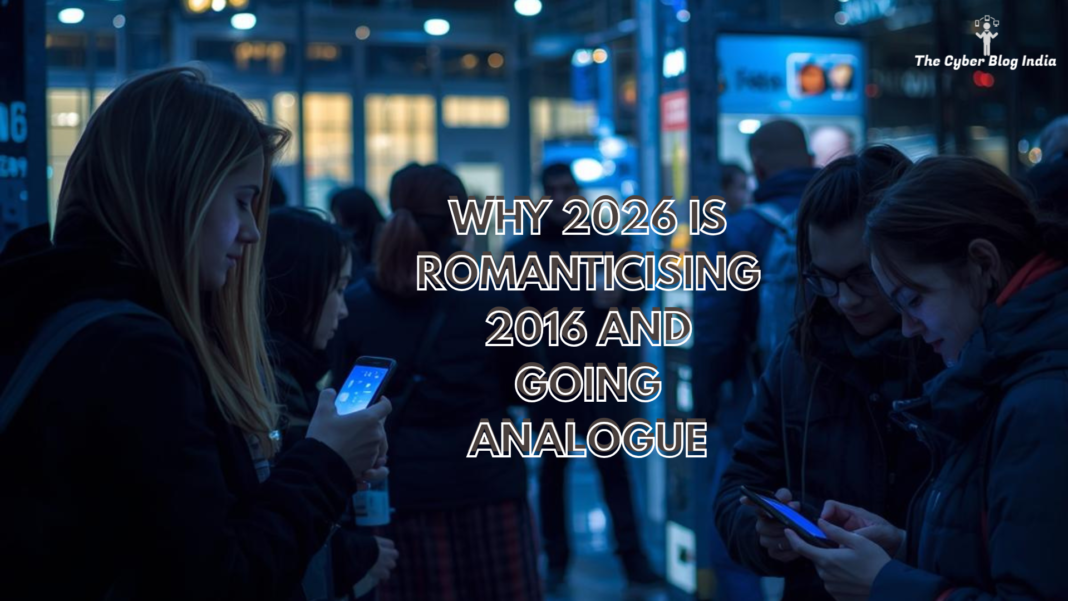

By the end of 2025, social media seemed to agree on one strange prophecy: 2026 will be the new 2016. At first, I thought it was just another trend, like iPods, flip phones, digital cameras, and wired headphones, making appearances on Pinterest. The more I scrolled, the more I began to wonder if this nostalgia was doing more than dressing up our feeds. Because this wasn’t just about old gadgets, it felt like a collective longing for a time when technology felt exciting rather than exhausting, and when being online did not mean being endlessly watched, measured, and monetised.
And so, I began to wonder. Are we really trying to go back to simpler technology? Or, are we trying to escape the way modern platforms have come to own our attention, our habits, and perhaps even our inner lives? Is choosing a flip phone an act of rebellion or just another carefully curated gesture, performed for the same algorithms we claim to be resisting?
To make sense of this, we have to look beyond the vintage filters and ask what lies underneath the trend. Are we rejecting technological progress itself, or are we rejecting the anxiety that has grown alongside it? And if so, could this sudden affection for 2016 be less about the past and more about Gen Z quietly negotiating the terms of a future that already feels overwhelming?
The Subjective Pull of Nostalgia
In 2016, I was in eighth grade, back when schools treated electronic devices like contraband. Phones were strictly forbidden, but I had just discovered the song Closer by The Chainsmokers. I felt an urgent need to share it with my best friend. So, in an act of rebellion, I slipped my Nokia keypad phone into my school bag. During lunch break, while everyone else rushed to the playground, we sneaked into the girls’ restroom and stood there, listening to the song in hushed excitement. What stays with me now isn’t the song itself, but the feeling around it. The fear of being caught mixed with the quiet joy of sharing something new. It was such a small moment, yet it felt intense in a way that today’s instant sharing rarely does.
I find myself wondering whether the people romanticising this ‘anti-tech’, ‘2016-style’ nostalgia are chasing a similar sensation. Perhaps what we miss is not the keypad phone or the wired earphones, but a time when digital experiences felt personal rather than performative. Ten years later, as adult responsibilities pile up and digital life grows increasingly surveilled, retreating to analogue technology can feel like a way of retreating from complexity itself.
An Attempt to Escape a Hyperconnected World
The appeal of older technology lies in what it symbolises, not what it actually offers. For instance, iPods represent intentional listening, digital cameras symbolise delayed gratification and flip phones set boundaries. Together, they form a curated vision of control in a digital environment that increasingly feels uncontrollable.
Studies consistently show rising levels of anxiety and reduced attention spans related to algorithmic feeds. The Facebook Papers controversy showed us that its design, which focuses on engagement, worsened mental health for younger users.
Yet despite this awareness, logging off still feels unbearable to many. Why?
Evolutionarily, isolation meant death. Humans survived by forming tribes, staying close together, and being social. After the COVID-19 pandemic, this need became even stronger. Being online turned into being visible and relevant. In a society driven by digital connections, not being present can feel like disappearing.
We scroll not just for fun, but for reassurance. Each notification gives us a slight dopamine boost, evidence that we still belong in the social scene. When we come across unfortunate news or triggers for comparison, we don’t leave the app. Instead, we scroll more to numb the discomfort caused by the very platform that feels like a trap.
Algorithmic Drift Away from Human Connection
Early social media platforms focused on personal connections. Opening Facebook or Instagram used to mean seeing posts from friends, family, and people you actually knew. However, over time, the business model of these platforms changed that experience. Instagram now prioritises content that generates measurable reactions rather than fostering relationships. Adam Mosseri, Head of Instagram, openly acknowledged this shift. He stated that the platform ranks content based on signals like “how likely you are to comment, like, or share a post.” Although this is presented as a way to show “relevant” content, scholars point out that reactive engagement is not the same as building genuine connections. As a result, users increasingly see posts from influencers, sensational content, and strangers who encourage interaction, often missing updates from their closest friends and family.
This change has consequences. The platform still feels social, but it no longer serves as a real social space. It is a performance arena designed for capturing attention. The gap between the promise of connection and the reality of isolation drives the “anti-tech” narrative. People are not rejecting technology; they are rejecting the feeling of being emotionally surrounded yet alone in their relationships.
Another force driving this trend is AI saturation. People are becoming more aware that much of what they see online is automated or completely synthetic. From AI-generated art to captions created in seconds, the internet feels less human each day.
Take Xania Monet, for example. She is one of the first AI’ artists’ to get enough radio play to debut on a Billboard chart. It is impressive from a software and technological perspective, but it also makes people feel uneasy. If even music, which we have always linked closely to human emotion, can be convincingly mimicked, then what still counts as real?
This worry fuels the desire for tangible, imperfect, human experiences. This is why there is a return to physical cameras, analogue media, and offline activities. Not because they are efficient, but because imperfection, and perhaps inefficiency, feels human.
Why We’re Not Going Back to 2016 (No Matter How Much We Want to)
There is a moment in O Superman by Laurie Anderson where the song stops feeling like music and starts sounding like a system thinking out loud; mechanical, repetitive, oddly soothing. When the voice asks, “So hold me, Mom, in your long arms,” it is not rebelling against systems of power but instead seeking comfort from them. That moment feels uncomfortably familiar today. Our relationship with digital platforms is no longer oppositional; rather, it is dependent. We are not trying to escape the system so much as asking it to be gentler with us.
This is why the fantasy of returning to iPods, flip phones, and offline living resonates so deeply. It is not a plan to abandon technology altogether, but an emotional response to feeling managed by it. And perhaps that is the real irony: the same platforms that insist they are building connections have created conditions where people dream of disappearing, but only aesthetically. We perform withdrawal without risking isolation. We imagine slowness without surrendering speed.