



Chances are you’ve never heard of Allapalli.
A colonial-era forest depot village that has transitioned into a small town, it lies in a remote corner of Maharashtra’s Gadchiroli, a district often in the news for the Naxal-linked violence that has gripped the region for decades.

However, before violence came to define this landscape, Allapalli was a name every colonial-era forester worth his salt had to know. Imperial Forest Service officers visited routinely, to see for themselves the “working” (a euphemism for silvicultural management of forests) of the finest example of the famous CP Teak (Central Provinces Teak).
JW Best, a young forest officer posted to Allapalli in 1904, wrote a vivid account of what life was like here, in the book Forest Life in India (1935).
“Alla Pilli was so far off and had so bad a reputation for the worst form of malaria that none but the most hardy…ventured near the place. Its remoteness was its chief charm… The village consisted of one main street where the few forest officials were housed, and all around, covering many acres was a confusion of strewn logs, timber carts, draft oxen or buffaloes, and temporary camps of cartmen and coolies,” he noted. “That was in the open season; in the rains the place was deserted, except for a few fever-stricken forest subordinates wellnigh prepared to sell their souls to get away from the place. Needless to say, it was not a popular locality with the native forest staff. In the middle of this huge cleared camp were the elephant sheds and saw-mills standing together like some ancient abbey in a modern town.”
***
Wild elephants had been gone from Gadchiroli for just over a century, by that point, primarily as a result of centuries of capture for domestic use. The forest department of the time, however, relied heavily on them for transport, porterage, hunting expeditions and in the logging industry. So, some were brought to Allapalli from elsewhere. As they settled in, more would be born here.
“Working in the forest, we used elephants and he-buffaloes. It was well to keep an eye on either when near them. One of the elephants had a playful way of throwing logs of teak at people he disliked… A single elephant can pull a big log over rough ground; sometimes it will roll it along by pushing it with its nose, getting its head well down for the purpose,” Best wrote.
Today, Allapalli is a very different place. The forests have receded, and been denuded; the wildlife has disappeared and the departmental hustle and bustle has faded away. The working elephants too have marched into the sunset. The last of this proud lineage were transferred to an elephant camp at Kamlapur, about 45 km away, in the 1960s, where a few surviving senior elephants now live a quiet life of retirement. (Elephants can live past the age of 70.)
Yet, the memory of dozens of those gentle giants who lived, played, worked and died in Allapalli in service of man and forest lingers on, in the form of an evocative artefact: elephant bells.
***
One of the walls in the drawing room of the 116-year-old Allapalli Forest Rest House, which itself has undergone much change, houses an open cabinet in which nine bells are lovingly preserved.
Each of these bears the name of the elephant it once belonged to, the bell being a sort of pendant worn around the neck.
Sardar, Muktamala, Bisankali, Ramkali, Anarkali…., I couldn’t help but feel an acute sense of wistfulness and melancholy wash over me as I held these bells and ran my fingers over the names etched on them. I remembered the nostalgic words of Best from 1935, who by then had retired and returned to Britain.

“In March 1905… I left behind me the saw-mills of Alla Pilli with regrets,” he wrote. “There is a special charm in the place. The high-pitched sing of circular saws and the aromatic scent of teak sawdust bring back to me the memories of that remote settlement. Now each year when… a shower of rain falls on the teak-wood furniture… the scent of teak again tantalizes my senses and I think of those wonderful first days in the jungle at Alla Pilli.”
As I placed the bells back in their cabinet, I tinkled each of them once, and in that moment I could almost hear the quiet, fading echo of a distant trumpet.
FROM BELLS TO TRIBUTES
As one travels by train to Dehradun, the last leg of the journey winds through 22 km of beautiful sal forest before the city rudely puts an abrupt end to its sights and sounds.
On this stretch, now part of the Rajaji Tiger Reserve, if one pays close attention, one may see a sign for a forlorn, forgotten wayside “jungli” railway station, as the train rushes past it: Kansrao.
No one stops here anymore (though the odd train may pause ever so briefly to let railway staff board or deboard here).
Looking at it, you would perhaps not realise that this is the station that inspired Ruskin Bond’s fictional railway stop of Deoli, immortalised in The Night Train at Deoli (1988). It figures in other stories by him too.
If you do manage to alight at the station somehow, take a short walk north from the little station-master’s cabin, down a mud road, and you will soon spot a charming old British-era bungalow: the Kansrao Forest Rest House, built in 1891.
Nip in if the day is dying. One must either be at the bungalow or the station by the time dusk gives way to night, because come nightfall, the forest all around comes alive with traffic of the four-legged kind: the sawing call of the leopard, alarm calls of cheetal and barking deer, the bellowing of the stately sambar, and the low rumbles of elephants.

On a cool afternoon in late-2024, my father (conservationist and former Indian Forest Service officer SEH Kazmi) and I found ourselves at this bungalow. I had wanted to visit Kansrao for many years — partly for the bungalow, which is a rare heritage forest rest house not ruined yet by “renovation”; and partly for what lay within.
Step inside and look up at the ceilings in each room and there are still old hand-drawn fans hanging here. These ancient cooling systems consisted of a large horizontal beam of wood or metal, with frilled cloth hanging along its length. Each beam was connected by a system of pulleys and ropes to the verandah outside, where a “punkhawallah” would sit or lie, pulling on the rope to fan the sahibs within.
There are only three other rest houses I know of where this system still survives: Supkhar in Madhya Pradesh’s Kanha Tiger Reserve, and Achanakmar and Chhaparwa in Chhattisgarh’s Achanakmar Tiger Reserve. I had already been to the others, so when I learnt that Kansrao had one too, I knew I had to visit.
***
The bungalow and its punkha, though, were only the secondary reason. The primary reason that brought me to Kansrao was an elephant named Rampyari.
I first read about Rampyari nine years ago, in a book by the naturalist Stephen Alter. I had been longing to meet her ever since. Soon after I reached Kansrao, as the shadows began to lengthen, I stepped out to go and see her.
I walked out of the bungalow, along a mud road into the forest. A plethora of birds fluttered in the trees, while others chirped from the undergrowth, looking for their last meal of the day. After a leisurely walk of about 100 metres, I was at a jungle road crossing. To my left was the path leading out of the forest, and to my right a road named after the martyred forest guard Naresh Singh Chauhan, killed by timber smugglers in 1993.
I, however, needed to go straight, down a road that looked like it hadn’t been trod upon recently.
“Go a couple of hundred metres down that road and you will see a tree bowing over the path on the left, and that is where you will find her,” I had been told by the bungalow chowkidar.
The sun was beginning to dip over the “rao” (the local name for a bouldery forest stream) a few hundred metres to my left, beyond the trees. A golden hue drenched hundreds of blooming kans flowers carpeting the rao that gives Kansrao its name: the stream of kans grass. I heard the faint hoot of a train trundling down the tracks.
As I walked briskly forward, dozens of little grasshoppers jumped comically out of the layer of short grass carpeting the road. Ahead lay a dense cobweb of trees and bushy undergrowth.
Just then, the distinct rumble on the old bridge over the rao announced the arrival of the train at Kansrao station.
By now, I could see the bowing branch. A clearing opened up on my left, and there she was.
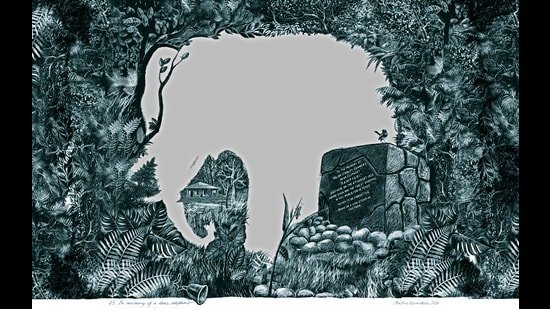
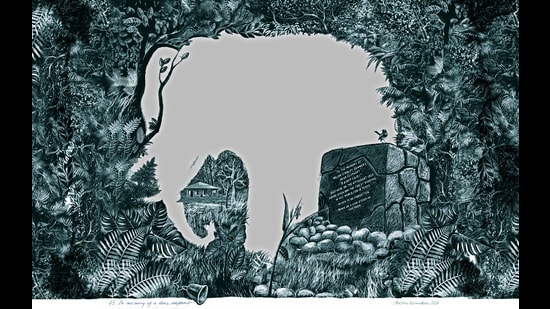
“To the Memory of Major Stanley Skinner’s Dear Elephant ‘Rampyari’. Died Here. On the 6th August, 1922. Having Given Him the Finest Shooting in This World, for 14 Years. Never to be Forgotten. Brave As a Lion, Steady as This Rock” read the epitaph carved on a large block of rock that sat atop a cairn of stones picked from the stream.

The face of the rock that bore the inscription was carved in the shape of an elephant’s footpad.
It is said that Rampyari’s grave was lost for a few decades, until researchers from the Wildlife Institute of India, Dehradun, undertaking a faunal survey in the area in the 1980s, stumbled upon it. Despite my best efforts, I could not find any written records of the life and times of Rampyari. I didn’t find much about Major Skinner either, but for the fact that he was a descendant of James Skinner or Sikandar Sahib, the Anglo-Indian founder of the famed 1st Horse aka Skinner’s Horse regiment of the Indian Army.
Major Stanley followed his beloved Rampyari to happier hunting grounds in 1932. Thereafter, his estate became part of Doon School. Legend has it his ghost still haunts the halls of his bungalow, rechristened Jaipur House; and the abandoned shed behind it, where Rampyari once lived.

***
The forest department, to its credit, has respected the sanctity of her final resting place.
There is a thoughtful clearing around it, and the engraving on her epitaph has been gently repainted in white. A few round, whitewashed stones mark the perimeter of where she lies. There are, thankfully, no gaudy signboards, concrete, chains or grilles to “secure” the space; nothing that would spoil the sombre beauty of this place. I pray it always remains so.
I sat beside her for a while. Cushioned by deep emerald forests, she lies overlooking a carpet of green, with noble verdant trees as her steadfast sentinels.
Just then, I noticed that I was not the only one to have come to pay his respects at her final resting place. She has other visitors too. Around her grave I could clearly see the footprints of wild elephants. I smiled to myself.
It was quiet, serene and beautiful. I sat there, tranquil, until a few playful langur monkeys settling in for the night reminded me that it was time to bid Rampyari goodbye. As I turned to leave, I brushed my hand against her epitaph one last time, and in that moment I thought I heard the tinkling of an elephant bell from somewhere far away.
(Raza Kazmi is a conservationist and wildlife historian. He is @RazaKazmi17 on X)