


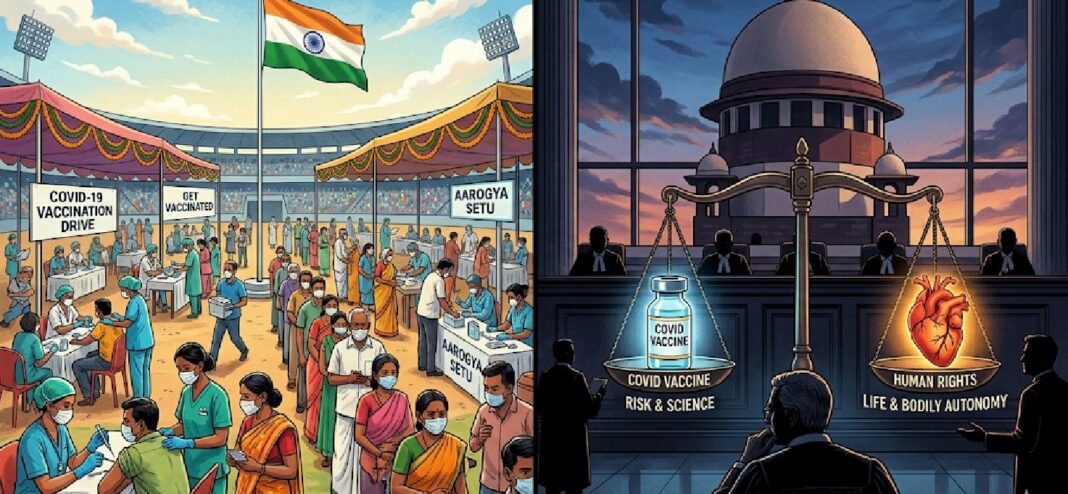


The pandemic may have ebbed, but it has not ended. It lingers—in memory, in grief, and increasingly, in questions that refuse to settle. For a country that witnessed the collapse of its healthcare system during the devastating second wave, Covid-19 vaccines were more than a scientific breakthrough; they were a lifeline.
Rolled out at unprecedented speed across a population of over a billion, the vaccination drive carried the authority of the State and the urgency of survival. Yet, as the immediate crisis receded, a quieter unease began to surface.
Across India, isolated but unsettling reports emerged of sudden deaths—often among young, otherwise healthy individuals. Many incidents unfolded in public spaces: on stages, at weddings, in gyms. In several cases, the timeline overlapped with recent vaccination. Science remained cautious. Public perception did not.
It is within this fraught space—between statistical rarity and emotional reality—that the Supreme Court has intervened, shifting the debate from liability to responsibility.
WHEN SCIENCE SAYS “RARE”, BUT SOCIETY HEARS “RISK”
From the earliest days of vaccine deployment, global scientific consensus remained firm: Covid-19 vaccines are safe, effective, and essential. But they were never described as risk-free.
The World Health Organization consistently noted that serious adverse events following immunisation are rare, but not impossible. Similarly, the US Centers for Disease Control and Prevention flagged rare cases of myocarditis—particularly among younger males—while emphasising that most instances were mild and resolved quickly.
European regulators classified certain cardiac and clotting conditions as “possible side effects”, even as they reiterated that the benefits of vaccination far outweighed the risks. Scientific studies echoed this layered truth: while vaccines carried a marginal risk, Covid-19 infection itself posed a far greater threat.
India’s own data reflected a similar pattern. The government’s Adverse Events Following Immunisation (AEFI) system recorded thousands of post-vaccination events. Yet, in the context of billions of doses administered, serious adverse effects remained exceedingly rare. And still, reassurance by numbers struggled against the power of narrative.
THE OPTICS OF SUDDEN DEATHS AND A CRISIS OF TRUST
Public health is not governed by data alone—it is shaped by visibility. The sporadic but widely circulated reports of sudden cardiac deaths among young Indians created a pattern in the public imagination. Even without definitive medical proof, the temporal link to vaccination became difficult to ignore in everyday discourse.
The Indian Council of Medical Research conducted a detailed study into sudden unexplained deaths among individuals aged 18 to 45. Its findings were cautious but clear: no direct causal link to Covid-19 vaccination was established. Instead, it pointed to a complex interplay of factors—prior infection, genetic predisposition, and lifestyle risks.
Globally, health agencies reiterated a fundamental principle: correlation is not causation. But in a society emerging from collective trauma, the absence of definitive answers does not calm anxiety—it amplifies it.
FROM PERSONAL LOSS TO CONSTITUTIONAL QUESTION
This gap between scientific uncertainty and human loss eventually reached the courtroom.
In Rachana Gangu vs Union of India and related petitions, individuals and families approached the Supreme Court—not to challenge vaccines themselves, but to question the absence of a safety net. They argued that serious injuries and deaths had occurred in temporal proximity to vaccination, and that India lacked a dedicated compensation mechanism.
The Union government’s response rested on established legal grounds: vaccination was voluntary, informed consent had been obtained, and no conclusive causal link had been established through the AEFI system. In the absence of negligence, it argued, liability could not be imposed on the State. As a matter of law, the argument was sound. As a matter of constitutional morality, the Court was unconvinced.
CONSENT AND THE EXPANDING ROLE OF THE STATE
Invoking Article 21, the Court reframed the debate. In a mass vaccination programme—driven by State policy, reinforced through public messaging, and undertaken amid a deadly pandemic—the idea of purely individual choice becomes blurred. Consent, in such a context, operates within a system shaped by urgency and trust.
The State, the Court implied, cannot remain a passive facilitator. It must also be an accountable actor. Its observation that
the government cannot remain a “silent spectator to the suffering of its citizens” reflects a deeper judicial philosophy—one that places human consequences at the centre of governance.
NO-FAULT COMPENSATION: A BRIDGE BETWEEN SCIENCE AND JUSTICE
The most significant outcome of the ruling is the directive to establish a no-fault compensation framework. This model marks a departure from traditional liability regimes. Instead of requiring victims to prove negligence—often impossible in complex medical cases—it allows compensation based on injury and a reasonable link to vaccination. The focus shifts from blame to relief.
Such frameworks already exist in several countries, designed to sustain public trust while acknowledging scientific uncertainty. India’s move in this direction signals an alignment of public health policy with principles of restorative justice.
At the same time, the Court upheld the integrity of existing scientific systems while strengthening them. It directed that data on adverse events be made publicly available at regular intervals—placing transparency at the heart of trust.
LIFE, DIGNITY, AND THE MEANING OF ARTICLE 21
At its core, the judgment is less about vaccines and more about the Constitution. Over time, Article 21 has evolved into a broad guarantee encompassing healthcare, dignity, and the right to live with security. This ruling extends that evolution, affirming that citizens must also be protected from—and compensated for—the unintended consequences of State-backed interventions. By removing the burden of proving fault, the Court prioritises human life over procedural rigidity. It acknowledges a simple truth: in public health, justice cannot depend solely on scientific certainty—because such certainty is often elusive.
A TEMPLATE FOR THE FUTURE
The ruling’s significance lies not just in what it resolves, but in what it anticipates. Future public health crises will demand rapid action, widespread compliance, and public trust. By mandating a no-fault compensation mechanism, the Court offers a template for balancing these imperatives. It reassures citizens that participation in collective health measures will not leave them unprotected in rare cases of harm. In doing so, it transforms trust from a moral expectation into a constitutional guarantee.
THE BOTTOM LINE
During the pandemic, the State asked its citizens to act for the collective good—to isolate, to comply, to vaccinate. Millions did so without hesitation. The Court has now made it clear: such trust cannot be one-sided. When individuals accept risk for the greater good, the State must share the burden of its consequences.
Because in a constitutional democracy, survival may be collective—but accountability must be too. And when the line between protection and risk blurs, it is the Constitution that must draw it again.
—The writer is a New Delhi-based journalist, lawyer and trained mediator