


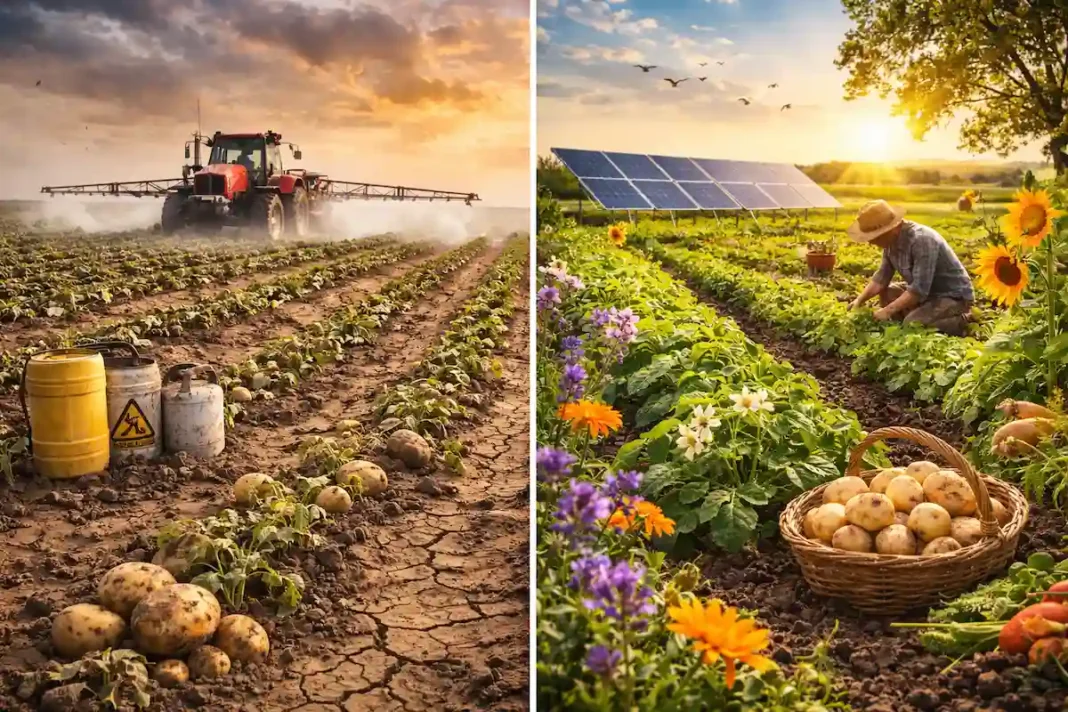
Consumers face a difficult decision when choosing between two similar-looking potatoes. One comes from a production method that prioritizes mass yields, while the other is kinder to the planet. Yet, the choice is more complex than it seems. Understanding the difference between conventional and sustainable farming informs better buying decisions at the grocery store and leads the way for a more resilient and healthier food future.
What is Conventional Farming?

As experts anticipate the global population reaching 10.3 billion by the 2080s, large-scale food production has become the primary system for feeding the world. Conventional farming — also known as industrial or monoculture agriculture — produces as much food as possible at the lowest possible cost, operating much like a factory to ensure an abundant supply.
It relies heavily on external inputs, including chemical fertilizers and technology to control growing conditions and boost returns. Although high-volume production has been successful in feeding individuals, it comes with significant environmental and health concerns.
Common Practices and Considerations
Monoculture is one of conventional farming’s defining features, in which producers plant a single crop across a vast expanse of land annually. While it streamlines production and harvesting, it increases the likelihood of pests and diseases, resulting in the need for chemical intervention.
Synthetic pesticides and similar inputs also harm soil microorganisms. Research shows that soil microbiota regulate 80% to 90% of natural processes, including nutrient cycling, biological control, habitat maintenance, carbon sequestration and food production.
Other practices, such as intensive tillage and heavy machinery operations, result in soil compaction, erosion and fossil fuel emissions that harm the planet. Despite the benefits of higher yields, conventional farming also risks water pollution, biodiversity loss and chemical exposure, posing potential health risks to consumers.
From precision irrigation to integrated pest management, exploring these eco-friendly farming techniques can help both farmers and consumers better understand what responsible agriculture looks like in practice.
What is Sustainable Farming?

Unlike industrial approaches, sustainable farming is a holistic agricultural technique that produces food in an eco-friendly manner. Rather than focus on increasing short-term harvests, it is more concerned with building a self-sustaining system that thrives for generations to come.
It balances environmental stewardship with profitability and social equity that supports the well-being of farmstead families, workers and communities. Producers work in accord with the natural world, viewing the farm as part of the living ecosystem.
Common Practices and Characteristics
Responsible food production aims to mimic natural ecosystems, integrating crop rotation and diversification to improve soil fertility and reduce plant diseases. Studies show that this method boosts soil health by 45% and increases cereal, cash crop and legume yields by 38%.
Integrated pest management (IPM) is another approach that eco-friendly growers use to mitigate unwanted pests, leveraging beneficial insects and targeted interventions. One study found that heavy pesticide use reduced local bee populations by 40% in the U.S., underscoring the importance of IPM as a key solution.
To conserve resources, farmers often implement water conservation measures — such as low-flow or precision irrigation — and no-till farming to prevent erosion. Sustainable producers are also turning to renewable energy sources to lower their carbon footprint while creating habitats for pollinators, fostering a truly generative farm ecosystem.
A Tale of Two Potatoes — Conventional vs. Sustainable Potato Farming
Potatoes are the perfect case study for applying the principles and understanding the environmental impacts of conventional vs. sustainable agriculture. Potatoes are often grown en masse, from local farms to large-scale operations, and are one of the most crucial staples on people’s plates. This variation demonstrates how two production methods for the same crop can yield very different outcomes.

The Conventional Potato
Like most conventional strategies, large-scale potato farming focuses on maximizing yields and aesthetic value, often through monoculture practices. Producers apply chemical pesticides, herbicides, fungicides, and fertilizers to protect their crops and boost harvests.
However, the reliance on synthetic substances and intensive tilling degrades soil fertility and causes erosion. Traditional potato farming also tends to overuse water resources for irrigation and causes runoff of chemical residues into nearby streams.
According to one study, conventional potato farming in India had a much higher impact on global warming, producing 2,007.669 kilograms of carbon dioxide (CO2) equivalent emissions per hectare — nearly 50% more than organic farming. The research also found that these traditional practices resulted in an 86% total negative environmental score, linked to adverse human health.
The Sustainable Potato
Sustainable potato producers nurture the land with responsible cultivation practices, from crop rotation to soil nutrient management. These efforts intrinsically mitigate plant diseases and pest infestations while enhancing soil fertility. A 2025 study on potato production in Northwest China showed that crop rotations improved soil health by 13.1% to 63.4%, and improved yields by 15.0% to 38.2%.
Rather than using scheduled chemical applications, farmers also apply IPM to work with the surrounding nature. Precision irrigation techniques further ensure potato crops receive the proper amounts of water without excess. Many sustainable farms integrate renewable energy to power their operations more efficiently, resulting in a healthier, more resilient potato farm.
The Potato Brand Comparison — Making a Sustainable Choice

From a conventional vs. sustainable standpoint, not all potato brands are the same, just as some sustainable farms are also not created equal — this extends to all types of produce. The brand someone chooses can affect the quality of the food and the health and safety of the planet.
Sterman Masser Potato Farms
Sterman Masser Potato Farms is a leading sustainable producer in Sacramento, Pennsylvania. As a multigenerational, family-owned business, the company has demonstrated a deep commitment to responsible agriculture through Gold Level certification in the Sustainability Standard by Primus Auditing Ops.
Environmentally friendly practices are embedded in its business model, from IPM to low-flow irrigation and treatment of acid mine drainage water. It also ensures no potato goes to waste, using them for retail, fresh-cut and dehydrated products. Other sustainable initiatives include crop rotation to improve soil quality and the integration of solar energy and biodegradable packaging.
The supplier’s sustainability even trickles down to its fleet of 40 distribution trucks and reefers, which utilizes innovative technologies and software to lower emissions and keep its carbon footprint minimal. This approach ensures it can make next-day deliveries and arrange transport to any of the lower 48 states.
Key Features
- Reduces CO2 emissions with its 1-megawatt (MW) solar farm
- Treats non-potable water from abandoned mines to decrease the amount of acid mine drainage in the surrounding waterways
- Utilizes methane gas from a nearby landfill to power its operations
Tasteful Selections
Another sustainable potato grower is Tasteful Selections, based in Arvin, California. Among its many efforts are cutting water waste through recycling and improving irrigation by 98% through a linear irrigation model. It has also reduced its carbon footprint by using renewable energy and installing a 3.6 MW on-site microgrid.
While Tasteful Selection has achieved excellent sustainability overall through organic practices, its packaging falls short of perfection. Although it clearly labels products in partnership with How2Recycle, the company does not clearly indicate if it uses biodegradable bags and containers.
There is also little indication of how it transports its infamous bite-sized potatoes to various retailers. Transportation emissions are a significant contributor to global warming and should not be overlooked within the green supply chain.
Key Features
- Recycled over 32 million gallons of water
- Plants and harvests organic, bite-sized potatoes over 300 days annually
- Utilizes artificial intelligence and machine learning to optimize energy consumption
| Feature | Sterman Masser Potato Farms | Tasteful Selections |
| Pest Management | Integrated pest management | Organic approach to pest management |
| Water Use | Low-flow irrigation and water treatment of acid mine drainage | Water recycling and linear irrigation systems |
| Soil Health | Crop rotation and nutrient management | Crop diversification |
| Energy Source | Solar farm and methane gas capture | Solar power and on-site 3.6 megawatt microgrid |
| Packaging | 100% biodegradable packaging | N/A |
| Waste Management | 100% potato utilization and recycling programs for metal scraps and cardboard | Partnership with How2Recycle |
| Certifications | Gold Level in the Sustainability Standard by Primus Auditing Ops | The first and only Green-e certified produce supplier |
How to Be a Sustainable Shopper

Becoming a sustainable shopper might seem daunting, but it is merely a matter of being informed about where food comes from and how it was grown. When grocery shopping, consumers should look for labels indicating a brand’s sustainability commitments.
Although the USDA Organic seal is an excellent starting point, the most innovative farms will include labels that cover water conservation, renewable energy integration and packaging recyclability. Perusing a company’s website to better understand its environmental stewardship and sustainability will offer even greater insight.
Asking the producer is another way to learn more about growing techniques and sustainability initiatives. A farmers market will provide direct access to suppliers, who can answer questions about pest control and nutrient management. Produce managers at the supermarket can also verify whether potatoes or other fruits and vegetables came from local or certified sustainable farms.
Most importantly, consumers should support brands that are transparent and committed to improving the food system. By opting for brands like Sterman Masser Potato Farms and similar suppliers, people send a powerful message that true environmental stewards will always be rewarded. This can inspire other producers to adopt sustainable agriculture practices, as well.
Frequently Asked Questions
Are sustainably farmed potatoes more expensive?
Like most green products, consumers will likely notice a price difference between conventionally and sustainably farmed potatoes. The 10% to 40% higher cost is usually due to the greater investments farmers make in environmental protection during crop production. This includes utilizing renewable energy, advanced irrigation technologies and soil management without synthetic chemicals.
When shoppers opt for a sustainable brand, they are supporting a system committed to quality food, ecological stewardship and long-term value. The more people buy sustainable products, the more affordable they will become over time.
Are organic potatoes the same as sustainably grown potatoes?
Although the terms “organic” and “sustainable” are often used interchangeably, Certified Organic is a regulated federal standard that prohibits the use of harmful pesticides and fertilizers during production. Other rules require eco-friendly pest control, no genetically modified organisms, and no artificial colors, flavors or preservatives. Products must also be traceable from the farm to the store.
Sustainability is a more holistic philosophy that considers an entire ecosystem within farm operations. For example, farms can be certified organic without generating solar energy, implementing water-conserving irrigation systems, or establishing a waste-recycling program.
A sustainable farm looks beyond the standard requirements of organic practices and demonstrates a deeper commitment to the environment.
Do conventional and sustainably grown potatoes taste different?
Many consumers and chefs say there are noticeable differences between conventionally and sustainably grown potatoes, attributing the better taste of responsibly farmed food to enhanced soil health.
Environmentally sound agriculture focuses on creating rich soil ecosystems that result in higher nutrient density and an earthier flavor profile. As such, sustainably grown potatoes are often firmer and have a more potato-like taste than conventional alternatives.
How can one farmer’s choice to be sustainable make a difference?
When one farm implements sustainable initiatives, it can create a ripple effect across the entire agricultural sector. Locally, this cleaner, greener approach to farming enhances biodiversity, protects nearby water resources and improves soil health. It can also drive demand for green technology and innovation on a larger scale.
Consumers send a clear message to the markets when they support sustainable farms through their purchasing decisions. Collectively, this cultivates a more resilient and responsible food system that conserves resources for future generations.
Are sustainable potatoes healthier for consumers?
Sustainable potatoes can contribute to better health by reducing exposure to agricultural chemicals. Responsible farming significantly reduces the use of synthetic pesticides and herbicides to control pests and diseases, unlike conventional farming.
Studies show that these synthetic compounds are linked to a higher risk of cancer, congenital disabilities, neurological issues, reproductive problems, and hormone disruption, among other adverse effects.
Farmers also grow organic crops in soil that contains higher levels of vitamins and minerals. Although research continues to evolve, those who purchase sustainable potatoes may feel more confident in the product’s quality and safety.
Harvesting a Healthy Planet
The difference between conventional and sustainable farming is clear — the latter represents a responsible approach that invests in the future. By choosing produce from sustainable sources, consumers can reduce their exposure to harmful chemicals and support a food system that protects the planet.