


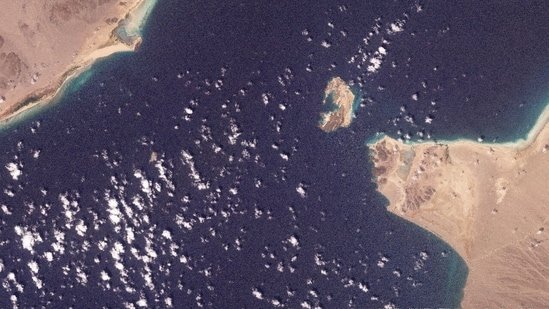

Even as US President Donald Trump struggles to have the Strait of Hormuz opened and relieved from the wrath of Iran’s retaliatory fire, another key waterway — Bab al-Mandab or Bab el-Mandeb — known as ‘Gate of Tears’ over its treacherous sailing conditions has emerged as a key talking point in the war which has breached the one-month mark.

US-Israeli strikes on Iran on February 28 triggered a drone-missile exchange that virtually closed off the Strait of Hormuz, a key waterway through which a fifth of world’s oil and gas requirements travel from the energy-rich Gulf to other countries, with Iran threatening to target any vessel that attempts to pass through it.

Why does Iran get to choose who passes through the Strait of Hormuz? Iran’s geographical advantage makes it sort of a de facto in charge of the fate of the waterway, with smaller oil-rich Gulf countries like Bahrain, Qatar, United Arab Emirates (UAE) and Oman on one side of it and Iran on the other. Track latest in Iran war here
Iran controls the entire northern coastline of the 21-mile-wide Strait, giving it direct access and proximity to the vital shipping lanes, giving the Iranians the position to dare other countries from having their tankers cross. The geographical advantage allows Iran to exercise direct monitoring and carry out targeted attacks through drones and missiles on vessels in the Strait.
With Hormuz remaining tense, an Iran-backed Yemeni fighter group known as Houthis has threatened to disrupt shipping through the Bab al-Mandab strait, through which 12 per cent of global trade happens. The Houthis, part of the ‘Axis of Resistance’ that supports Iran, recently joined the ongoing war by launching strikes on Israel.
Why this Strait – ‘Gate of tears’ – might actually be a teary affair
The Bab al-Mandab strait is part of the Red Sea with Yemen situated on one side of it. The Houthis are part of the Axis of Resistance — an informal name given to Iran and allies combined — which has a common objective of resisting anti-Western and anti-Israel actors in the Middle East. The Axis mainly comprises Hezbollah in Lebanon, Hamas/PIJ in Palestine, Houthi forces in Yemen, and various Iraqi militias.
Since the Israeli war on Gaza began, Houthis have been intermittently targeting commercial ships in the Red Sea since and Gulf of Aden in late 2023 using missiles, drones, and explosive boats, saying they were targeting ships linked to Israel during the Gaza war.
Some analysts have warned that the Bab el-Mandab strait could emerge as a new flashpoint in the US-Iran war after Houthis’ March 28 warning missile launch towards Israel for the first time since the war with Iran began.
Yemen is situated on one side of the strait, and the Houthis have previously attacked shipping in the Red Sea, causing major disruption in late 2023 and 2024.
Bloomberg has reported that Iran has approached the Houthis to prepare for a similar campaign.
The new key risk
While there is no specific Houthi blockade as of now, a chokehold of the second major chokepoint could have a significant impact on the world economy. “The Houthi’s ability to disrupt shipping through the Bab al-Mandab strait, which accounts for roughly 12 percent of global trade, is the new key risk,” The Conversation quoted as saying analyst Chris Weston at the Australian financial services firm Pepperstone.
The Bab el-Mandab Strait is about 30 kilometres wide at its narrowest point and lies between Yemen on the Arabian Peninsula to the northeast and Eritrea and Djibouti in Africa on the west.
The Strait, whose name literally translates to “Gate of Tears” due to its treacherous sailing conditions, has become crucial due to the permit for ships to directly transit between the Mediterranean Sea and the Indian Ocean by passing through the Red Sea and the Gulf of Aden.
For example, an oil tanker leaving Saudi Arabia to go to the Netherlands only has to travel 12,000 kilometres if it sails via the Red Sea, compared with over 20,000 kilometres going south around Africa.
Before the opening of Egypt’s Suez Canal in the 19th century, ships were required to sail all the way around the southern tip of Africa to join these two points, according to The Conversation report.
The Bab el-Mandab strait accounts for as much as 14 per cent of global maritime trade under normal circumstances even though the supplies that pass through it are limited, fossil fuels being a major component.
The International Energy Agency (IEA) estimates that in 2025 about 4.2 million barrels of crude oil and petroleum liquids crossed the Bab al-Mandab Strait per day. That’s amounts to about five per cent of global production.
Can the strait be closed?
Unlike the Strait of Hormuz from where there’s just one way out, Bab el-Mandab can’t be “closed” entirely. Ships can still exit to the Mediterranean via the Suez Canal even if there’s disruption on one end.
However, oil bound for Asia from this new exit point still has to pass through Bab el-Mandab to avoid the longer way around and face higher commute costs.
Despite Houthis’ intermittent Red Sea attacks, the Strait was never totally “closed” with some ships continuing to pass through throughout the crisis.
While the same might happen this time also, for shipping companies, just the looming threat of attacks may be enough to take precautionary measures and restrict shipping.
Insurance costs could also repel shipping companies from choosing the route. Back in 2024, insurance costs were about 0.6 per cent of the value of the cargo on a ship. After the Red Sea crisis, this rose as high as two per cent, per the report.
Even if not alone, but the effective disruption in Bab el-Mandab along with an already-shut Strait of Hormuz could severely disrupt the already volatile global supply chains further.