


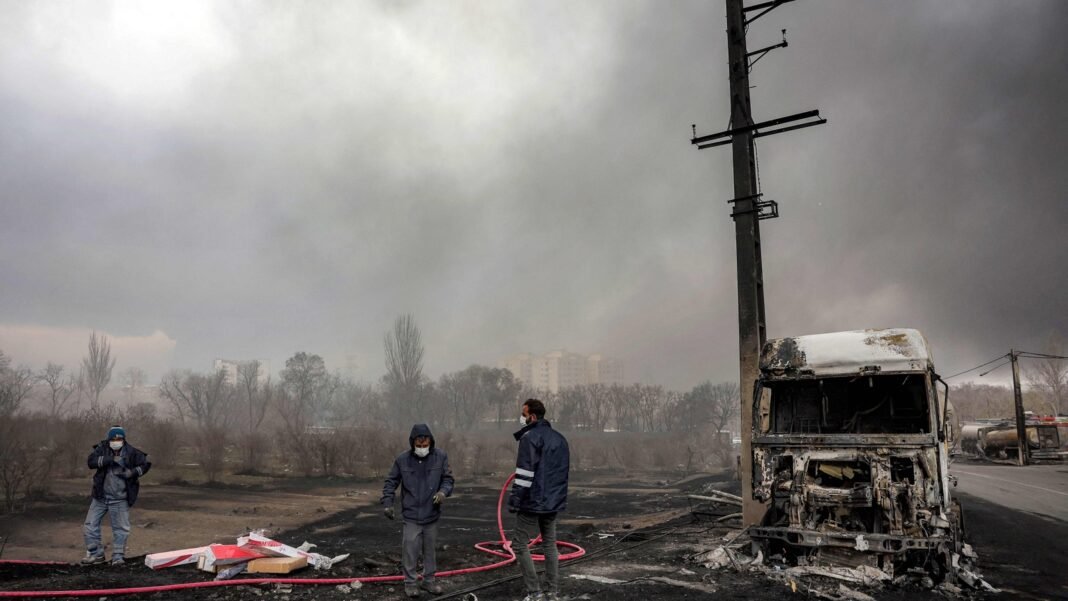

Global markets remain focused on crude oil prices even as the infrastructure necessary to keep millions of people alive now sits directly in the line of fire in the US and Israel’s conflict with Iran that has spread to wider West Asia/Middle East over the past week.
Missiles and drones currently curtail crude production across the Persian Gulf, but analysts warn that water, not just oil, represents the resource most at risk in the arid but energy-rich region.

A week of strikes on vital infrastructure
Within a couple of days of the start of the conflict with Israeli and American airstrikes on Tehran on February 28, the fighting quickly moved toward critical life support systems.
Iranian strikes on Dubai’s Jebel Ali port on March 2 landed about 15 km from one of the largest desalination plants in the world. This facility produces the vast majority of the drinking water for the city’s residents. Iran has said it does not intend to target any places in the UAE or Oman, Bahrain and other neighbours other than the US military bases.
But the Fujairah F1 power and water complex in the UAE suffered damage as missiles and drones were intercepted, and the falling debris caused damage.
Kuwait’s desalination plant also reported impacts, news agency AP said. These incidents appeared to follow attacks on nearby bases or ports.
On Sunday, Bahrain accused Iran of indiscriminately attacking civilian targets, and said one of its desalination plants was damaged.
This means the human cost is mounting. The UAE defence ministry has announced that the death toll from Iranian strikes has risen to four. In Kuwait, the interior ministry confirmed that two officers died during the performance of their duties.
In an attempt to cool regional tempers, Iran’s President Masoud Pezeshkian offered an apology to neighbouring states for attacks on US bases within their borders. When Donald Trump said the apology meant an admission of defeat, Iran reiterated that it would still attack areas that have US bases.
Accusations and counters: ‘A new precedent’
The targeting of water facilities involves multiple claims and counter-claims, much like the rest of this conflict that’s seen use of unmanned military hardware at times being guided by AI. In this modern context, an age-old practice of cutting supplies has come into play.
Iran claims a US airstrike damaged a desalination plant on Qeshm Island in the strategic Strait of Hormuz. Iranian foreign minister Abbas Araghchi stated that the strike cut the water supply for 30 villages. He warned that the US set “a dangerous new precedent”.
But Ali Al Nuaimi, chairman of the UAE’s National Defence Committee, said his country would not strike civilian targets if it entered the war. “The UAE recognises the Iranian people as victims of their own regime,” he also said.
Analysts say the strategic importance of these water facilities cannot be overstated.
Michael Christopher Low, director of the Middle East Centre at the University of Utah, described the Gulf states as “saltwater kingdoms”.
“Everyone thinks of Saudi Arabia and their neighbours as petrostates. But I call them saltwater kingdoms. They’re manmade fossil-fueled water superpowers,” Low told the Associated Press.
“It’s both a monumental achievement of the 20th century and a certain kind of vulnerability,” he noted.
Dependency on these systems is nearly total for several nations, reports the regional news outlet Iran International. Desalination provides approximately 90% of all drinking water in Kuwait; this figure stands at 86% in Oman and roughly 70% in Saudi Arabia.
Water at the heart of power
Many of the desalination plants are physically integrated with power stations. Attacks on electrical infrastructure can therefore simultaneously halt water production.
David Michel, a senior fellow at the Centre for Strategic and International Studies, described this as an “asymmetrical tactic”. “Iran may lack the capacity to strike the US or Israel with equal force. Instead, it imposes massive costs on Gulf countries to pressure them into calling for a cessation of hostilities,” he said.
More than 90 per cent of the Gulf’s desalinated water comes from just 56 plants, according to a CIA report of 2010, which said each of these plants is extremely vulnerable to military action or sabotage. A leaked 2008 US diplomatic cable highlighted the fragility of the Saudi capital Riyadh in particular. It warned that Riyadh would require evacuation within a single week if the Jubail desalination plant or its associated pipelines suffered serious damage.
Saudi Arabia and the UAE have since invested in pipeline networks and storage reservoirs to cushion short-term disruptions. Smaller states like Bahrain, Qatar, and Kuwait possess far fewer backup supplies, AP reported on Sunday.
How water plants work, why they are vulnerable
Most plants use reverse-osmosis (RO) systems to remove salt from seawater. This involves pushing water through ultra-fine membranes to produce the freshwater necessary for cities, industry, and hotels.
The infrastructure is not foolproof in the first place, as it faces long-term threats beyond military strikes. Climate change increases the likelihood of intense cyclones and storms in the Arabian Sea, which could overwhelm drainage systems and damage water plants on the coast. Furthermore, the desalination process itself is energy-intensive.
It produces significant carbon emissions and releases highly concentrated brine back into the ocean, which harms marine habitats, AP reported citing experts.
Iran remains extra vulnerable as, after five years of extreme drought, water levels in Tehran’s reservoirs have plunged to 10% of their capacity, the news agency said. Unlike its neighbours, Iran still relies heavily on rivers and underground aquifers; it operates only a small number of desalination plants. Efforts to expand this infrastructure are hampered by US-led international sanctions too.
What history, law say
The targeting of water facilities challenges a global convention too. International humanitarian law, including the Geneva Conventions, prohibits the targeting of civilian infrastructure indispensable for survival. This includes drinking water facilities.
During the 1990-1991 Gulf War, retreating Iraqi forces sabotaged Kuwaiti desalination facilities. They also released millions of barrels of oil into the sea. This massive slick threatened water intakes across the entire region. Kuwait was left largely without fresh water and required years to recover.