




By Sanjay Raman Sinha
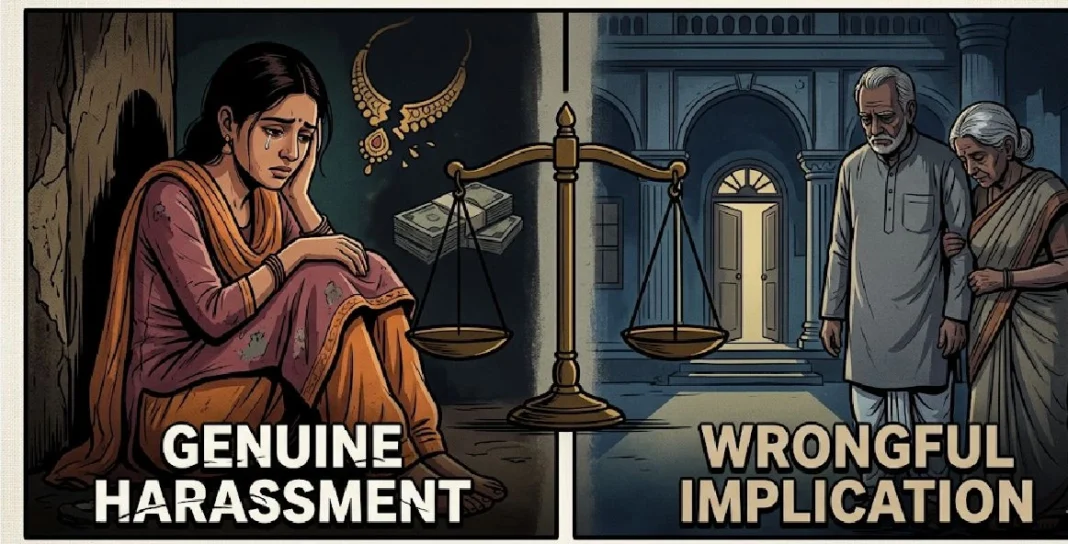
In a significant ruling, a single-judge bench of the Madhya Pradesh High Court quashed an FIR filed against the parents of a man accused of dowry harassment by his wife, underscoring the judiciary’s growing concern over the indiscriminate implication of family members in matrimonial disputes.
Justice Vinay Saraf, in Lokendra Singh Rathore vs The State of Madhya Pradesh (2026), held that relatives of an accused cannot be prosecuted based on vague, omnibus allegations lacking substantive evidence. The petition had been filed by the husband’s parents, seeking relief from criminal proceedings initiated under the Bharatiya Nyaya Sanhita (BNS), 2023, and the Dowry Prohibition Act, 1961.
The Court observed that matrimonial disputes between spouses should not be converted into instruments of coercion by implicating extended family members. It emphasized that such practices subject innocent individuals to undue mental distress and the rigours of criminal trial. Even in cases that eventually end in acquittal, the Court noted, the process itself leaves lasting scars and social stigma.
The judgment adds to a growing body of judicial concern over the “weaponization” of anti-dowry laws. Originally designed as a shield to protect women from cruelty and coercion, these provisions are increasingly alleged to be used as leverage in marital conflicts.
Data from the National Crime Records Bureau reflects this troubling trend. In 2020 alone, over 1,11,000 cases were registered under Section 498A of the Indian Penal Code (now Section 85 of the BNS), but a significant number were either found to be false or closed due to insufficient evidence. Conviction rates remain strikingly low—often hovering between 10 percent and 15 percent—raising questions about the quality of complaints and investigations.
A Delhi district court study (2021-25) examining nearly 10,000 cases revealed that convictions were secured in only 0.2 percent of trials, with almost half the cases quashed before reaching trial. Similarly, findings from Hyderabad’s family court suggest that only a fraction of dowry harassment complaints are genuine, with many driven by familial pressure or used as bargaining tools in settlements.
Legally, Section 498A—and its successor under the BNS—targets two specific forms of cruelty: grave conduct likely to drive a woman to suicide or cause severe harm, and harassment aimed at coercing dowry demands. Courts have repeatedly clarified that ordinary marital discord does not fall within its ambit.
The Supreme Court, in Arnesh Kumar vs State of Bihar (2014), had earlier cautioned against automatic arrests under this provision, terming its misuse as “legal terrorism”. It mandated procedural safeguards, including justification for arrests and judicial oversight.
Recent legislative changes under the Bharatiya Nagarik Suraksha Sanhita (BNSS) now require a preliminary inquiry for offences carrying three to seven years of punishment, including Section 85 of the BNS. Meanwhile, the Bharatiya Sakshya Adhiniyam (BSA) emphasizes digital evidence—such as messages and emails—bringing greater scrutiny to claims made in matrimonial disputes.
Despite these safeguards, the law continues to give a first-mover advantage to the complainant. The accused often faces immediate legal and social consequences, including arrest and prolonged trial, even when allegations fail to hold up in court.
As domestic disputes increasingly take on a criminal dimension, courtrooms risk becoming arenas for strategic litigation rather than justice. Legal experts argue that reforms—such as penalizing false complaints, making the offence compoundable or bailable, and introducing gender neutrality—could help restore balance.
While the law remains a crucial protection for genuine victims of dowry harassment and domestic violence, courts are increasingly signalling the need to prevent its misuse and ensure that justice does not come at the cost of fairness.