



The Code on Social Security, 2020 (SS Code) is one of the most significant reforms in India’s labour law framework. By consolidating nine central Acts into one unified Code, it aims to modernise and extend social protection across India’s diverse workforce—formal, informal, gig, platform, and unorganised.
At the heart of understanding which benefits apply to whom lies the combined reading of:

-
Section 1(4) – the master applicability clause
-
The First Schedule – the detailed applicability table for each Chapter
Together, they form the Applicability Framework of the SS Code.
This article presents a complete, expert-level analysis of both Section 1(4) and the First Schedule, with legal interpretation, comparison to earlier Acts, and practical examples.
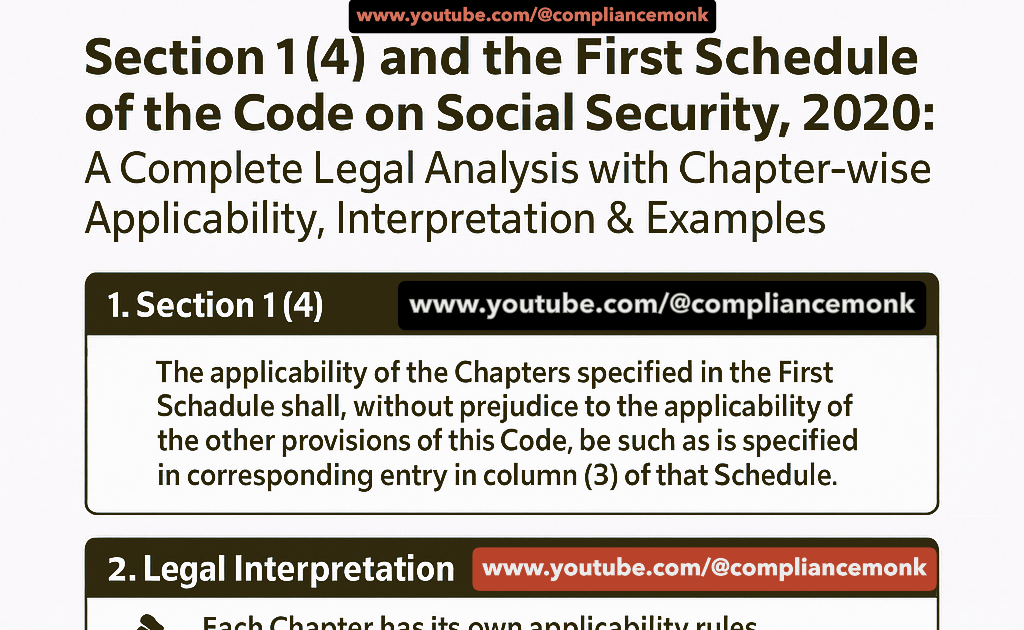
1.1 Statutory Meaning
Section 1(4) states that the applicability of each Chapter of the SS Code shall be exactly as specified in Column (3) of the First Schedule.
It also clarifies that this is:
“Without prejudice to the applicability of the other provisions of the Code.”
Meaning:
Even if a specific Chapter does not apply to an establishment (e.g., PF or ESI), other general provisions of the Code (e.g., registration, authorities, penalties, definitions) may still apply.
1.2 Legal Interpretation
(i) Each Chapter has its own Applicability Rules
The SS Code is not applied as an “all or nothing” law.
Instead, every Chapter—PF, ESI, Gratuity, Maternity Benefit, etc.—has custom applicability conditions, found only in the First Schedule.
This avoids overlap, conflicts, and confusion.
(ii) “Without Prejudice” – Legal Significance
The phrase ensures that the non-applicability of a particular Chapter does not provide blanket exemption from the entire Code.
Example:
If ESI (Chapter IV) does not apply due to employee count <10:
-
Employees’ Compensation (Chapter VII) may apply.
-
General provisions (definitions, authorities, offenses) still apply.
(iii) Harmonisation Across Nine Earlier Acts
Before the Code, each law had separate applicability rules.
Section 1(4) harmonises them by pointing to one consolidated Schedule.
This creates a unified, conflict-free compliance structure.
The First Schedule provides the complete applicability conditions for each major Chapter of the Code.
Below is an in-depth Chapter-wise analysis, comparisons with original Acts, and examples.
Earlier Act: Employees’ Provident Funds and Miscellaneous Provisions Act, 1952
Applicability
Comparison with EPF Act, 1952
✔ Same threshold retained
✔ Earlier “specified industries list” (Schedule I) abolished → PF now universal
✔ Voluntary coverage continues under Section 1(5)
Legal Insight
The Code universalises PF applicability, shifting from industry-based coverage to employee-number-based coverage.
Example
A logistics company with 22 employees → PF applies.
A CA firm with 12 employees → PF not mandatory (unless voluntary).
Earlier Act: Employees’ State Insurance Act, 1948
Applicability
Special Conditions:
-
Hazardous Occupations: ESI applies even if 1 employee works in a hazardous occupation (notified by Central Government).
-
Plantations: May voluntarily opt-in.
-
Contribution Start Date: ESI becomes payable only from the date ESIC commences benefits, as notified.
Comparison with ESI Act, 1948
✔ Core threshold of 10 retained
✔ Major changes:
-
ESI now pan-India (no separate notified area)
-
Hazardous occupation coverage expanded
-
Plantation voluntary entry is new
Legal Insight
ESI’s jurisdiction is widened dramatically, strengthening occupational safety and health protections nationwide.
Example
Fireworks factory with 3 workers → ESI applies (hazardous).
IT company with 12 employees → ESI applies.
Earlier Act: Payment of Gratuity Act, 1972
Applicability
-
All factories, mines, oilfields, plantations, ports, and railways
-
Every shop/establishment with 10+ employees anytime in last 12 months
-
Any establishment notified by Government
Comparison with Gratuity Act 1972
✔ Threshold of 10 employees retained
✔ Coverage extended via notifications
✔ Legal recognition of fixed-term employee gratuity introduced in the Code
Legal Insight
The SS Code preserves gratuity obligations while widening scope and simplifying compliance.
Example
A shop had 10 employees for 5 days last year → Gratuity applies permanently.
Earlier Act: Maternity Benefit Act, 1961
Applicability
-
All factories, mines, and plantations
-
Shops/establishments with 10+ employees anytime in last 12 months
-
Government-notified establishments
Comparison with MB Act 1961
✔ Same threshold retained
✔ New modern definitions: commissioning mother, adoptive mother
✔ Digital service delivery introduced
Legal Insight
The Code codifies the progressive benefits introduced in 2017 amendments and strengthens gender protections.
Example
A retail store with 11 employees → Maternity Benefit Chapter applies.
Earlier Act: Employees’ Compensation Act, 1923
Applicability
-
Applies to employees not covered by ESI,
-
Subject to Second Schedule (hazardous occupations list)
Earlier Act Comparison
✔ Same structure maintained
✔ Clear division created: Either ESI applies OR Employees’ Compensation applies—not both
Legal Insight
Prevents dual liability and streamlines employer responsibility.
Example
A workshop with 6 employees (no ESI) → Employees’ Compensation applies.
Earlier Act: Building and Other Construction Workers Act, 1996
Earlier Cess Act: BOCW Cess Act, 1996
Applicability
Comparison with BOCW Act 1996
✔ Core framework retained
✔ Simplification through unified registration
✔ Flexibility in cess collection authority introduced
Example
Any real estate developer → Covered under BOCW welfare and cess obligations.
Earlier Acts:
-
Unorganised Workers Social Security Act, 2008
-
First-time legal recognition for gig and platform workers
Applicability
-
Unorganised sector
-
Unorganised workers
-
Gig workers
-
Platform workers
Comparison
✔ 2008 framework strengthened
✔ Historic first-ever statutory recognition for gig/platform workers
✔ Aggregator contribution model created
Legal Insight
The Code transforms the future of work social security landscape.
Example
Ola, Uber, Zomato, Swiggy delivery partners → Covered under Chapter IX schemes.
Earlier Act: Employment Exchanges (Compulsory Notification of Vacancies) Act, 1959
Applicability
-
Career centres
-
Employers
-
Job seekers
-
Vacancies
Comparison
✔ Act modernised into digital “career centre” framework
✔ Greater transparency introduced
Example
An employer notifying vacancies to a career centre is covered under this Chapter.
| Component | Role |
|---|---|
| Section 1(4) | Directs all applicability decisions to First Schedule |
| First Schedule | Provides Chapter-wise applicability rules |
This ensures:
✔ Uniform interpretation
✔ Zero conflict between Chapters
✔ Simple compliance roadmap
✔ Modernised social security governance
Case: Engineering Firm
-
Employees: 25
-
Non-hazardous
-
Not a factory
Applicability:
| Chapter | Applies? | Reason |
|---|---|---|
| PF (III) | ✔ | 20+ employees |
| ESI (IV) | ✔ | 10+ employees |
| Gratuity (V) | ✔ | 10+ employees |
| Maternity (VI) | ✔ | 10+ employees |
| Employees’ Compensation (VII) | ❌ | ESI applies |
| BOCW (VIII) | ❌ | Not construction |
| Unorganised Workers (IX) | ❌ | Formal establishment |
| Employment Information (XIII) | ✔ | Vacancy reporting |
This example shows how Section 1(4) + First Schedule create a complete compliance matrix.
Section 1(4) of the Code on Social Security, 2020 acts as the foundational “gateway” directing all applicability decisions to the First Schedule.
The First Schedule in turn provides clear, chapter-specific thresholds for PF, ESI, Gratuity, Maternity Benefits, Employees’ Compensation, BOCW Welfare, and Unorganised Worker Welfare.
The combined effect:
✔ Harmonises nine major laws
✔ Removes inconsistencies
✔ Enhances compliance predictability
✔ Expands and modernises social security coverage
✔ Supports India’s diverse workforce—formal, informal, gig, platform, and unorganised
This chapter-wise applicability framework is essential reading for HR professionals, compliance officers, labour law practitioners, and policy makers.