


By Sanjay Raman Sinha
In an extraordinary intervention, the Supreme Court has imposed an interim ban on the controversial National Council of Educational Research and Training (NCERT) Class 8 Social Science textbook: Exploring Society: India and Beyond (Vol II). The Court took suo motu cognisance after a section titled, Corruption in the Judiciary, triggered alarm within the country’s highest judicial institution.
A bench, comprising Chief Justice of India Surya Kant and Justices Joymalya Bagchi and Vipul M Pancholi, delivered unusually blunt remarks during the proceedings, calling the inclusion of the section a “deep-rooted, well-orchestrated conspiracy” and a “calculated move” to undermine the judiciary. The chief justice was particularly emphatic. “They have fired a gunshot. The judiciary is bleeding… I will not allow anyone on earth to defame the judiciary,” he said during the hearing.
BLANKET BAN ORDERED
The Court’s interim order was sweeping. It directed a complete halt to the distribution of the textbook, imposing what it termed a “blanket ban” on further publication, reprinting, or digital circulation. Authorities were instructed to seize all physical copies currently in circulation, while digital versions were ordered to be removed from online platforms.
The Court also issued show cause notices to the NCERT Director and Secretary of the Department of School Education, asking them to explain why contempt proceedings should not be initiated against those responsible for the chapter’s inclusion.
At the heart of the controversy is the judiciary’s view that the textbook presented a blinkered narrative, one that downplayed the institution’s role in promoting justice, democracy and social equity.
The bench expressed concern that such content could influence young and impressionable students, encouraging a biased perception of judicial institutions and undermining public confidence in them.
HOW NCERT TEXTBOOKS ARE PRODUCED
Textbooks produced by NCERT follow a structured and multi-layered process. Although the organization functions as an autonomous academic body under the Ministry of Education, it operates within the broader policy framework set by the government. Typically, the process begins with alignment to the National Curriculum Framework and the National Education Policy.
Subject experts are then tasked with drafting chapters, which undergo several rounds of internal and external peer review before final publication.
In the present case, reports suggest that while the chapter was drafted by an expert committee, it may not have received adequate scrutiny from legal professionals, a lapse that may have contributed to the controversy.
A HISTORY OF TEXTBOOK CONTROVERSIES
The NCERT has faced similar controversies in the past. Over the past decade, revisions of school textbooks have triggered intense debate among educators, historians and political commentators.
Critics have argued that certain historical narratives have been rewritten or selectively edited. Topics such as the Delhi Sultanate, the Mughal Empire, and the origins of certain historical terms have reportedly been altered or removed.
References to communal violence, including the Gujarat riots, as well as discussions on extremist movements, have also been toned down in some editions.
Sections addressing caste discrimination, stereotypes and sensitive political developments have likewise been trimmed or removed.
Critics argue that such revisions risk creating a sanitised or ideologically filtered version of history, shaping how young students interpret the past and understand contemporary politics.
At the heart of the debate lies a deeper concern: when curricula are rewritten through the lens of prevailing political or ideological narratives, education itself risks becoming a tool of influence rather than inquiry.
APOLOGY AND WIDER DEBATE
The NCERT has since issued an unconditional apology and promised to revise the controversial chapter after consulting subject experts.
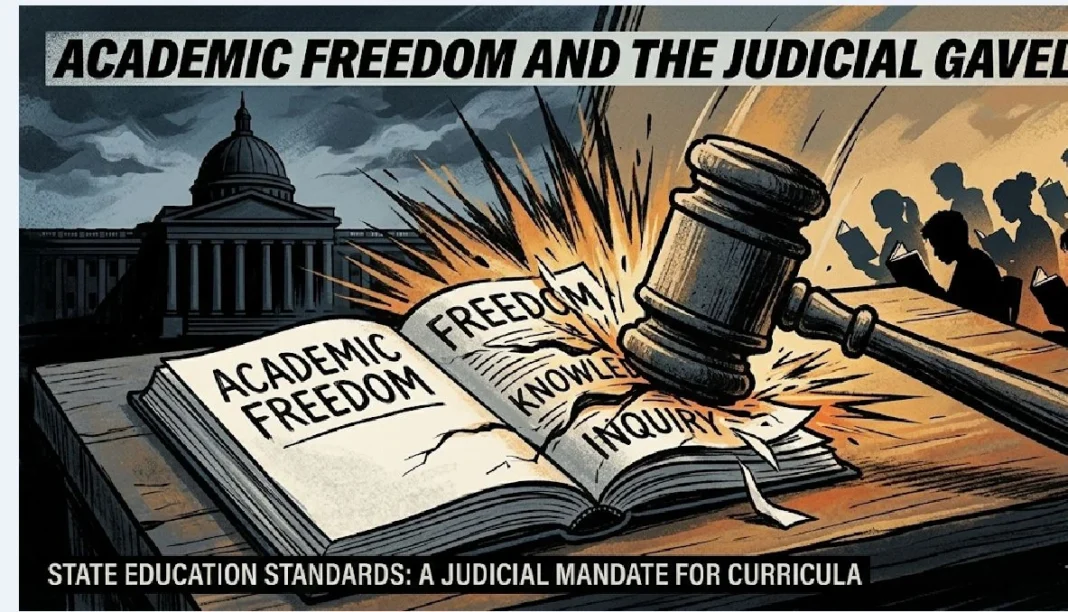
While the Court’s decision to safeguard the judiciary’s reputation is widely seen as understandable, the episode has also sparked questions about the limits of judicial intervention in academic discourse.
Some scholars argue that protecting institutional credibility should not come at the cost of academic autonomy.
In that sense, the chief justice’s metaphorical “gunshot” may serve as a warning not only to textbook authors, but also to institutions across the board.
For critics and supporters alike, the episode underscores the need for rigorous scholarship, balanced narratives and careful oversight—both in educational publishing and in public institutions themselves.
It is a reminder that while institutions must defend their integrity, they must also remain open to scrutiny in a democratic society.