


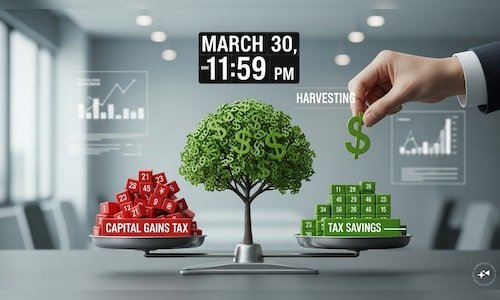

One strategy gaining attention is tax harvesting. This is a smart way to reduce capital gains tax liability.

What is tax harvesting?
Tax harvesting, also called tax-loss harvesting, is a simple way to reduce the tax you pay on your investments. You sell investments that are currently in loss so that this loss can cancel out the profits you made from other investments.
For example, you earned a profit from some shares or mutual funds this year. Normally, you would have to pay tax on that profit. But if you also have some investments that are in loss, you can sell them before March 31 and set them against the loss. This loss is then adjusted against your profit, so your total taxable gain becomes lower.
How does tax harvesting work?
Capital gains are of two types: Short-term capital gains (1 year or less) and long-term capital gains (more than 1 year). Both are taxed differently.
If you sell shares within 1 year, the profit is taxed at 15%, and if you sell after 1 year, gains up to ₹1 lakh are tax-free, and anything above that is taxed at 10%.
Tax harvesting helps investors use this system smartly. So, if someone has long-term gains within the ₹1 lakh limit, they can sell their investments and buy them again immediately. Since the gains are within the tax-free limit, no tax is paid, but the purchase price resets at a higher level. This can help reduce tax in the future.
However, there is a key rule that the transaction must be properly sold from your demat account. If you buy and sell on the same day in the same account, it is treated as an intraday trade, where no actual delivery happens. Such trades are not considered valid for tax harvesting and won’t give you tax benefits.
At the same time, if your losses are more than your gains then investors can carry forward these for up to eight years and used later to save tax. However, this is allowed only if the income tax return is filed on time.
According to Mumbai-based CA and CFP Balwant Jain, “Tax harvesting for claiming initial ₹1.25 lakh of tax-free LTCGs can be done by March 31. If you book higher LTCGs, you will have to pay tax at a flat rate of 12.5% on the remaining amount.”
“Even if you book higher capital loss, the unabsorbed loss can be carried forward for set-off against capital gains in subsequent years,” he said.