


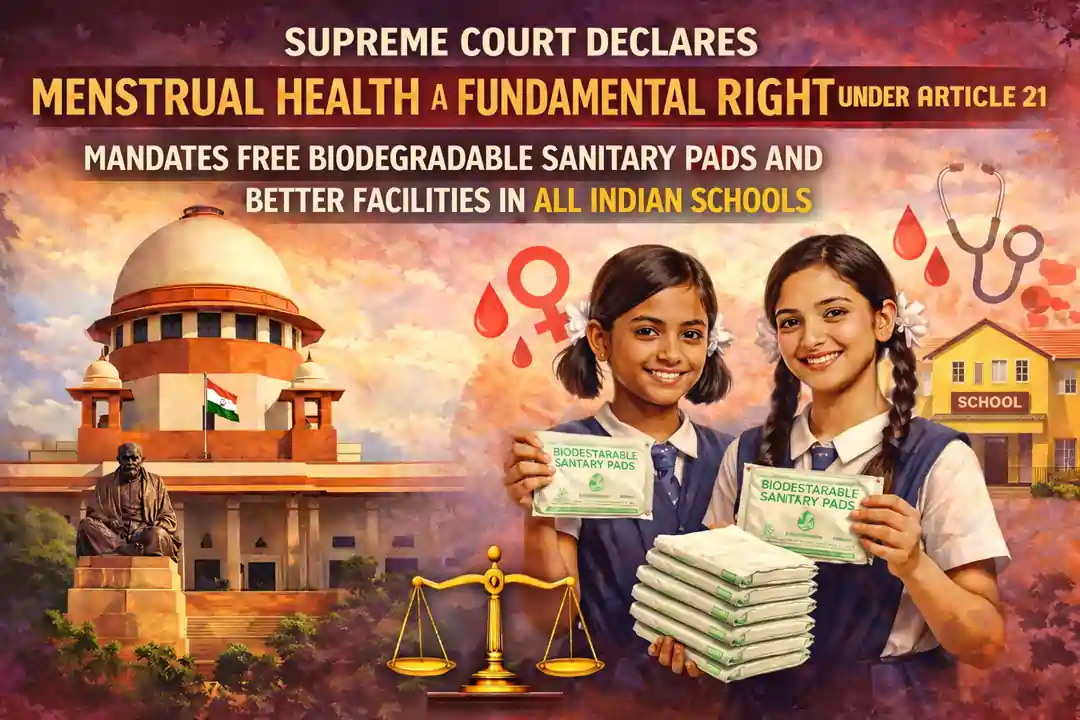

Supreme Court and the Right to Menstrual Hygiene under Article 21
(With reference to Dr. Jaya Thakur v. Government of India)

The scope of Article 21 of the Constitution of India, which guarantees the right to life and personal liberty, has continuously evolved through judicial interpretation. The Supreme Court of India has consistently expanded this provision to include the right to live with dignity, health, privacy, and bodily autonomy.
Within this progressive constitutional framework, the issue of menstrual hygiene has emerged as a matter of fundamental rights, particularly concerning women, adolescent girls, and menstruating persons. The case of Dr. Jaya Thakur v. Government of India plays a significant role in recognizing menstrual hygiene as an inseparable component of human dignity and health under Article 21.
1. Constitutional Basis: Article 21 and Human Dignity
Article 21 has long been interpreted to mean more than mere physical existence. The Supreme Court has held that:
The right to life includes the right to live with dignity and all that goes along with it.
This interpretation brings within its ambit:
Menstrual hygiene, being directly connected to physical health and social dignity, naturally falls within this constitutional protection.
2. Dr. Jaya Thakur v. Government of India: Case Background
In Dr. Jaya Thakur v. Government of India, a public interest petition was filed highlighting the lack of access to menstrual hygiene facilities and sanitary products, particularly among:
The petitioner emphasized that inadequate menstrual hygiene infrastructure violates:
-
The right to health
-
The right to dignity
-
The right to education
all of which flow from Article 21.
3. Supreme Court’s Observations in the Case
While the Court did not frame a new standalone fundamental right titled “Right to Menstrual Hygiene,” it made constitutionally significant observations, recognizing that:
-
Menstruation is a natural biological process, not a matter of shame
-
Lack of access to hygienic menstrual products and facilities leads to serious health risks
-
Denial of such facilities affects dignity, privacy, and equality
-
The issue cannot be treated merely as a policy concern but has constitutional implications
The Court acknowledged that menstrual hygiene is intrinsically linked to the right to life under Article 21.
4. Menstrual Hygiene as Part of the Right to Health
In Dr. Jaya Thakur, the Court noted that poor menstrual hygiene can result in:
Since the Supreme Court has consistently held that the right to health is an integral part of Article 21, denial of menstrual hygiene products and facilities amounts to a violation of fundamental rights.
5. Right to Dignity and Privacy
The Court recognized that menstruating individuals often face:
Managing menstruation without access to clean toilets, sanitary products, or disposal facilities forces women and girls to live in undignified and unsafe conditions. Such deprivation was acknowledged as incompatible with the constitutional promise of dignity under Article 21.
6. State Obligations Highlighted by the Court
The judgment reinforced that once an issue falls within Article 21, the State has positive obligations, including:
-
Ensuring availability of affordable or free sanitary napkins
-
Providing clean and private sanitation facilities
-
Creating awareness to eliminate menstrual stigma
-
Supporting menstrual hygiene management in schools and public institutions
The Court stressed that fundamental rights require effective implementation, not symbolic recognition.
7. Broader Constitutional Significance
The recognition of menstrual hygiene in Dr. Jaya Thakur v. Government of India is significant because it:
-
Elevates menstrual health from a welfare issue to a rights-based issue
-
Reinforces gender-sensitive constitutional interpretation
-
Connects public health policy with constitutional accountability
-
Strengthens the discourse on substantive equality for women
8. Limitations of the Judgment
It is important to note that:
-
The Court relied on existing constitutional principles, rather than creating a new explicit right
-
Implementation largely depends on executive action and policy frameworks
-
Ground realities still reflect gaps in access and awareness
Nevertheless, judicial recognition provides a strong constitutional foundation for future reforms.
9. Conclusion
The case of Dr. Jaya Thakur v. Government of India marks an important step in constitutional jurisprudence by affirming that menstrual hygiene is integral to the right to life, health, dignity, and privacy under Article 21.
The Supreme Court’s approach reflects a sensitive understanding of lived realities faced by women and menstruating persons. By constitutionalizing menstrual hygiene concerns, the Court has sent a clear message that biological realities cannot be ignored in the pursuit of equality and dignity.
True realization of this right, however, requires sustained policy action, social awareness, and administrative commitment to ensure that no individual is denied dignity merely because of a natural biological process.