

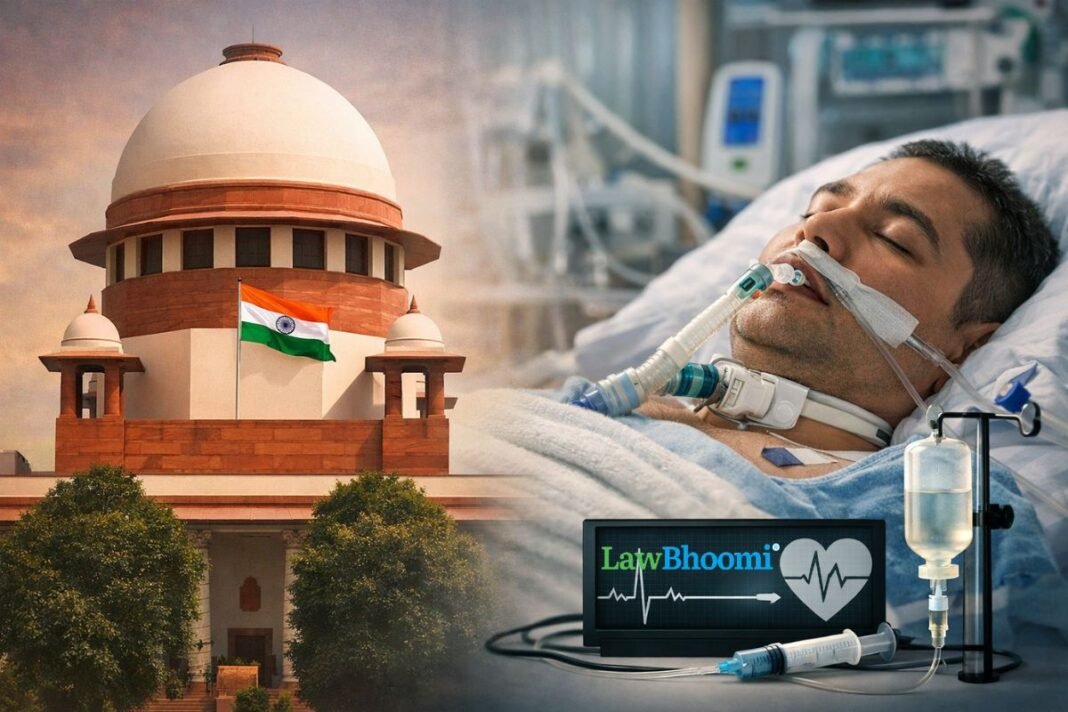
In a significant decision recognising the right to die with dignity, the Supreme Court of India in Harish Rana v. Union of India has allowed passive euthanasia in a case involving a man who had been in a permanent vegetative state for more than thirteen years. The Court permitted the withdrawal of life-sustaining medical treatment after medical experts confirmed that there was no possibility of recovery.
The decision was delivered by a bench comprising Justice JB Pardiwala and Justice KV Viswanathan. The case is considered the first instance where the Supreme Court has applied the guidelines laid down in its landmark 2018 judgment on passive euthanasia.
Background of Harish Rana v. Union of India Case
The case concerned Harish Rana, a 32-year-old man who suffered a severe brain injury after falling from the fourth floor of a building at his paying guest accommodation many years ago. The accident left him in a Persistent Vegetative State (PVS), a condition in which a patient loses awareness of surroundings but continues basic biological functions.
Medical records showed that Rana had remained completely paralysed with 100% quadriplegia and had not shown any signs of recovery for over thirteen years. He survived only through Clinically Administered Nutrition (CAN), which was delivered through surgically inserted feeding tubes.
According to the Court, medical reports consistently showed that his condition had not improved and that continuing treatment only prolonged biological existence without offering any possibility of recovery.
Petition Filed by the Father
Harish Rana’s father approached the Court seeking permission to withdraw life-sustaining treatment for his son. He argued that his son had been suffering in a permanent vegetative state for more than a decade and that continued medical support served no therapeutic purpose.
The father emphasised that the prolonged treatment had not improved Rana’s medical condition and that keeping him alive in such circumstances only extended suffering and loss of dignity.
The Court took note of the emotional and difficult circumstances faced by the family, observing that the parents had continuously cared for their son throughout the thirteen years following the accident.
Medical Evaluation by Expert Boards
In accordance with the legal procedure established by the Supreme Court, the patient’s condition was examined by two separate medical bodies:
- Primary Medical Board
- Secondary Medical Board
Both medical boards examined the patient and reviewed the medical records in detail.
The Primary Medical Board concluded that the patient’s chances of recovery were extremely remote. Medical observations indicated that Rana remained bedridden, required assistance for breathing through a tracheostomy tube, and received nutrition through a gastrostomy feeding tube.
Following this report, the Supreme Court directed that the case be reviewed by a Secondary Medical Board constituted at the All India Institute of Medical Sciences (AIIMS).
After conducting its own assessment, the Secondary Medical Board reached the same conclusion — that the patient had no meaningful prospects of recovery and that continued life support was not in his best interest.
Court’s Observations on Life-Sustaining Treatment
The Supreme Court in Harish Rana v. Union of India noted that the patient was being sustained through Clinically Administered Nutrition, which the Court recognised as a form of medical treatment.
The bench clarified that such treatment could be withdrawn if medical experts determine that continuation would serve no therapeutic purpose.
According to the Court, maintaining life support in the present case merely prolonged biological survival without offering any chance of improvement.
The Court therefore concluded that withdrawing the treatment would be consistent with the patient’s dignity and medical best practices.
Directions Issued by the Supreme Court in Harish Rana v. Union of India
After reviewing the medical reports and hearing the parties, the Court permitted the withdrawal of life support and issued several important directions.
Withdrawal of Treatment
The Court directed that all life-sustaining medical treatment, including clinically administered nutrition, should be withdrawn.
Normally, the procedure requires a reconsideration period of thirty days before treatment is withdrawn. However, considering the circumstances of the case, the Court waived this waiting period.
Palliative Care at AIIMS
The Court directed that the patient should be shifted to the palliative care centre at AIIMS so that the withdrawal of treatment could take place under proper medical supervision.
AIIMS was instructed to ensure that the transfer from the patient’s residence to the hospital takes place smoothly and with full medical support.
Ensuring Dignity
The Court emphasised that the withdrawal of life support must be carried out with dignity.
A carefully designed medical plan must be followed to ensure that the patient experiences minimal discomfort and that the process respects the patient’s dignity.
Guidelines for Hospitals and Courts
The Supreme Court in Harish Rana v. Union of India also issued broader directions to ensure that similar cases in the future follow a clear procedure.
Role of High Courts
The Court directed High Courts across the country to issue instructions to Judicial Magistrates. These magistrates must be prepared to receive formal intimation from hospitals whenever a decision is taken to withdraw life support based on the recommendation of medical boards.
This direction aims to ensure transparency and legal oversight in such sensitive decisions.
Panel of Doctors in Every District
The Court also directed the Union Government to ensure that Chief Medical Officers in every district maintain a panel of registered medical practitioners.
These doctors may be nominated to serve on Secondary Medical Boards whenever such cases arise.
The objective is to create a reliable medical review system so that decisions regarding withdrawal of life support are taken carefully and responsibly.
Recommendation for Comprehensive Law
While deciding the case, the Supreme Court observed that India currently relies mainly on judicial guidelines to regulate passive euthanasia.
The Court therefore recommended that the Union Government enact comprehensive legislation to address issues relating to end-of-life care and withdrawal of life support.
A dedicated law could provide clearer procedures and safeguards, reducing the need for courts to intervene in individual cases.
Appreciation for the Patient’s Family
The bench also recorded its appreciation for the parents of Harish Rana, recognising their long years of care and dedication.
Justice Pardiwala noted that the family never abandoned the patient and continued to care for him throughout the thirteen years after the accident.
The Court remarked that their actions reflected deep compassion and love for their son despite the extremely difficult circumstances.
Legal Background: Right to Die with Dignity
The present ruling is rooted in the Supreme Court’s landmark 2018 Constitution Bench judgment in the Common Cause case.
In that judgment, the Court recognised that the right to die with dignity forms part of the fundamental right to life under Article 21 of the Constitution.
The Court also allowed passive euthanasia under strict safeguards and laid down a procedure for withdrawing life support.
These guidelines were further simplified and modified by the Supreme Court in January 2023 to make the process more practical for hospitals and families.
Under the framework established in these judgments:
- Withdrawal of life support requires approval from two medical boards.
- The decision must be taken carefully after examining the patient’s condition.
- The process must respect the dignity of the patient.
The present case represents the first instance where these guidelines have been formally applied by the Supreme Court in an individual case.
Earlier Proceedings in the Case
The legal journey of the case began several years ago.
In 2024, the patient’s father first approached the Delhi High Court, seeking permission for passive euthanasia.
However, the High Court dismissed the petition in July 2024. The court observed that the patient was not terminally ill, which was one of the factors considered relevant at that stage.
The family later approached the Supreme Court.
In August 2024, the Supreme Court initially declined to entertain the plea but directed the State of Uttar Pradesh to bear the treatment expenses.
Later, in 2025, the petitioner filed a miscellaneous application highlighting that the patient’s condition had worsened and that recovery was impossible.
At that stage, the Supreme Court ordered the constitution of a Primary Medical Board to evaluate the patient’s medical condition.
After reviewing the board’s report and the subsequent opinion of the AIIMS Secondary Medical Board, the Court finally decided to allow withdrawal of life support.
Conclusion
The Supreme Court’s decision allowing passive euthanasia in the case of Harish Rana highlights the evolving understanding of the right to life and dignity under the Constitution.
By applying the guidelines laid down in earlier judgments and issuing additional directions to hospitals and authorities, the Court has attempted to create a clearer process for handling similar cases.
The ruling also underscores the need for a comprehensive legal framework to address complex ethical and medical questions surrounding end-of-life care in India.
Attention all law students and lawyers!
Are you tired of missing out on internship, job opportunities and law notes?
Well, fear no more! With 2+ lakhs students already on board, you don’t want to be left behind. Be a part of the biggest legal community around!
Join our WhatsApp Groups (Click Here) and Telegram Channel (Click Here) and get instant notifications.
