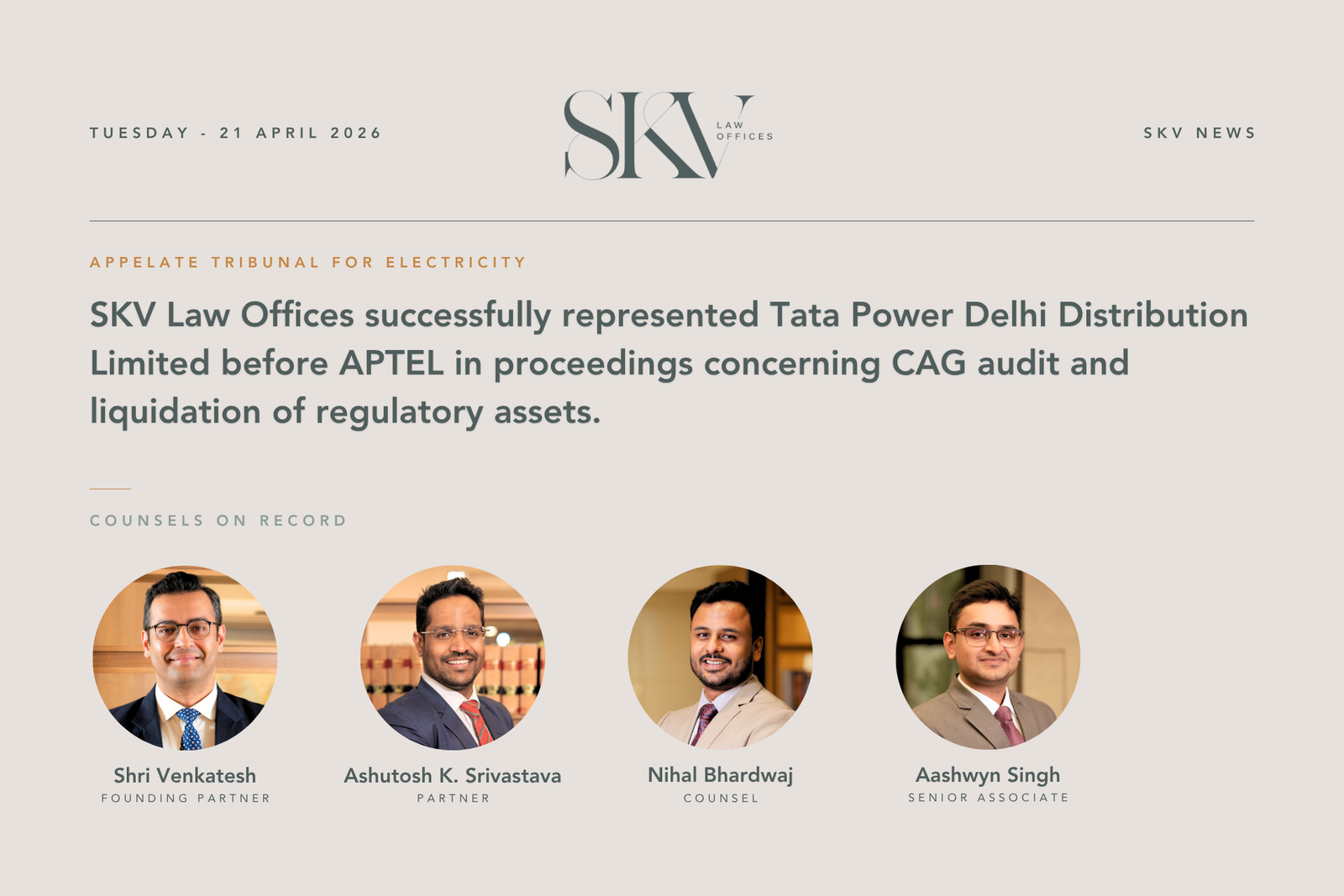

SKV Law Offices successfully represented Tata Power Delhi Distribution Limited before APTEL in proceedings concerning CAG audit and liquidation of regulatory assets
21.04.2026
SKV Law Offices acted for Tata Power Delhi Distribution Limited (“TPDDL”) in proceedings before the Appellate Tribunal for Electricity (“APTEL”) in O.P. No. 1 of 2025 and connected Interlocutory Applications, concerning the legality of a proposed audit by the Comptroller and Auditor General of India (“CAG”) and the timeline for liquidation of regulatory assets.

By its judgment dated 21 April 2026, APTEL quashed the approval for a CAG audit of the Delhi distribution companies, including TPDDL, directed the Delhi Electricity Regulatory Commission (“DERC”) to appoint an independent Chartered Accountant for a limited audit, and rejected DERC’s application seeking extension of time to commence liquidation of regulatory assets.
Background
The Original Petition was registered suo motu by APTEL under Section 121 of the Electricity Act, 2003 (“EA 2003”), pursuant to directions issued by the Hon’ble Supreme Court in W.P. (C) No. 104 of 2014 and connected matters (the “RA Judgment”). Under the RA Judgment, APTEL was directed to monitor implementation of directions relating to liquidation of regulatory assets accumulated by distribution companies, including the Delhi distribution companies such as TPDDL.
In its judgment dated 6 August 2025, the Supreme Court held that long pending regulatory assets reflect regulatory failure, with the ultimate burden falling on consumers. Regulatory commissions were directed to prescribe a defined trajectory for liquidation of regulatory assets within a stipulated timeframe and to conduct a strict and intensive audit into the circumstances under which such assets had accumulated without recovery.
Proceedings before APTEL
In the course of monitoring implementation of the RA Judgment, two principal issues arose before APTEL:
- Whether DERC was legally entitled to initiate an audit of the Delhi distribution companies by the CAG; and
- Whether DERC was entitled to any further extension of time to commence liquidation of regulatory assets.
DERC sought to justify the CAG audit as flowing from the Supreme Court’s directions and also sought additional time to commence regulatory asset liquidation. TPDDL opposed the proposed CAG audit and the request for extension of time, inter alia, on grounds of statutory non compliance and absence of public interest.
Findings of the Tribunal
CAG Audit Not Mandated under the RA Judgment
APTEL held that while the Supreme Court had directed a strict and intensive audit, it had not directed that such audit must be carried out by the CAG. The Tribunal rejected DERC’s contention that a CAG audit was a necessary corollary of the Supreme Court’s judgment.
Statutory Preconditions under the CAG Act Not Fulfilled
Examining Section 20(3) of the CAG (Duties, Powers and Conditions of Service) Act, 1971, APTEL held that the mandatory statutory conditions for entrusting audit of a private entity to the CAG were not satisfied.
The Tribunal found that there was no recorded satisfaction by the Lt. Governor of Delhi that the CAG audit was expedient in public interest, and that the distribution companies, including TPDDL, were not granted any opportunity of hearing prior to the audit being entrusted to the CAG. The approval process was characterised as having been undertaken in a cavalier manner.
APTEL further held that, even on merits, no public interest justified a wholesale audit of the accounts of the distribution companies by the CAG. The audit directed by the Supreme Court was limited to examination of the circumstances leading to accumulation of regulatory assets, and not a comprehensive financial audit.
DERC Empowered to Appoint Independent Auditors
APTEL held that DERC was fully competent to appoint appropriate Chartered Accountants or independent professionals to carry out the intensive audit contemplated by the RA Judgment, and that recourse to the CAG was neither mandatory nor warranted.
APTEL’s Jurisdiction under Section 121 Affirmed
The Tribunal rejected the argument that its powers under Section 121 of the EA 2003 were limited to supervisory oversight. APTEL held that where a regulatory commission, while purportedly implementing Supreme Court directions, acts in breach of statutory requirements, the Tribunal is duty bound to intervene to ensure lawful compliance.
Regulatory Asset Liquidation
On DERC’s application seeking extension of time to commence liquidation of regulatory assets, APTEL held that the provisional quantum of regulatory assets, amounting to ₹38,552 crore, was already known, and that there was no legal impediment to immediate commencement of liquidation.
The Tribunal deprecated DERC’s conduct, noting repeated delays despite undertakings given to the Supreme Court, the Delhi High Court and APTEL, and rejected DERC’s application for extension of time.
Operative Directions
By its judgment dated 21 April 2026, APTEL:
- Quashed the approval dated 5 March 2026 granting consent for a CAG audit of the Delhi distribution companies;
- Directed DERC to appoint an independent Chartered Accountant within one week from 20 April 2026;
- Directed completion of the audit within three months of such appointment; and
- Directed DERC to commence liquidation of regulatory assets within three weeks.
APTEL granted time until 30 June 2026 for passing the true up order for FY 2023 to 24, having regard to the statutory procedure involved.
Team
The matter was argued by Mr. Shri Venkatesh, Founding Partner, SKV Law Offices, and was supported by Mr. Ashutosh K. Srivastava, Partner, Mr. Nihal Bhardwaj, Counsel, and Mr. Aashwyn Singh, Senior Associate.
Read the full order here.
[ad_1]
Source link

