



Chaitra Navratri is in full swing, with many devotees observing fasts during the nine-day festival. During this period, they actively abstain from certain foods such as grains like wheat and rice, pulses and lentils. The goal is to eat sattvik food.


During Navratri, devotees eat simple vegetarian meals that are believed to help attain the spiritual focus required during puja days for prayer and meditation. Every home that celebrates Navratri follows this tradition.
How are these simple, pure vegetarian dishes reinterpreted on the gourmet table? And is there any trend, aside from festive fasting, that is creating a demand for simpler, vegetarian foods? All these questions are answered by a culinary expert.
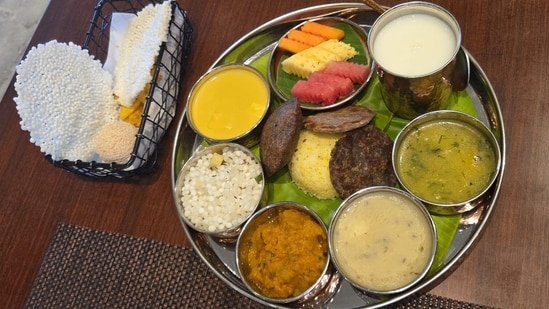
HT Lifestyle met head chef Kush Koli at Lore, Radisson Hotel, MG Road, Delhi, who curated a special Navratri thali that fuses traditional fasting dishes with a modern, fine-dining presentation.
Born into a family of chefs and trained at the prestigious Institute of Hotel Management (IHM), Pusa, Koli has worked in several high-profile kitchens. He is currently Head Chef at Radisson, working under Michelin-starred Chef Atul Kochhar and has previously managed restaurants and banquets at the Parliament of India, serving dignitaries including Prime Minister Narendra Modi and Home Minister Amit Shah. His experience also includes stints at The Oberoi, Hotel Ramada City Centre, Jalandhar and Punjabi By Nature, where he began his culinary journey.
Drawing from his rich journey and extensive culinary expertise, the Chef’s curated Navratri thali at Lore, Radisson Blue, stays true to the principles of sattvik food eaten during Navratri, while also leaving room for innovative touches.
Navratri thali meets creativity
Fine dining’s elevated flair is evident not just in the presentation but also in the exquisite curation of the dishes. The thali features fasting-friendly ingredients like kuttu and singhara flours, along with many seasonal vegetables, all cooked in minimal spices, and the stay true to Sattvik principles.
Where does fine dining come in? Through creativity! It takes the lead, transforming and elevating everyday ingredients into something extraordinary. At first glance, fine dining may seem intimidating to the uninitiated, but at its heart, it is all about creativity, along with the ability to see the bigger picture by pairing uncommon ingredients into dishes.
Take the Anarkali Ghewar Chat, for instance, served in a shot glass, for a contemporary presentation. It is topped with ghewar, a traditional festive sweet. But for Navratri, it is prepared with kuttu flour. The Chef further explained how it is layered with curd and mint-chutney, balancing sweet and savoury notes. The Chef called it ‘one of the flowing starts in a menu.’
Aside from the experimentation, the Chef also ensured that tradition stays at the heart of the menu, “When I was working on the Navratri menu, we thought we should stick to the core flavours of the festival, now blow (diners) minds from the festive season.” It had to remain rooted in tradition and respectful of its religious significance.
Chef Koli further mentioned that he introduced Kuttu Ke Theplas and Singare Ki Thalipeeth to the menu, giving these traditional breads a refreshing twist.
Here’s the rest of the menu:
Appetizer
- Anarkali Ghewar Chat
- Teen Fallo Ka Mel
Main Course
- Qasar-e-Pukhtan
- Bengali Aloo Rassa
- Ambiya Ki Nihari
- Pethe Ki Sabzi
- Sabudana Ki Khichdi
- Zeera Kesar Rice
Breads
- Kuttu Ki Puri
- Singhare Ka Thepla
- Thalipeeth
Beverage
- Kesar Badam Milk/ Salted Lassi
Dessert
- Benaras Casatta
- Sabudana Papad
- Banana chips
- Vrat Ke Chips
- Rajgira Ladoo
Chef’s special recipe: Ambiya ki Nihari – perfect for summers!
Out of the dishes, one stood out, perfect for the summer season. We asked Chef Koli for the recipe of Ambiya Ki Nihari, a refreshing, tangy dish that uses the season’s raw mangoes in the best way possible.
It goes on to show that Navratri dishes are not only festive but also seasonal and practical, which inherently makes them healthy. Here’s the recipe for you to try at home to beat the summer heat with a strong savoury punch:
Ingredients
- Oil- 1 tbsp
- Cumin seeds- ½ tbps
- Asafoetida- pinch
- Red chilli powder- 1 tsp
- Coriander powder- 1 tsp
- Jaggery (Gur), grated or broken- ½ cup
- Salt- ½ tsp
- Water- 1.5 cups
- Raw mangoes
Method:
- Peel and cut the raw mangoes into medium-sized pieces.
- Heat oil in a pan, add cumin seeds and hing. Let them sizzle.
- Add the chopped raw mangoes to the pan. Sauté for 1-2 minutes.
- Add coriander powder, red chilli powder, and senda namak. Mix well to coat the mangoes.
- Add 1 cup of water. Cover the pan and cook for 5-7 minutes on medium heat until the mangoes become tender.
- Add the jaggery and stir until it melts completely, let it simmer for another 4-5 minutes until the gravy thickens to a desired consistency.
- Turn off the heat. Sabzi should look glossy and thick.
Chef’s tip for home cooks on what to use in place of onions
Onions are generally not used in sattvik food, as they are classified as a tamasic ingredient. Even in the scientific community, one of the health downsides of consuming onions is heartburn. A study published as far back as 1990 found that they can increase acid reflux. So we asked Chef Koli if there is any substitute for onions that would not compromise on taste.
He suggested, “For home cooks, if you don’t want to use onion, you can use dehydrated coconut powder. It gives a similar sweetness and texture and also balances out the sharpness of tomatoes.” Koli often uses this substitute for Jain food preparations, too. Besides Navratri fast observers, those who suffer from digestive issues can actively begin to incorporate this substitute in meal preparation.
Rise of plant-based and fasting diets
Where does plant-based, simple vegetarian food stand in the bigger picture? Is there any broader trend in the growth of this diet, independent of religious or spiritual practices?
Koli shared his observation, “What I have observed, especially over the last year, is that people are becoming more diet-conscious. Many are following intermittent fasting, and they want meals that are balanced.” It suggests diners are looking for healthier, lighter, more sustainable meal options, making plant-based foods gain ground in mainstream dining.
Fasting-friendly diets are no longer confined to a niche or limited to specific seasons or festivals. They are steadily becoming popular as people realise that this type of food is also healthy. Chefs are exploring and customising these meals with their culinary expertise, bringing great, innovative fusion ideas to life, while also keeping the dishes rooted in tradition.
Sattvik food is becoming more practical than ever, whether it is using seasonal fruits, like raw mango in Ambiya Ki Nihari or replacing onions, which can trigger digestive issues, with a more soothing alternative like coconut powder.