


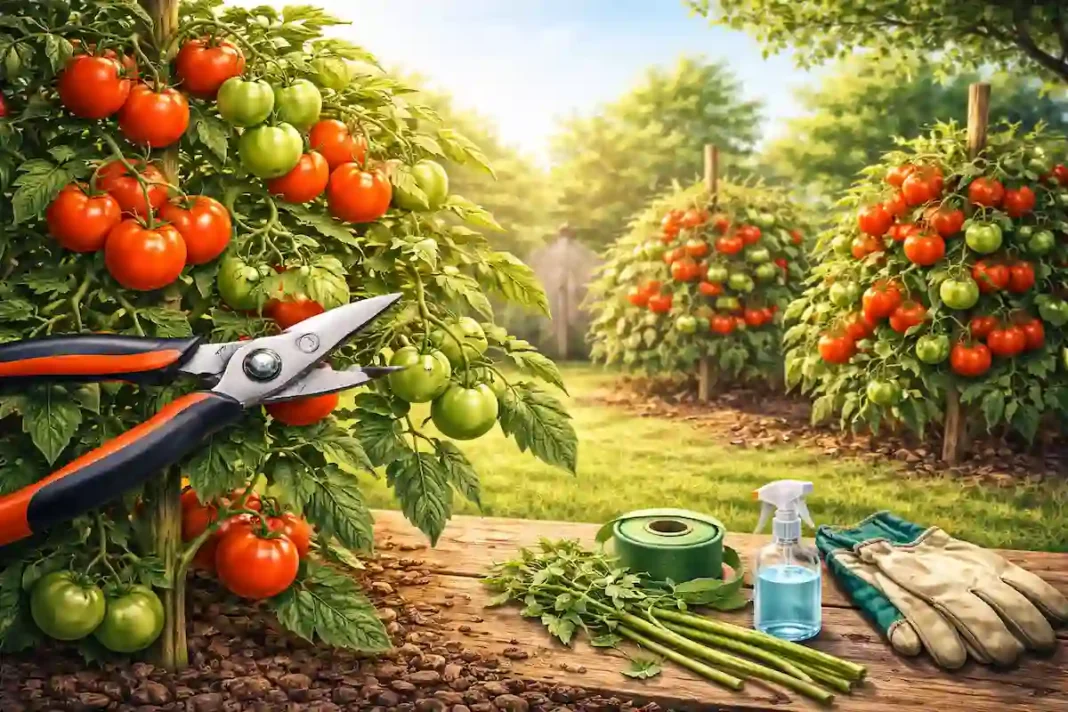
Updated: March 2026 | Reviewed by the Agri Farming Editorial Team | 15+ years vegetable growing experience | 500+ tomato plants grown and observed annually
Pruning tomato plants is one of the most reliable ways to improve your harvest without spending more money or changing your soil.
Done at the right time, tomato plant pruning redirects the plant’s energy away from endless vegetative growth and toward producing bigger, better fruit.
Whether you’re figuring out how to prune tomato plants for the first time or trying to recover from last season’s mistakes, this guide covers the full picture. It draws on home garden experience and university extension recommendations, including research from Cornell Cooperative Extension and UC Davis.
After pruning tomatoes across several growing seasons, one pattern becomes obvious: small, regular cuts outperform heavy occasional sessions every single time.
In my own garden, just removing the lower leaves touching the soil each week reduced early blight problems dramatically, before I changed anything else. That one habit alone made a visible difference.

Quick Answer: How to Prune Tomato Plants
Think of this as your starter tomato pruning tips for beginners — a reference you can return to each week before heading out to the garden.
5-Step Tomato Pruning Checklist
- Wait until plants are 12 to 18 inches tall before making any cuts.
- Remove suckers growing in the crotch between the main stem and a branch when they are under 2 inches long.
- Strip off lower leaves touching or near the soil to block soil-borne disease splash.
- Thin out branches crowding the canopy interior so air moves through freely.
- Check plants every 7 to 10 days and repeat throughout the growing season.
Best Time to Prune Tomato Plants (Quick Answer)
Prune on a dry morning so cut surfaces seal before evening humidity arrives.
Start 2 to 3 weeks after transplanting, once the plant is showing active new growth.
Avoid pruning right after rain or irrigation — a mistake that led to fungal issues across a whole row of plants in my first season.
What Parts of Tomato Plants Should Be Removed
- Suckers (shoots growing at the junction of the main stem and a branch)
- Lower leaves touching or close to the soil
- Yellow, diseased, or damaged leaves
- Crowded inner branches blocking airflow and sunlight penetration
- The growing tip on indeterminate varieties 4 to 6 weeks before first frost (topping)
What You Should Never Cut from Tomato Plants
- The main growing stem (apical tip)
- Flower clusters or visible fruit-bearing branches
- Healthy green leaves shading ripening fruit in hot climates
- Growth tips before the plant has set its first fruit cluster
Tomato Pruning Mistakes Beginners Make Most Often
- Pruning with dirty, unsterilized tools (one of the fastest ways to spread disease across plants)
- Removing too much foliage in a single session
- Cutting during wet or rainy conditions
- Treating determinate and indeterminate varieties exactly the same way
What Is Pruning Tomato Plants and Why It Improves Growth
Pruning means selectively removing specific parts of the tomato plant — mainly suckers, crowded branches, and problem foliage — so the plant’s energy shifts toward ripening fruit rather than endless vegetative growth.
A tomato plant left entirely to itself will grow into a tangled, dense structure. That looks productive, but inside the canopy, airflow drops, light penetration suffers, and the plant competes with itself for nutrients.
Some gardeners disagree about how much pruning actually helps, and results do vary by variety and climate. But in most gardens, targeted tomato plant trimming produces measurable improvements.
What Happens If You Don’t Prune Tomato Plants
Without any pruning, tomato plants usually become overcrowded. Airflow drops, creating the warm, damp conditions that fungal diseases like early blight and septoria leaf spot need to spread.
Fruit tends to take longer to ripen, and individual tomatoes often stay smaller because the plant is supporting too many growing points at once.
That said, unpruned plants do not automatically fail. In many home gardens, especially with determinate varieties, they produce a decent harvest. Pruning just tends to improve the consistency and quality of that harvest.
For a detailed breakdown of how these infections spread and how to treat them early, read our guide on tomato pests and diseases.
Benefits of Pruning Tomatoes for Higher Yield
- Directs plant energy toward existing fruit clusters instead of new vegetative growth
- Improves canopy structure and reduces fungal disease risk
- Allows sunlight to reach fruit directly, improving color and sugar development
- Makes the plant easier to stake, cage, or trellis
- Extends the productive fruiting window, especially in shorter growing seasons
For more ways to improve your total harvest beyond pruning, read our guide on how to boost tomato yield with 24 proven production steps.
Does Pruning Tomato Plants Produce Bigger Tomatoes
Usually, yes. When you reduce the number of active growing points, the plant concentrates sugars, calcium, and other nutrients into fewer fruit.
The difference is most noticeable with large indeterminate slicing varieties. With cherry tomatoes or compact determinate types, the size improvement is subtler.
Overall yield quality tends to be better when basic tomato plant maintenance is done consistently throughout the season.
Situations When Pruning Tomatoes Is Not Necessary
Determinate (bush) varieties are bred to set all their fruit in a concentrated window, then stop. Those side branches you would normally remove as suckers on an indeterminate plant are the very branches carrying the most fruit on a determinate type.
For these, only light pruning makes sense — removing diseased foliage and the lowest leaves near the soil.
If you are growing in a very short season where you need maximum early yield, minimal pruning also tends to work better.
When to Prune Tomato Plants for Maximum Yield
When to Start Pruning Tomato Plants After Transplanting
Wait 2 to 3 weeks after transplanting before any pruning. The plant needs that recovery window to establish root contact with the soil and resume active growth.
Starting too early adds stress on top of transplant shock.
Once you see 4 to 6 inches of new growth from the transplant point, the plant is usually ready for its first light session.
Should You Prune Tomato Seedlings
No. Seedlings need every leaf they have to build energy reserves before going into the ground.
Pruning at the seedling stage does more harm than good in almost every situation. The only exception is removing a sucker directly competing with the main stem.
This is a common mistake beginners make out of enthusiasm, and it usually just slows early development down.
Should You Prune Tomatoes After Rain
No, and this is worth repeating because it catches people out regularly.
Wet foliage and soil conditions make fresh pruning cuts significantly more vulnerable to bacterial and fungal infection. Moisture carries spores, and an open wound on a wet plant is essentially an open door.
Wait at least 24 hours of dry weather after rain before pruning. If your region gets frequent summer rain, morning pruning on clearly dry days is your best window. This one habit alone can make or break your disease management across the season.
Best Time of Day to Prune Tomato Plants
Morning, consistently.
Cutting in the morning gives wounds several hours of warm, dry air to begin sealing before cooler, damper evening conditions arrive.
Afternoon pruning in humid climates is far from ideal. Pruning at night or while plants are still wet from morning dew is worst of all.
Tomato Pruning Schedule: How Often to Prune
Every 7 to 10 days during peak growing season is the right frequency for most indeterminate varieties.
Tomatoes grow fast when conditions are warm. A sucker that is barely visible one week can be a thick 6-inch shoot the following week.
Setting a consistent schedule, rather than pruning reactively when things look overgrown, keeps the workload light and plant stress low. In my experience, missing two or three sessions in a row is when the work starts feeling overwhelming.
When to Stop Pruning Tomato Plants
Stop heavy pruning about 4 weeks before your first expected frost date.
Late in the season, the plant needs its full canopy to ripen what is already on the vine.
The only pruning worth doing at this point is topping indeterminate plants, which redirects energy away from new growth and toward finishing existing tomatoes.
How to Prune Tomato Plants Step by Step

Step 1: Identify Tomato Suckers Correctly
A sucker is a new shoot that grows from the axil — the V-shaped junction where a leaf stem meets the main stem.
Honestly, most gardeners overthink this part once they have seen it a couple of times in person.
A true sucker grows from the leaf axil with no flower structure visible. A productive branch grows from the main stem at a wider angle and often shows a small flower cluster near its tip within the first few inches.
If you search for a tomato pruning diagram online, the axil location is the one spot every illustration focuses on, because that is genuinely where the whole identification process starts.
When unsure, wait a few days and watch for flowers before cutting. Better to leave a sucker a week longer than to remove a fruit cluster by mistake.
Step 2: Remove Lower Leaves for Disease Prevention

Strip any leaves touching or hanging close to the soil.
Soil holds spores from fungi responsible for early blight and other common diseases. Rain and irrigation water splash those spores upward onto the nearest leaf surfaces — usually the lowest leaves. That is where infections start and then move upward through the plant.
Keeping the lowest 10 to 12 inches of stem bare throughout the season breaks this cycle. Research from Alabama Cooperative Extension consistently lists lower leaf removal as one of the highest-value disease prevention practices available to home gardeners.
Step 3: Remove Unnecessary Suckers Early
Pinch or snap suckers off by hand when they are under 2 inches. At that size, they break cleanly and the wound is tiny.
Once a sucker reaches 4 to 5 inches, use clean bypass shears and leave a short stub rather than cutting flush to the stem.
On indeterminate plants, focus sucker removal on the lower third of the plant and any shoots directly competing with the main leader. Not every sucker needs to go, but the ones growing below the first flower cluster almost always should.
Step 4: Open the Canopy for Airflow and Sunlight
After removing suckers and lower foliage, step back and look at the plant from the side and above.
Can you see light reaching the interior? Can air move through without hitting a wall of leaves? If not, selectively remove a few crossing or crowding branches in the center.
The goal is not a bare plant. You want a canopy where sunlight and airflow reach most leaf and fruit surfaces. Open structure maintained consistently across the whole season beats aggressive cutting done once.
Step 5: Monitor Plant Recovery After Pruning
Watch the plant for 2 to 3 days after any session.
Brief, mild wilting on a hot afternoon is normal, especially if you removed a noticeable amount of foliage. What is not normal is ongoing wilting, rapid yellowing, or the plant looking significantly worse 48 hours later.
That usually signals either over-pruning or an underlying issue like root stress or disease. A well-handled plant should show resumed new growth within 7 to 10 days.
How to Identify Tomato Suckers vs Productive Branches

What Are Tomato Suckers
Suckers are vegetative shoots emerging from the leaf axil.
Left to grow, each becomes a full branch capable of producing fruit, but also its own suckers, creating exponential canopy complexity.
On indeterminate tomatoes, this growth pattern works against you unless managed through regular sucker removal as part of your standard tomato plant maintenance routine.
Which Tomato Suckers Should Be Removed
On indeterminate varieties, remove suckers growing below the first flower cluster consistently. These lower suckers pull nutrients without contributing significantly to fruit production.
Also remove any sucker growing straight up in direct competition with the main leader.
Suckers in the lower canopy that are already reducing airflow near the soil surface should go too.
Which Suckers Should Not Be Removed
Many experienced growers deliberately keep one sucker just below the first flower cluster as a second leader. This double-leader setup keeps the plant productive after the main stem begins maturing and slowing.
In hot climates, keeping some upper canopy suckers also protects developing fruit from direct sun exposure that causes sunscald.
The decision depends on your climate, variety, and how much vertical space you have.
The 2-Inch Sucker Pruning Rule
Remove suckers when they are 2 inches or shorter. Smaller than that and they are easy to miss during inspection.
Larger than 4 to 5 inches and the removal wound is significant enough to stress the plant and waste energy already invested in that growth.
The 2-inch window is roughly where the effort-to-benefit ratio is best, and catching suckers at this stage is what makes weekly pruning sessions quick rather than exhausting.
Pruning Determinate vs Indeterminate Tomato Plants

Interestingly, this is the single distinction most beginners get wrong, and it accounts for most of the “pruning ruined my harvest” complaints you see in gardening forums.
Knowing your variety type before you pick up any tool is the most important tomato pruning tip for beginners, full stop. Use this tomato pruning chart as a quick reference:
| Feature | Determinate (Bush) | Indeterminate (Vining) |
|---|---|---|
| Growth pattern | Stops at fixed height | Continues growing all season |
| Fruiting pattern | All at once, concentrated window | Continuous throughout season |
| Sucker removal | Minimal or none | Regular removal recommended |
| Best pruning method | Light (lower leaves and diseased foliage only) | Single-leader or double-leader system |
| Topping needed | No | Yes, 4 to 6 weeks before first frost |
| Common examples | Roma, Celebrity, Patio | Beefsteak, Cherokee Purple, most heirlooms |
Should Determinate Tomato Plants Be Pruned
Only lightly. The side branches on determinate tomatoes carry most of the crop.
Removing them as suckers — the right move on indeterminate plants — directly reduces your harvest on bush types.
Stick to lower leaf removal, dead or diseased foliage, and the occasional crossing branch that is genuinely blocking airflow.
How to Prune Indeterminate Tomato Plants Correctly
The most effective approach on indeterminate varieties is single-leader or double-leader pruning.
Remove suckers below the first flower cluster consistently. Allow one or two main stems and train them vertically on a stake or trellis.
Top the plant 4 to 6 weeks before first frost to stop new growth and redirect resources into ripening existing fruit. This is essentially the same approach used in commercial greenhouse tomato production, scaled down for home gardens.
Pruning Cherry Tomato Plants
Cherry tomatoes are vigorous and somewhat forgiving. They benefit from regular pruning but can handle a second or third leader without a major quality drop.
Focus on keeping the lower stem clear and maintaining enough interior airflow to manage disease pressure.
In my experience with high-yielding cherry varieties, regular lower leaf removal and one light sucker-thinning session per week is usually enough to keep things manageable without restricting production.
For variety-specific tips on growing cherry tomatoes from seed to harvest, check out our guide on growing cherry tomatoes in pots and trays.

Basic Pruning Tools for Home Gardeners
- Bypass pruning shears: Sharp blades make clean cuts that heal faster than crushed tissue. A decent pair is worth the investment; cheap shears bruise stems more than they cut them.
- Pruning snips or scissors: Useful for small suckers and tight spaces near flower clusters.
- Your fingers: For suckers under 2 inches, snapping by hand is faster and makes a smaller wound than any tool.
How to Disinfect Pruning Tools Between Plants
Wipe blades with 70% isopropyl alcohol or a 10% bleach solution between plants, and especially after cutting anything showing signs of disease.
This is the single habit most beginners skip and then regret. I learned it the hard way after spreading mosaic virus through half a row by using the same unwashed shears on every plant in sequence.
Let blades air dry briefly before cutting to reduce any burning effect on fresh tissue.
Preventing Disease Spread While Pruning
- Never prune when plants or soil are wet
- Dispose of pruned material well away from the garden — do not compost diseased cuttings
- Work from your healthiest plants toward any showing symptoms, never in reverse
- Wash hands if handling visibly infected material before touching other plants
How Much to Prune Tomato Plants Without Reducing Yield
The One-Third Pruning Rule Explained
Remove no more than one-third of the plant’s total leaf surface in a single session.
Leaves are how the plant produces energy through photosynthesis. Remove too many at once and you interrupt that process significantly.
The plant responds by shifting resources toward regrowing foliage rather than ripening fruit. That recovery period can cost 7 to 14 days of productive growth, which matters a great deal in shorter seasons.
Signs You Pruned Too Much
Here is where most people go wrong: they expect the plant to look better immediately after a pruning session.
Watch for these signals in the 48 to 72 hours after cutting: persistent wilting that does not recover in the evening, sudden yellowing of remaining leaves, a visible stall in growth, or fruit that appears to stop sizing up.
Sunscald — white or tan patches on exposed fruit — is also a clear sign that too many protective leaves were removed.
The tomato pruning before and after difference should show up in canopy structure within a day, but yield improvements build over several weeks, not overnight. If you see stress signals, stop pruning for at least two weeks, water the plant well, and let it recover.
Can you fix an over-pruned tomato plant? Usually yes, if the main stem is intact and enough leaves remain for photosynthesis. Recovery just takes time.
Can Over-Pruning Damage Tomato Plants
Yes, significantly.
Removing more than half the foliage in one session causes plant shock. In hot climates, exposed fruit clusters become highly vulnerable to sunscald without leaf cover.
Heavy over-pruning is harder to recover from than under-pruning, so when uncertain, always err on the conservative side. Under-pruning rarely kills a plant. Over-pruning sometimes does.
How Pruning Affects Tomato Taste
One thing rarely mentioned in standard tomato pruning guides: pruning affects how the fruit actually tastes.
When a plant is pruned to focus energy on fewer fruit, those tomatoes tend to accumulate higher concentrations of sugars and lycopene. The result is often a noticeably richer, more intense flavor compared to fruit from a dense, heavily branched plant.
This is particularly obvious with heirloom indeterminate varieties, which already tend toward complex flavor when given sufficient resources to develop properly.
The effect is less dramatic on cherry tomatoes and minimal on most determinate varieties. But if you are growing beefsteak, brandywine, or similar large indeterminate types for eating fresh, consistent pruning often produces tomatoes that taste meaningfully better alongside being larger and better colored.
University extension research on sugar accumulation in tomato fruit supports this connection between reduced fruit load per plant and improved soluble solids content.
Pruning Tomato Plants to Prevent Diseases and Improve Airflow
How Pruning Reduces Fungal Diseases
Fungal diseases like early blight, late blight, and septoria leaf spot need prolonged leaf wetness to germinate and infect. Most spores require 4 to 8 continuous hours of wet leaf surface.
A dense unpruned canopy stays wet for much longer after rain or irrigation than a well-managed, open one.
Cornell Cooperative Extension research has shown that improved canopy management reduces fungal infection rates measurably over the course of a growing season — and that finding holds up in home garden conditions, not just research plots.
For further reading backed by university research, the University of New Hampshire Extension pruning fact sheet covers canopy management and disease prevention in practical detail.
Why Removing Lower Leaves Prevents Soil Infection
Most soil-borne tomato pathogens survive in the top layer of garden soil on decomposing organic matter.
Irrigation and rain water splash those spores upward onto nearby leaf surfaces. The lowest leaves are always the first target.
Keeping the bottom 10 to 12 inches of stem completely bare creates a physical gap between the soil spore reservoir and the plant’s leaf canopy — and it costs nothing except a few minutes per plant.
How Pruning Improves Airflow and Sunlight Penetration
Good airflow through the canopy allows leaf surfaces to dry quickly after moisture exposure.
Surprisingly, the drying time difference between a pruned and unpruned plant is dramatic. A pruned, open plant in a light breeze can dry within an hour or two of rainfall. The same plant with a dense, overlapping canopy can stay wet for six or more hours.
Beyond disease management, improved sunlight penetration directly affects fruit ripening speed, color development, and sugar accumulation in the flesh.
Tomato Pruning Tips Based on Climate and Growing Conditions

Pruning Tomatoes in Hot Climates
In regions with intense afternoon sun, leave more upper leaf cover than you might otherwise.
Exposed fruit in high temperatures develops sunscald quickly. Focus pruning on the lower portions of the plant and allow more canopy density in the upper fruiting zone.
Prune early in the morning before temperatures climb, and hold off on heavy sessions during heat waves when plants are already under stress.
Pruning Tomatoes in Humid Climates
High ambient humidity means fungal pressure is persistently elevated throughout the season.
In these conditions, more aggressive canopy management is usually justified. Keep the lower third of every plant clear, thin the interior consistently, and be especially strict about dry-morning-only pruning.
Copper-based fungicide applications after heavy pruning sessions can also reduce infection risk during high-humidity periods.
Pruning Tomatoes in Cool Climates
Short-season cool climates make the end-of-season topping technique especially valuable.
Cutting the main growing tip 4 to 6 weeks before expected frost stops the plant from setting new fruit that will never ripen and pushes all remaining resources into the tomatoes already on the vine.
Cool-climate gardeners should also start pruning slightly later in spring to avoid stressing young transplants during cold nights when recovery is slow.
How to Prune Tomato Plants in Containers
Container tomatoes need more consistent pruning than garden plants because the root volume is fixed.
A pot-bound plant simply cannot support the same leaf area and fruit load as one growing in open soil. Single-leader pruning works best for containers: one main stem, all suckers removed, and a stake for vertical support.
Regular tomato plant maintenance in containers keeps demand proportional to what the pot’s limited soil and nutrients can actually deliver.
If you are just starting with pot growing, our complete guide on how to grow tomatoes in pots covers soil mix, pot size, watering, and support systems alongside pruning.
Greenhouse Tomato Pruning Tips
In greenhouse production, single-leader pruning is essentially standard practice.
Plants are trained up vertical strings, every sucker is removed, and lower leaves are stripped progressively as the plant climbs.
Greenhouse environments often reduce natural airflow, making consistent leaf and sucker removal even more critical than it is outdoors. Commercial operations follow a strict weekly pruning schedule with sanitized tools as a baseline requirement, not an optional extra.
Seasonal Tomato Pruning Schedule
| Growth Stage | Pruning Action | What to Avoid |
|---|---|---|
| Early growth (2 to 3 weeks post-transplant) | Remove lowest leaves, first small suckers | Heavy cuts, removing healthy upper foliage |
| Vegetative growth (pre-flower) | Regular sucker removal every 7 to 10 days | Removing all suckers on determinate types |
| Flowering stage | Light sucker removal, clear lower stem | Cutting flower clusters or immediately adjacent leaves |
| Fruiting stage | Maintain airflow, remove yellowing leaves | Heavy pruning sessions that stress the plant |
| Late season (4 weeks before frost) | Top indeterminate plants, stop new sucker removal | Removing leaves shading ripening fruit clusters |
Advanced Tomato Pruning Techniques
Single Stem Pruning Technique
This method removes every sucker, leaving only the single main central stem growing vertically.
The result is fewer tomatoes, but those that develop are often larger and earlier to ripen because the plant’s entire energy goes into one growth axis.
It works best for indeterminate varieties in tight vertical spaces or greenhouse rows, and requires catching suckers early every single week without exception.
Double Leader Pruning Technique
The double-leader approach keeps the main stem and one strong sucker — usually the one directly below the first flower cluster — as co-leaders.
This balances productivity and manageability. You get more fruit than a single-stem plant without the uncontrolled complexity of a fully unpruned one.
Train both leaders up separate stakes or strings to keep them from tangling as they grow.
Tomato Topping Technique Explained
Topping means cutting the growing tip off the main stem to halt upward growth entirely.
Done 4 to 6 weeks before expected first frost on indeterminate varieties, it prevents the plant from spending remaining energy on new fruit that will not ripen before cold arrives.
The plant shifts that energy into maturing what is already on the vine. This is one of the most reliable late-season techniques for anyone gardening in a climate with a defined frost window.
Common Tomato Pruning Mistakes That Reduce Harvest

Removing Too Many Leaves at Once
One mistake beginners make — and I made it too in my first season — is stripping large amounts of foliage in a single pass because the plant looks too dense.
The plant then spends the next week or two regrowing leaf cover instead of sizing fruit.
Follow the one-third rule and spread heavy work across multiple sessions a week or so apart.
Pruning Too Early or During Wet Weather
Pruning young transplants before they have recovered from planting stress slows their early root development.
Pruning during or immediately after rain introduces pathogens into fresh wounds at exactly the point when the plant is least able to defend itself.
Both mistakes are easy to avoid once you understand why timing matters so much in tomato plant care.
Ignoring Plant Stress Signals Before Pruning
If a plant is already wilting from heat, drought, or a root problem, adding pruning stress on top can push it into serious decline.
Fix watering, soil, or root issues first. Prune only plants that look visibly healthy and are growing actively.
A stressed plant does not have the reserves to heal pruning wounds efficiently.
Cutting the Main Growing Stem by Mistake
Accidentally removing the apical tip of the main stem during early to mid-season is one of the harder pruning errors to recover from on indeterminate tomatoes.
Always identify the central leader clearly before cutting anywhere near the top of the plant.
If it does happen, the plant will usually push a new leader from a nearby sucker, but this sets the plant back several weeks.
Removing Productive Branches by Mistake
Confusing a fruit branch with a sucker is a common beginner error.
A true sucker grows from a leaf axil with no flower structure at all. A productive branch grows from the main stem at a wider angle and often shows a small flower cluster near its tip.
When genuinely unsure, wait and observe for a few days rather than cutting. The cost of waiting is almost always lower than the cost of removing the wrong growth.
Tomato Pruning Myths vs Facts
| Myth | Fact |
|---|---|
| Pruning always reduces yield | Targeted pruning typically improves yield quality and often total weight on indeterminate varieties |
| All suckers must be removed | Determinate types should keep most suckers; indeterminate plants benefit from selective removal |
| Pruning is mandatory for healthy tomatoes | Plants grow without pruning; it improves outcomes but is not required for plant survival |
| More pruning always means bigger fruit | Over-pruning causes stress and slows fruit development; balance matters more than quantity of cuts |
| You can prune any time of day or season | Morning timing, dry conditions, and growth stage all significantly affect pruning outcomes |
| Before and after results from pruning are immediate | Visible canopy improvement is immediate; yield and fruit size benefits build over weeks |
Frequently Asked Questions About Pruning Tomato Plants
1. Should I remove yellow leaves from tomato plants?
Yes. Yellow leaves are no longer contributing to photosynthesis and can be a point of disease spread.
Remove them cleanly at the base of the leaf stem without leaving a stub.
A few yellowing lower leaves mid-season is normal as the plant matures. Yellowing spreading rapidly upward is a sign of a larger problem worth investigating separately.
2. Can you prune tomatoes too much?
Yes, and it is one of the more common ways to unintentionally harm a productive plant.
Removing more than one-third of the canopy in one session, cutting below fruit clusters that need leaf support, or pruning too frequently during hot or drought conditions all qualify as over-pruning.
3. What happens if you don’t prune tomatoes at all?
The plant grows into a dense, multi-stemmed structure.
For determinate varieties this is often acceptable and still produces a decent harvest. For indeterminate types, especially in humid climates, the lack of pruning usually increases disease pressure, slows fruit ripening, and reduces the size of individual tomatoes.
4. Should you prune tomatoes in summer?
Regular light maintenance pruning continues through summer on indeterminate varieties.
In peak summer heat, avoid heavy sessions during heat waves and stick to morning pruning only.
Summer is also when the topping decision approaches for gardeners with autumn frost dates coming. Adjust pruning intensity based on how the plant is coping with heat and available water.
5. How often should tomatoes be pruned?
Every 7 to 10 days during active growing season for indeterminate varieties.
This frequency keeps suckers small and manageable and prevents the work from becoming overwhelming.
Determinate types need attention mostly at the start of the season for lower leaf removal, then minimal intervention thereafter.
6. Should I remove tomato flowers early in the season?
Removing the very first flower cluster was a common recommendation for many years, with the idea that it pushes more energy into root development.
Current evidence and garden experience suggest this provides minimal practical benefit for most home gardeners.
Leave flowers in place unless the plant is clearly underdeveloped or under visible stress from recent transplanting.
7. What leaves should not be removed from tomato plants?
Do not remove healthy green leaves in the upper two-thirds of the plant, leaves directly shading ripening fruit in hot-climate gardens, or any significant quantity of leaves from a plant that is already visibly stressed.
These leaves are actively supporting the plant’s growth hormones and energy production.
Removing them without a clear reason costs more than it gains.
8. Is pruning necessary for container-grown tomatoes?
More so than for garden plants. The limited root volume in a container cannot support unlimited canopy growth.
Regular sucker removal and leaf thinning keeps the plant’s demands in proportion to what the pot’s soil and nutrient supply can realistically deliver.
Single-leader pruning is the most practical and effective method for tomatoes in pots.
Key Tomato Pruning Takeaways for Bigger Harvests
Pruning tomatoes consistently and correctly gives you more practical control over your harvest than almost any other single garden habit.
After pruning hundreds of plants across different climates and varieties, the biggest yield improvements almost always came from consistency rather than aggressive cutting — that is the one insight worth carrying into every season.
The core principles are not complicated: remove suckers early while they are small, keep the lower stem bare to block disease splash, open the canopy for airflow and sunlight penetration, use clean tools on dry mornings, and never remove more than one-third of the plant at once.
For indeterminate varieties, regular tomato pruning is one of the highest-return uses of time in the entire garden. For determinate types, keep it targeted and light.
The best pruning method for tomatoes is ultimately the one you can sustain across the whole season, not the most aggressive approach you can execute once.
Match your approach to your climate, your variety, and the signals the plant is actually giving you. In most gardens, the difference between an average tomato harvest and a genuinely good one comes down to these small, regular decisions made consistently over weeks.
Pruning works best when paired with proper feeding throughout the season. See our natural tomato fertilizer guide to keep your plants well nourished at every growth stage.
Beginner Pruning Action Plan
- Confirm whether your variety is determinate or indeterminate before doing anything else.
- Wait 2 to 3 weeks after transplanting before the first session.
- Remove lower leaves and small suckers on your first pass, nothing more.
- Set a 7 to 10 day recurring reminder for follow-up pruning throughout the season.
- Stop heavy pruning 4 weeks before expected frost; top indeterminate main stems at that point.
- Keep tools clean, prune only when the plant is dry, and never work on a visibly stressed plant.
About the Author: Written by the Agri Farming Editorial Team — vegetable growing specialists with a focus on tomatoes and kitchen gardens. Our guides are based on hands-on growing experience across multiple climates, cross-referenced with university extension research and professional growing practices.