




By Neeraj Mishra
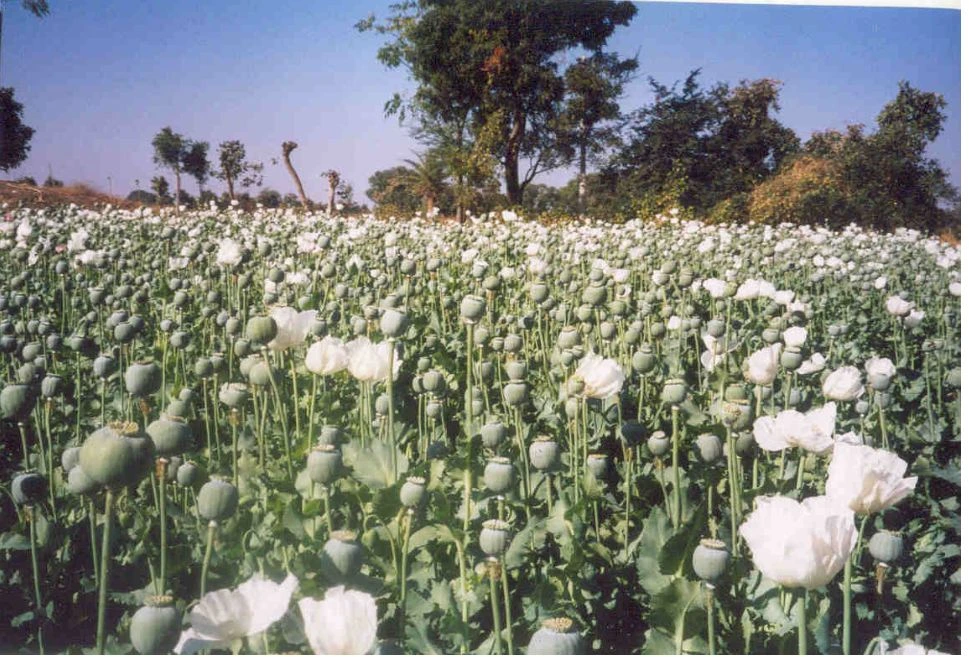
If someone manages to source high-quality opium in Delhi, there is an increasing possibility that it has travelled not from Afghanistan, but from hidden plantations in Chhattisgarh. A series of raids over the past fortnight has exposed a disturbing trend: illegal poppy cultivation appears to be expanding across the state. What is striking is not just the scale, but the spread. These fields are not confined to one hotspot or district. From Durg to Raigarh to Balrampur, investigators are finding plantations tucked away in remote farmland, often guarded around the clock and allegedly operating under local political protection.
So far, officials say that more than 20 acres of poppy have been identified across five disconnected villages, with the crop’s estimated value exceeding Rs 50 crore. The scale is alarming when compared with India’s tightly controlled legal cultivation. Licensed plots in Neemuch in Madhya Pradesh and Ghazipur in Uttar Pradesh are typically restricted to small parcels not exceeding 10,000 square feet. Against that benchmark, entire acres of illicit plantation suggest a far larger operation.
Investigators believe the motivation is simple: enormous profits backed by organised networks and local protection. According to preliminary intelligence inputs, criminal groups from Bihar have been leasing land in remote villages from unsuspecting farmers. The poppy plants are often grown discreetly alongside regular crops to avoid suspicion.
The economics of the trade make the risk worthwhile. A kilogram of raw opium can reportedly fetch around Rs 50,000 at source in Chhattisgarh. The consignment is then transported to Khunti in Jharkhand, where it is processed before moving on to markets in Delhi. By the time it reaches the capital, the same quantity can sell for as much as Rs 5 lakh, depending on purity and quality.
The cultivation itself requires time, skill and patience. A poppy plant completes its growth cycle in roughly 90 to 120 days and needs careful tending at each stage. When the bulb matures, farmers make precise incisions on the pod to allow the sticky latex—raw opium—to ooze out and dry. Harvesting the resin demands experience and delicate handling.
Even beyond the latex, nearly every part of the plant carries value. The dried pods, known locally as “doda”, and the flowers can also be consumed as intoxicants. This versatility makes poppy cultivation especially attractive to illegal growers.
What remains puzzling is how such an elaborate operation has flourished in a state where villages are scattered across forested terrain and where crop cycles require months of visible activity. Leasing land, cultivating poppy for three months, and then transporting the harvest across state borders to Jharkhand suggests a complex network with significant logistical and political backing.
Police responses so far appear mixed. Durg Superintendent of Police Vijay Agarwal has said that doda was being sold locally to truck drivers, but added that investigators have not yet found clear evidence of a larger organised crime network. However, Raigarh police say they have managed to trace the supply chain both backward and forward, linking the cultivation directly to processing hubs in Khunti.
Political reactions have been muted. The opposition Congress has largely avoided aggressive criticism so far. Observers point out that during former chief minister Bhupesh Baghel’s tenure, cannabis consumption culture had become visible in urban centres, with hash and hookah lounges proliferating. At one point, Raipur alone reportedly had more than 125 hookah bars.
Whether the recent discoveries mark the tip of a much larger narcotics network—or a series of opportunistic ventures—remains an open question. What is clear is that the emergence of large-scale poppy cultivation in Chhattisgarh signals a worrying shift in India’s internal narcotics landscape.
—The writer is a senior journalist