


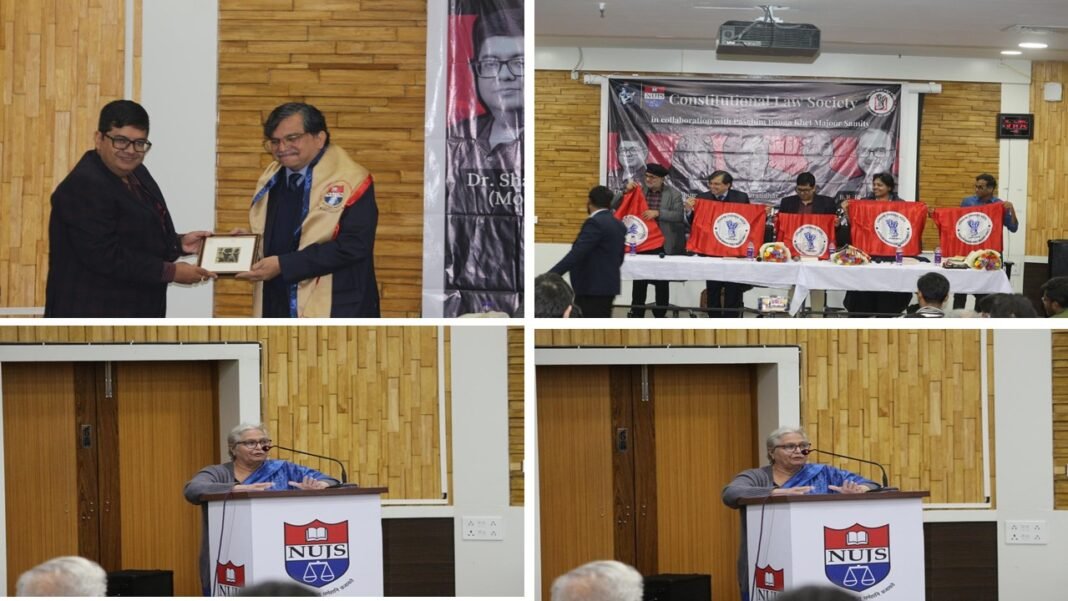
- Date: 10th January, 2026
- Venue: Room 328
Brief Biography of Dr. S. Muralidhar
Justice Dr. S. Muralidhar is a renowned jurist and legal scholar in India who has contributed immensely to constitutional jurisprudence and civil liberties through his judicial and bar experiences. He has been the Chief Justice of the Orissa High Court and has held judgeships in the Delhi High Court and the Punjab and Haryana High Court. At present, he is a Senior Advocate practicing before the Supreme Court of India. He has stellar academic credentials with a first-class Bachelor of Sciences in Chemistry from Madras University, followed by a Bachelor of Laws degree where he stood first. As a student, he also represented India in the Philip C. Jessup International Law Moot Court Competition in Washington D.C. He further specialized in Constitutional and Administrative Law in his LL.M. degree at Nagpur University, where he again stood first. He completed his Ph.D. in the University of Delhi on his doctoral work on legal aid and the criminal justice system in India. In addition, he is a Fellow of the Institute of Company Secretaries of India. As the editor of the volume “Incomplete Justice: The Supreme Court at 75,” he has been a vocal critic of institutional failures, often tracing the roots of contemporary judicial crises, such as the huge backlog of cases, to the eighteenth century colonial administrative past.
Book Overview
The volume “Incomplete Justice: The Supreme Court at 75” becomes a critical reflection that is multidisciplinary in nature and aims to go beyond the conventional and celebratory “jubilee” approaches that tend to downplay the shortcomings of the judiciary. By working together with organizations such as the Paschim Banga Khet Majdoor Samity (PBKMS), the volume brings high-level constitutional discourse down to earth to reflect the realities of rural workers and marginalised groups.
Moreover, the volume examines the court’s struggle between being a “repository of memory” and its tendency towards “institutional amnesia,” which is most evident in the court’s failure to monitor compensation funds for Bhopal gas victims for several decades. The authors also examine the court’s transformation into an “executive court”, which is a necessary development due to the inability of other constitutional functionaries, resulting in the court’s increasing and sometimes undisciplined resort to Article 142 of the Constitution of India. Deep-seated institutional biases are also examined, such as the “gendered biography” of pathologizing assertiveness in female lawyers and the class bias embedded in the “landowner” background of many judges.
Finally, the book raises the question whether the current judiciary, beset by these deep-seated institutional biases and a lack of constitutional foundation, can ever hope to realise the transformative vision of “economic democracy” that was originally intended at the founding of the nation.
Report on the Panel Discussion
On January 10, 2026, a panel discussion on the aforementioned book was held at the mini auditorium of The West Bengal National University of Juridical Sciences (NUJS), Kolkata. The panel consisted of esteemed legal scholars and practitioners of law, including Dr. S. Muralidhar, Bikash Ranjan Bhattacharya, currently serving as a sitting Member of Parliament in the Rajya Sabha, Jhuma Sen, an advocate practicing in the Calcutta High Court and the Supreme Court, and Arvind Narrain, an author and legal scholar. Dr. Shameek Sen, Professor of Law at NUJS, was the moderator of the session.
The event, organised by the NUJS Constitutional Law Society in collaboration with rural workers’ trade union PBKMS, discussed the book “Incomplete Justice: The Supreme Court at 75” by Justice S. Muralidhar. Instead of the traditional, triumphant and pompous atmosphere that ignores the shortcomings of the judiciary, the event provided an honest evaluation of the judiciary’s efforts and its failure to provide full justice to the marginalised and working classes of the country.
At the start of the event, the panel discussed the longstanding challenge faced by the judiciary regarding the burgeoning backlog of cases. Dr. Muralidhar pointed out the problem of “too many cases and too few judges” is not new but has been an ongoing problem since the colonial era in the 18th century, as evident from the Cornwallis reports. As a result of this, the judiciary has resorted to “secondhand justice” via mega Lok Adalats, which are generally appreciated for clearing thousands of cases in one go. However, the darker side of such Lok Adalats, as discussed by the panel, is the “compensation trap” wherein the person may be offered only 10 lakhs instead of the rightful 20 lakhs, under the threat of not being able to claim anything in the coming decade either. The vulnerability of the system has been further highlighted by the crisis faced by the Kolkata High Court, wherein 11 judges retired on the same day, threatening to disrupt the proceedings of the cases that were to be held, including the ones that were mutually agreed upon by the parties, thereby putting the cause list in limbo.
A recurring subject propped up throughout the conversation: the role of the court as keeper of memory, even as it succumbed to “institutional amnesia.” The message was stark; people suffer when the courts fail to recall their own precedents or their financial obligations. The Bhopal Gas Tragedy case provided the starkest example of this phenomenon. Although Union Carbide paid $470 million, much of the compensation remained unused for years after being deposited in the Reserve Bank of India, until lawyers raised the issue through RTI efforts in the early 2000s.
The panel also focused on the Supreme Court’s voice change towards an “executive court.” This change was linked to the other constitutional actors’ inability to perform their roles. This led to the Supreme Court’s involvement in the thick of politics, especially in regime change and challenges to the 10th Schedule. The long arc of the court was also interpreted as a gendered biography. It was argued to show the persistence of double standards in professional perceptions. The panel noted how what is described as “assertive” in a male lawyer is perceived as “unlovely aggression” and “hysteria” in a female lawyer. The MP District Judge case, where a female advocate was subjected to patronizing barbs like “Isn’t she delightful?” by a senior counsel, is an example that led to a much-needed “rethink” in the final judgment.
The panel also talked about how a “Jurisdiction of Atonement” came up after the Emergency, driven by judges such as Bhagwati and Krishna Iyer. This was an attempt to reframe the court as a protector of rights and to push for a “dignity of the person” that is enshrined in the Preamble. However, the speakers said that a Brahamanical attitude still persists, as evidenced by the disconnect between constitutional ideals and realities, where children are still persecuted for drinking water from water pots. The lack of complete justice is attributed to a lack of Constitutional Law training that judges brought with them from the Collegium system.
Further issues discussed by the panel included class bias and disability. The panel expressed concerns about class bias in the judiciary, noting a growing shift against workers’ rights and labour issues, where matters such as minimum wages and working hours are viewed in terms of “discipline” rather than rights. It also examined judicial responses to disability and dissent, particularly in the case of G. N. Saibaba. The discussion ended with a question: Can a 75-year-old judiciary, still shackled by its colonial legacy and political pressures from all sides, achieve its set out constitutional goals?