
[ad_1]


By Dr Swati Jindal Garg
The right to live with dignity—central to India’s constitutional framework—extends beyond mere survival. In Parvez Noordin Lokhandwalla vs State of Maharashtra, the Supreme Court affirmed that the right to life includes the freedom to move, interact, and live with human dignity.
At the same time, criminal jurisprudence must reconcile this liberty with the State’s responsibility to ensure that accused persons do not evade investigation or trial. The law presumes every individual innocent until proven guilty, yet the judicial system must also secure the presence of the accused when required.
This delicate balance came into sharp focus in Nimesh Navinchandra Shah vs Central Bureau of Investigation, where the Court questioned how Look Out Circulars (LOCs) are issued and enforced.
The apex court bench, comprising Justices Vikram Nath and Sandeep Mehta, asked the Central Bureau of Investigation to frame a Standard Operating Procedure (SOP) governing the issuance of LOCs. The issue arose after the petitioner—despite having judicial permission to travel abroad—was stopped at an airport because an LOC had been issued against him.
Justice Nath’s observation was striking: “LOC is not a confidential document.” The remark underscores a deeper constitutional concern: personal liberty cannot be curtailed by opaque executive action.
WHAT IS A LOOK OUT CIRCULAR?
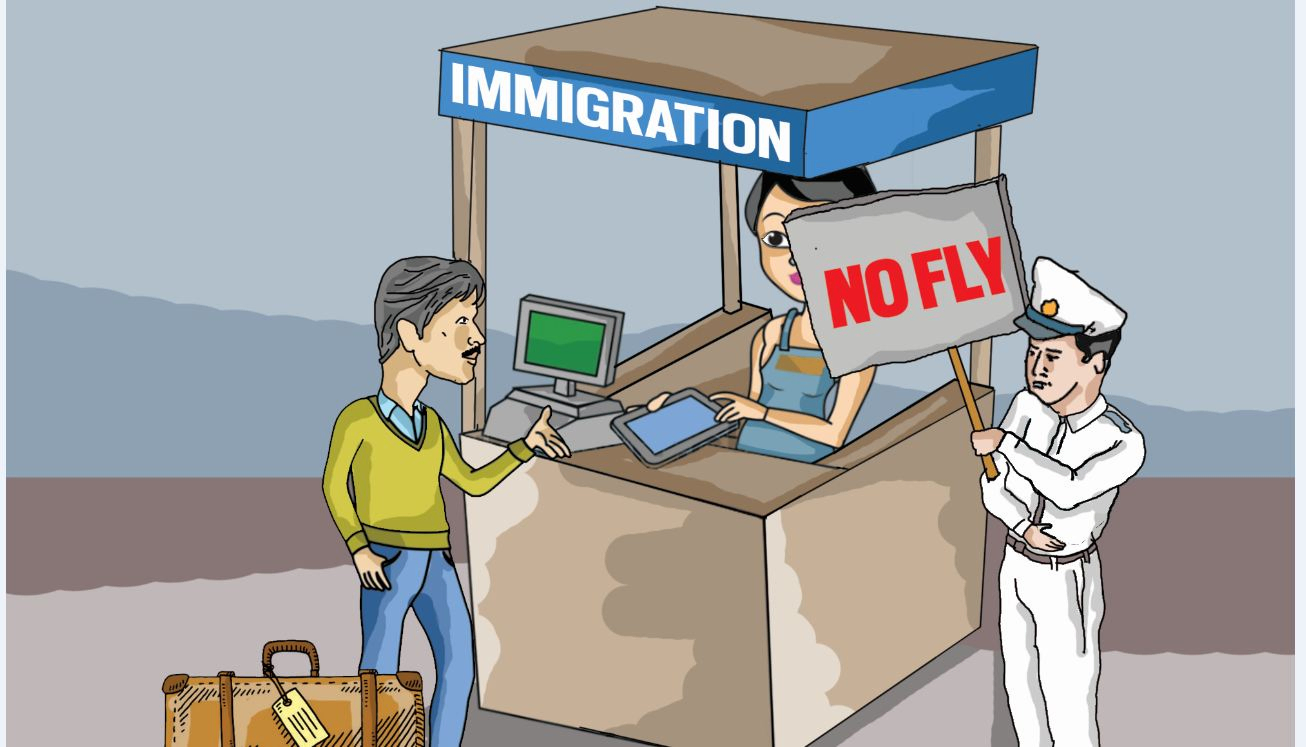
A Look Out Circular is an administrative alert issued by investigative agencies to immigration authorities to prevent certain individuals—often accused persons—from leaving the country. Typically, such circulars are issued when agencies believe there is a risk of flight or when the individual’s presence is necessary for investigation.
However, LOCs differ from judicial orders in one crucial respect—they are often issued without the knowledge of the affected individual. In many cases, a person discovers the existence of an LOC only when stopped at an airport.
This lack of transparency raises serious questions about due process. In the present case, the petitioner had already secured permission from a court to travel abroad. Yet, the existence of an undisclosed LOC effectively nullified that permission.
The Court noted that even the CBI’s internal guidelines require that reasons for issuing an LOC be recorded. If such reasons are absent, the circular cannot be enforced. This requirement is not procedural ornamentation—it is a safeguard against arbitrary State action.
LIBERTY AND THE CONSTITUTIONAL FRAMEWORK
Under the Constitution, Article 21 guarantees the right to life and personal liberty, permitting restrictions only through “procedure established by law”. When travel restrictions arise through administrative mechanisms lacking transparency or oversight, they risk infringing this constitutional protection.
The Court’s intervention therefore serves as a reaffirmation of constitutional values: liberty cannot be curtailed through undisclosed executive measures.
THE LARGER TENSION: INVESTIGATION VS FREEDOM
Investigative agencies often argue that secrecy is essential to prevent flight risks. Yet, individuals also possess a fundamental right to know what restrictions have been imposed upon them.
The Supreme Court’s query—why an LOC cannot be served or communicated to the accused—touches the core of this tension. Transparency does not necessarily compromise investigation; rather, it ensures that restrictions are lawful, reasonable, and proportionate.
Globally, legal systems face similar dilemmas. The Court’s insistence on procedural clarity reflects an effort to harmonize investigative efficiency with constitutional rights.
PROCEDURAL FAIRNESS AS A CONSTITUTIONAL IMPERATIVE
Procedural fairness is not an administrative courtesy—it is a constitutional necessity. By directing the CBI to frame an SOP for LOC issuance, the Court seeks to institutionalize safeguards against misuse.
A structured procedure would ensure consistency, accountability, and clarity in the exercise of investigative powers.
IMPLICATIONS BEYOND THE CASE
The Court’s intervention could potentially reshape India’s LOC framework. A formal SOP might include:
- Clear documentation of reasons for issuing an LOC.
- Mandatory communication to the affected individual.
- A mechanism for judicial review.
- Coordination between investigative agencies and courts to avoid conflicting directives.
Such measures would align investigative practices with constitutional principles while preserving the State’s ability to conduct effective investigations.
COMPARATIVE PERSPECTIVES
In several jurisdictions, restrictions on travel are subject to stronger judicial oversight.
In the United States, individuals placed on “no-fly lists” can challenge their inclusion through legal processes. In the United Kingdom, movement restrictions typically arise through court-issued control orders. Across the European Union, limits on liberty must satisfy the principle of proportionality and are subject to judicial scrutiny.
India’s LOC regime, historically administrative in nature, has lacked comparable procedural safeguards. The Supreme Court’s scrutiny may mark the beginning of a shift towards global standards of transparency and accountability.
CONCLUSION
The Court’s observations in Nimesh Navinchandra Shah vs Central Bureau of Investigation extend beyond a single petitioner’s grievance. They signal a broader effort to ensure that State power operates within constitutional boundaries.
As Justice Nath succinctly put it: “LOC is not a confidential document.” The statement reflects a larger constitutional truth—liberty cannot be curtailed by secrecy. In a democracy governed by the rule of law, transparency and accountability are not obstacles to investigation; they are its foundation.
—The author is an Advocate-on-Record practising in the Supreme Court,
Delhi High Court and all district courts and tribunals in Delhi
[ad_2]
Source link

