


About the Program
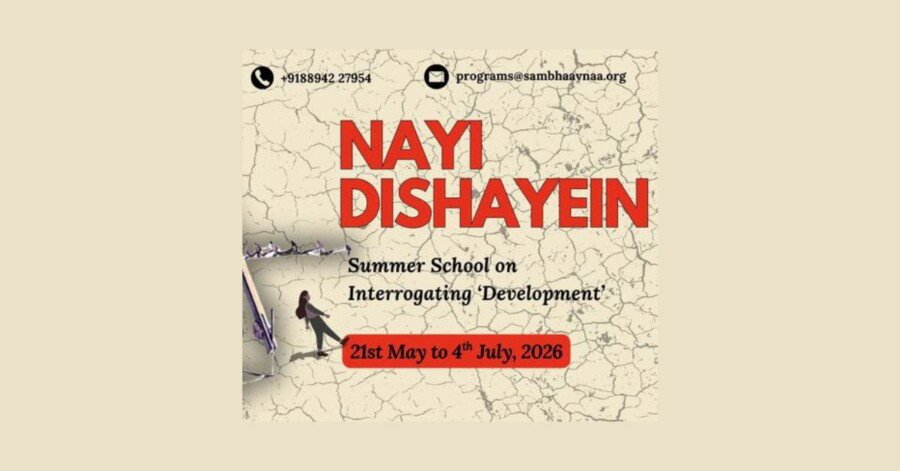
Sambhaavnaa Institute has been organizing a participatory, reflective, and perspective-building program called Nayi Dishayein that interrogates ‘development’ and seeks to understand its history and origins, its workings, and its ramifications on people and the planet.
In this program, we invite curious young people to:
- Critically examine the notion of development: Where did it come from? How and why have we bought into it so uncritically?
- If it is all about economics, economic systems, and economic models, what exactly is an economy? What is our current economic system, where did that come from, and can there be other ways of organizing our economy? Can we have infinite growth on a finite planet? Can GDP be the be-all and end-all of human well-being?
- Can we discern the root causes of growing inequality and the unequal opportunities in this model of development? Can we understand its compulsions to crush both people and the planet on its way?
- We are, to start with, a country quite fractured along the lines of gender, caste, class, ethnicity, religion, sexuality, and knowledge: Does this kind of development heal those fractures or further deepen them?
- Finally, how have people been countering these onslaughts, if at all? What role and impact do these people’s movements have against this juggernaut? What is their contribution to a more just and sustainable society?
- What can my role as a young individual be in all this?
This program aims to interweave theory and practice. The first part of the program is a 10-day campus-based component that will focus on building a varied and dynamic understanding of some of the pertinent issues facing our society today. It deploys a mix of lectures, classroom discussions, exercises and presentations, field trips, theater, film/documentary screenings, songs of resistance, and the sharing of lived experiences by activists and scholars.
The second part of this program shall involve field immersion for four weeks with some ongoing social change initiatives (in groups of 2–3). Participants will travel to a grassroots organization.
Participants will return to Sambhaavnaa Institute for the third part of this program (for 4 days) to reflect on their learnings and experiences based on their internship.
Resource Persons
- Janaki Srinivasan: Janaki Srinivasan teaches political science at Panjab University, Chandigarh. Her research interests are in development studies and political theory, with special attention to theory from the global south, the politics of social movements, and feminist theory and practice. Janaki facilitates ‘Gender and Development’ session at the Nayi Dishayein program at Sambhaavnaa Institute.
- Anirban Bhattacharya: Anirban Bhattacharya leads the National Finance team at the Centre for Financial Accountability (CFA), where he writes and campaigns on socio-economic issues, inequality, and democratic rights in India’s financial system. He engages in research and advocacy to promote transparency and accountability of financial institutions and economic policy.
- Himanshu Kumar: Himanshu Kumar is a Gandhian activist who, together with his wife, ran the Vanvasi Chetana Ashram in Dantewada, Chhattisgarh, for 22 years. He learned the local Adivasi language (Gondi) and worked through the Ashram to help Adivasis access their rights under the law. Starting in 2005, during the murderous Salwa Judum campaigns of vigilante groups against the Adivasis of Bastar in Chhattisgarh, Himanshu worked to try to get villagers back to their homes, get people falsely accused out of jail, and win justice for the victims of police and vigilante crimes. His Ashram was eventually bulldozed and he was forced to move to Delhi, from where he continues to try to follow up with legal cases on the state’s treatment of the Adivasis.
- Mohammad C: Mohammad is an activist and educator dedicated to social justice through community engagement and critical pedagogy. For over a decade, he has been a core facilitator at Sambhaavnaa Institute, leading workshops that bring together youth, activists, and professionals to challenge systemic inequalities. He focuses on political education and social transformation, using Theatre of the Oppressed as a participatory tool to deepen understanding and collective reflection.
- Fatema Chappalwala: Fatema is an educator and environmentalist with experience in political education and program coordination. She designs and facilitates workshops on gender, environment, development, and waste management, using creative and participatory methods such as Theatre of the Oppressed and experiential learning. As a writer and curriculum designer, she is deeply committed to using education as a tool for social and environmental transformation.
Nitin Varghese: Nitin Varghese is a core member of the Jagrit Adivasi Dalit Sangathan (JADS), a collective that has been working for over 20 years to advocate for the rights of Dalit and Indigenous communities in rural areas of Madhya Pradesh. These communities face systemic violations of their right to land, livelihood, access to resources and the right to live with dignity. Nitin Varghese is a vocal advocate on issues such as illegal deforestation, forced eviction of local communities, and the denial of access to land and forests. The human rights defender Nitin Varghese and other defenders associated with the Jagrit Adivasi Dalit Sangathan have been repeatedly targeted in reprisal for their peaceful campaigns in support of the land and environmental rights of the Adivasi community in the Burhanpur District, Madhya Pradesh.

Who is the program for?
This program is open to anyone in the age group of 21–28 who is:
- Seeking to engage with the above questions
- Someone who aspires to work in the development sector
- Seeking to make sense of the contradictory world we live in
- Grappling with one’s role in a humane and sustainable world.
Dates
- 21st May to 30th May 2026: Program at Sambhaavnaa campus (First part)
- 1st June to 30th June 2026: 4 weeks of internship (Second part), Travel days included
- 1st to 4th July 2026: Reflections about the internship at Sambhaavnaa campus (Third Part)
Venue for the campus components
Sambhaavnaa Institute, Kandbari, Tehsil, Palampur, District Kangra, PIN 176061, Himachal Pradesh.
Language & Fee
Language: This program will be conducted in English and Hindi. Basic proficiency in both is required. (Speaking either English or Hindi is sufficient, but the ability to understand both is essential.)
Contribution to the Program: They request participants to contribute an amount of Rs. 6,000 towards workshop expenses, inclusive of all onsite workshop costs: boarding, lodging, and all the materials used in the workshop. Travel will be borne by the participants.
How to Apply?
Interested candidates can apply online via the link given at the end of the post.
Click here to Apply.
