




Kundalpur is a town in the Damoh district of Madhya Pradesh. It is a prominent Jain pilgrimage center consisting of about sixty temples. It is one of the earliest and largest Jain sites in central India.1 Legends tell that the town’s name is after the nearby hill’s kundal-like (earring) shape. According to a legend, Mahendrakirti Bhattaraka discovered the Jain temples over these hills. The legend goes that he once visited Hindoria and lost his route while searching for Vairatnagar. He somehow reached Patera village. However, there was no Jain temple in the town. The saint had vowed to take food only after seeing a Jain statue. Two days had passed, and the saint was without food. On the third night, he had a dream where he was instructed to go to Kudalgiri hills, which had a Jain temple. The saint reached the hills, but no villager knew about the said temple. One older man from the Bhil community helped the saint locate the temple. The saint was very pleased to find the temple and its statues. He cleaned the temple and appointed the Bhil older man as its caretaker. Since then, the place has been famous for pilgrimage.2
Late nineteenth-century documents show that the town was a famous Jain pilgrimage site, and a fortnight-long annual fair was held in March.3 The fair was so large and important that the chief trade of the Damoh district used to come from it. The fair traces its origins to the Jain temple erected by the Punwar Banias.4 J D Beglar was the earliest archaeologist who visited the site in 1878. In brief, he describes whitewashed Jain temples on the top of a hill spur, locally known as Bahori Ban (Boorabun on maps).5 Cunningham visited the town in 1885 and described the temples with some details. While Beglar tells the chief image of Neminatha, Cunningham identified it as of Mahavira, stating a lion on its pedestal. He also mentions an inscription of Chhatrasal (1649-1731), dating Samvat 1757, corresponding to 1700 CE. He also notices another inscription dating to Samvat 1501. He discovered two more temples near the pond, both flat-roofed. One was empty, and the other had an image of Vishnu. These temples are generally assigned to the 6th CE, and these are the earliest architectural remains in the Damoh district. He further tells that the fair that used to be held in March had not been held for the past thirteen or fourteen years. The reason for this was an agreement that the then-deputy commissioner and fair planners made to keep the fair during colder months, but when the time came, the attendance was very low. For this reason, the fair was not organized in the coming years.6
Russell, who edited the district gazetteer in 1906, mentions that the fair, which was in abeyance for almost thirty years due to water supply deficiency, had been revived at the instance of Seth Brindawan Parwar Bania, the fair’s manager. The most important fair ceremony is Jaljatra, where the idol is bathed in water and the water is subsequently auctioned. The fair is the place for an annual panchayat where all the matters related to the Parwar Bania community are settled.7 The town has witnessed considerable progress, with new Jain temples being constructed and old ones renovated and enlarged. The fair continues to be held yearly, though the nature and grandeur have changed with time.


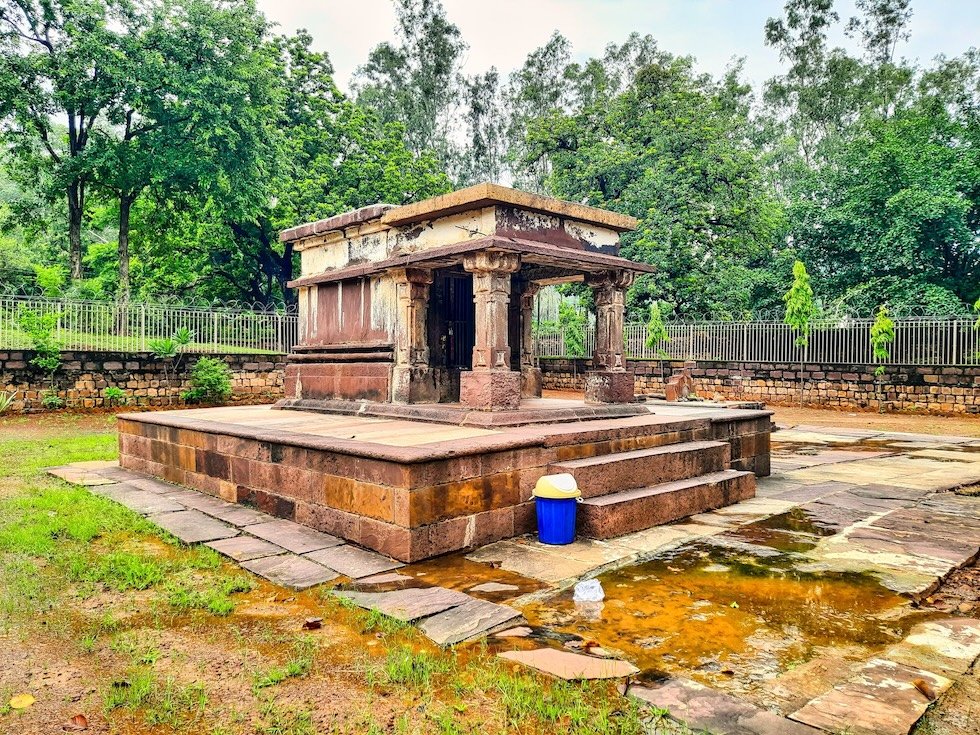
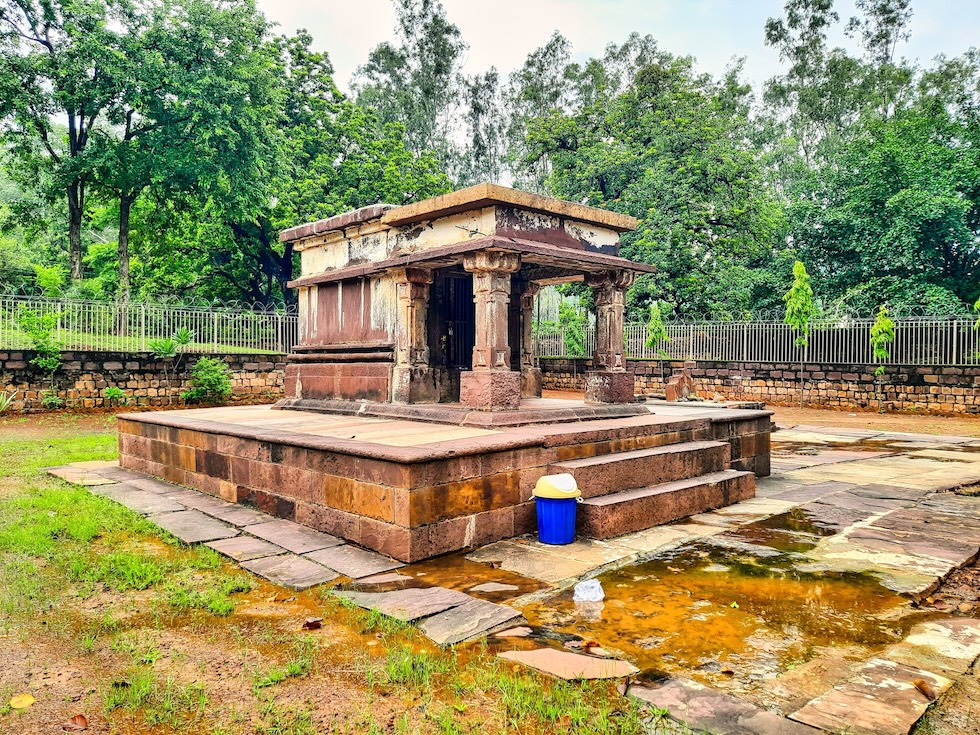
Vishnu Temple – Beglar and Cunningham mentioned two temples in the complex. However, only one has survived. The temple faces north and is built on a low-rise jagati (platform) approached with a two-step staircase. It is composed of a garbhagrha and a mukha-mandapa. The front pillars of the mukha-mandapa have heavy square bases supporting an orthogonal shaft. On the top are heavy brackets supporting a flat roof. The garbhagrha is a square room supporting a flat roof. A few images are placed inside the garbhagrha. Beglar and Cunningham only mentioned an image of Vishnu that is still seen inside the garbhagrha. They did not mention the rest of the statues, and it seems they were placed sometime later. Among these is a statue of Uma-Maheshvar and a yaksha-yakshi, attendants of a Jain tirthankara. The temple’s flat-roof style made Cunningham declare that the temple was constructed during the post-Gupta period of 600 CE or later. Not many scholars have agreed with this suggestion; the style and compositions of statues inside the garbhaghra also do not conform to the Gupta or post-Gupta conventions. These statues are generally assigned to the Kalachuri period.8 S N Mishra has included these temples in his list of Gupta temples, stating that Cunningham’s suggestion that these temples are similar to the flat-roofed temples at Tigawa and Udayagiri, but this does not hold as the temple in Kundalpur has a single slab flat roof and other temples have multiple slabs forming the flat roof.9


Jain Temples – More than fifty temples are strewn around the Vardhamana Tank and over the hill encircling the tank. The main temple is over the hill and dedicated to Mahavira. The temples were restored during the reign of the Bundela king Chhatrasal in the eighteenth century CE. The whitewashed temples can be seen from a long distance and mark the majesty of this Jain pilgrimage site as an atishaya-kshetra.
Inscriptions: Alexander Cunningham reports two inscriptions from the Jain temples.
- Inscription of Chhatrasal10 – It is a 24-line inscription dated to Samvat 1757, corresponding to 1700 CE. The inscription refers to the rule of the Maharajadhiraja Shri Chhatrasal. Not all verses are very clear, but what could be gleaned from the read lines suggests that the restoration of the present Mahavira temple was initiated by a pupil of Bhattaraka Surendrakirti, who belonged to the Mulasangha, Balatkargana, Sarasvatigacha. The genealogy of Surendrakirti is provided, starting from Yashakirti, followed by Lalitakirti, Dharmakirti (author of Ramadevapurana), and Padmakirti.
- Inscription in a small temple11 – the inscription is dated to Samvat 1501. No further details are known.
1 Titze, Kurt (1998). Jainism, a Pictorial Guide to the Religion of Non-violence. Motilal Banarasidass. New Delhi. ISBN 9788120815346. p. 125
2 Javeri, Thakurdas Bhagavandas (1914). Bharatvarshiya Digambar Jain Directory. pp. 261-262
3 Grant, Charles (1870). Gazetteer of the Central Provinces of India. Education Society Press. Bombay. p. 249
4 Hunter, W W (1881). The Imperial Gazetteer of India, vol. III, Dabha to Harduaganj. Trubner & Co. London. p. 30
5 Beglar, J D (1878). Report of a Tour in Bundelkhand and Malwa, 1871-72, and in the Central Provinces, 1873-74, vol. VII. Government Printing. Calcutta. p. 58
6 Cunningham, Alexander (1885). Reports of a Tour in Bundelkhand and Rewa in 1883-84; and of a Tour in Rewa, Bundelkhand, Malwa, and Gwalior, in 1884-85, vol. XXI. Government Printing. Calcutta. pp. 166-167
7 Russell, R. V. (1906). Central Provinces District Gazetteer, Damoh District. The Pioneer Press, Allahabad. pp. 203-204
8 पाठक, अशर्फीलाल (1981). दमोह जिला का ऐतिहासिक पुरातत्त्व, Ph.D. thesis (unpublished) submitted to the Sagar University. pp. 155-156
9 Mishra, Sudhakar Nath (1992). Gupta Art and Architecture. Agam Kala Prakashan. New Delhi. pp. 84-85
10 Lal, Hira (1916). Descriptive Lists of Inscriptions in the Central Provinces and Berar. Government Press. Nagpur. p. 52 | Javeri, Thakurdas Bhagavandas (1914). Bharatvarshiya Digambar Jain Directory. pp. 259-261
11 Lal, Hira (1916). Descriptive Lists of Inscriptions in the Central Provinces and Berar. Government Press. Nagpur. p. 52
Bibliography:
सोनी, संजय बाबू (2002). दमोह जिले का पुरातत्त्व, Ph.D. thesis (unpublished) submitted to the Dr. Harisingh Gour University, Sagar. pp. 226-227
Acknowledgment: Some of the photos above are in CC0 1.0 Universal Public Domain from the collection released by the Tapesh Yadav Foundation for Indian Heritage.