


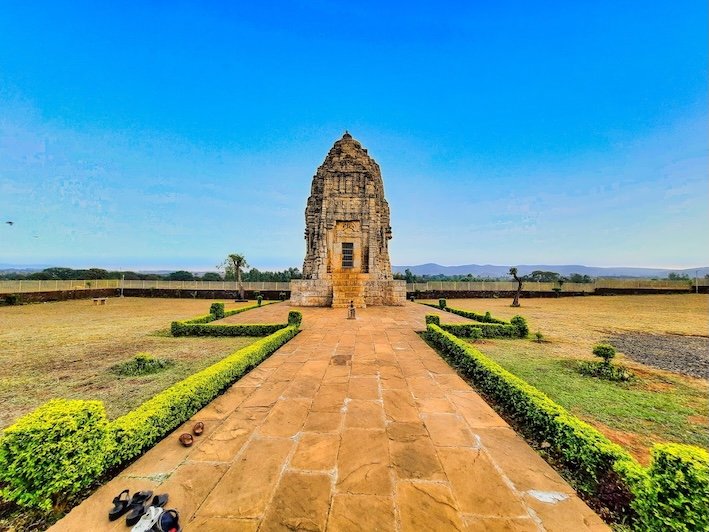


Kukarramath (or Kakarramath) is a village in the Dindori district of Madhya Pradesh. It is named after the temple of Shiva, locally known as Kukarramath. The legend behind the temple tells that once a Banjara (a nomadic community) owned a much-prized dog. He was compelled to pawn it with a Bania (money-lender). After a while, once, when the Bania was asleep, a few thieves broke into his house, stealing money and hiding in a nearby pond. The next morning, the dog led the Bania to that pond, and the latter was able to retrieve the stolen money. In gratitude, the Bania freed the dog, allowing him to reunite with his original master. The Banjara, seeing the dog, thought that it had escaped from the Bania. His pledge being broken, the Banjara killed the dog before finding a note attached to its collar stating the release from the Bania. He was so overcome with grief that he renounced life and devoted all his time to building a temple standing over the dead body of the dog. The temple came to be known as Kukarramath, or the math of the dog. The present name, Ranmukteshwar (ऋणमुक्तेश्वर), also suggests that the enshrined god frees the worshippers from all debts & obligations. Another popular legend, instrumental in enhancing the temple’s importance, says that a cobra with red eyes circles the linga every night and spreads its hood over it.1


Ranmukteshwar Temple – The temple faces west and stands over a jagati (platform). It consists of a square garbhagrha (sanctum) and a narrow antarala. The sanctum doorway consists of multiple shakhas (bands); however, these are much defaced. The lintel has five niches occupied by standing deities. Identifying these is unclear; however, these five, with the four in the recesses, could represent the navagrha group. Decorative pediments are placed above these five niches, spanning the four levels. Below the lintel is a semi-circular makara-torana with two horse-riders emerging from the makaras at the base. This piece appears out of place and could be used during conservation.


The temple follows the pancharatha (five projections) plan. The adhishthana has multiple mouldings. A miniature temple with a long shikhara adorns the bhadraratha of the adhishthana. A large niche is provided on the bhadra-ratha (middle projection), and a small niche is provided over the karnaratha (corner projection). The bhadra niche is beautifully decorated with pillars on the extreme sides. These niches are designed as small shrines with a doorway consisting of multiple shakhas. River goddesses are placed over the bases of the jambs, and lintels are decorated with the main deity over the latalabimba. Surya is present over the lalatabimba of the eastern bhadra niche. The bhadra niches are vacant at present. The temple is generally assigned to the 10th-11th century and was built during the Kalachuri dynasty.
1 Rudman, F R R (1912). Central Provinces District Gazetteers – Mandla District Gazetteer, vol. A-Descriptive. The Times Press. Bombay. p. 240
Acknowledgement: Some of the photos above are in CC0 1.0 Universal Public Domain from the collection released by the Tapesh Yadav Foundation for Indian Heritage.