

Kodal is a village located in the Damoh district of Madhya Pradesh. Not much is known about the history of the place, except that it would have held considerable importance during the Kalachuri period, when a temple with a monastery was constructed here. The growth of the Mattamayura sect drove the construction of Shaiva temples during the Kalachuri period. The teachers of this sect generally selected small or minor villages that were well-suited for the propagation of their sect.


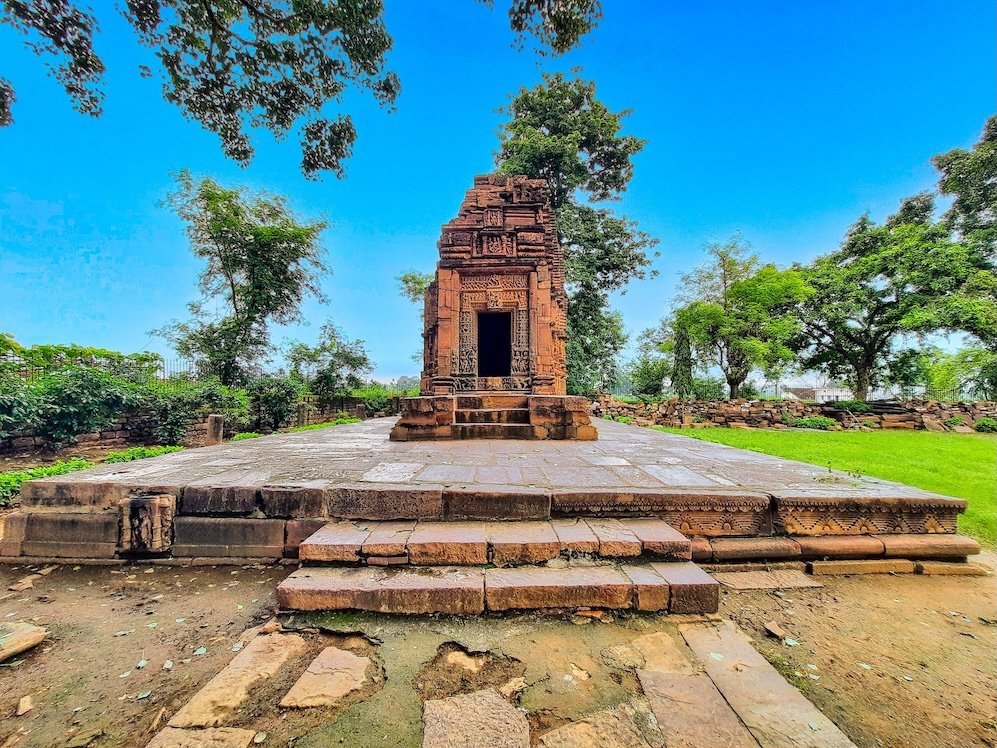
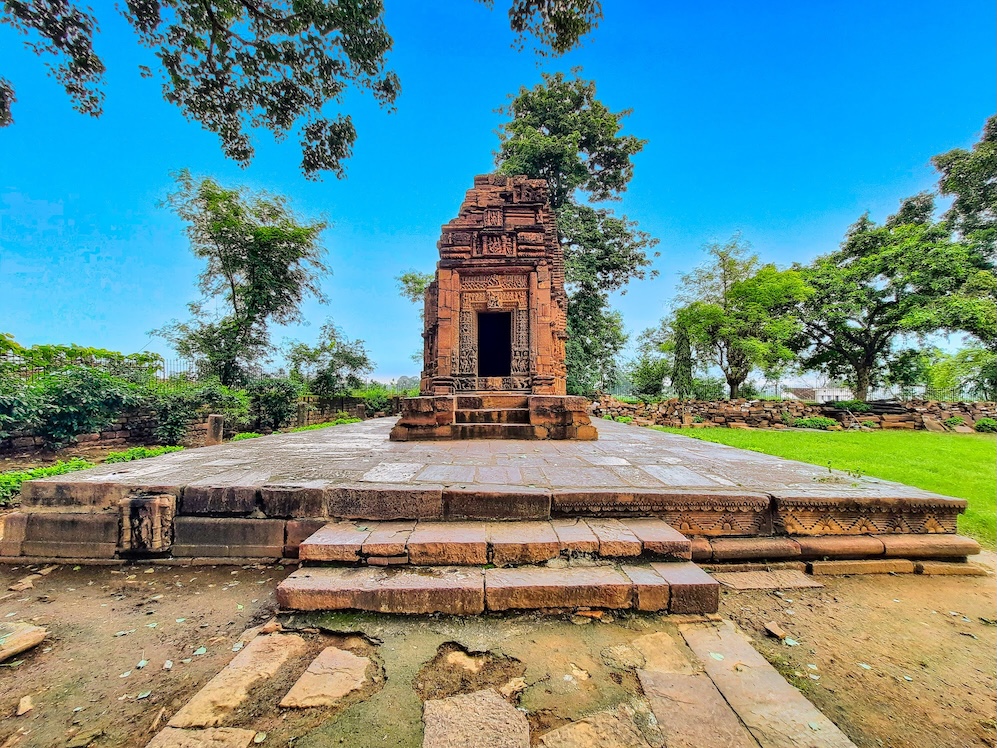
Shiva Temple — The temple is built in the middle over a low jagati (platform), leaving ample space for parikrama (circumambulation). The jagati is composed of multiple moldings. As the temple is renovated using fallen materials, the original moldings of the jagati could not be ascertained. The temple consists of a garbhagrha and an antarala. It might have a mukha-mandapa in the front, but that has not survived.1


The garbhagrha doorway is elaborately carved and comprises six shakhas (jambs). The outermost shakha features dvarapalas at the bottom. The right dvarapala has a fierce appearance, representing Mahakala, and the left dvarapala has a softer appearance, representing Nandi. A floral motif runs above the dvarapalas across the jambs. The inner next shakha has three niches on each shaft, while the bottom part has river goddesses, Ganga and Yamuna. The river goddess panels occupy the space corresponding to these and the remaining four inner shakhas. The niches over the shafts have images inside, except the one which shows shivalinga worship, the rest have secular images of musicians and dancers. The following four inner shakhas are decorated with nagas, flowers, and circular and diamond motifs.


The lintels are also carved with a multitude of images. The lalata-bimba depicts Shiva and Parvati in Kalyanasundara-mudra, while Brahma officiates the wedding. The latter is shown between the couple near a yajna-kunda. On either side are distributed nava-grahas (nine planets), four on one side and five on the other. At the terminals are niches housing images of goddesses, Parvati on the left and Kali on the right. The lintel above features Shiva as Nataraja in the middle niche, accompanied by the Sapta Matrikas, with Ganesha and Shiva-Veenadhara. Ganesha and Veenadhara are typically depicted at either end of the Matrikas group; they are shown here standing at the end of the frieze, after Chamunda.


The temple follows the pancharatha (five projections) plan. The temple’s adhisthana (or vedibandha) is composed of multiple moldings. The lowermost molding is a khura decorated with flower motifs. Above it rises a kalasa, padma, kalasa, antarapatta with lattice design, and kapotapali. Above it rises jangha, composed again of multiple moldings. The base comprises bhitta and a large kumbha, the latter decorated with niches housing images of deities. It is topped with a padma, kalasa, antarapatta, and kapotapali moldings. The upper part is divided into two tiers, separated by a bandhana molding. Niches are provided only on the lower tier, bhadra; the rest of the projections are studded with images without niches. The upper tier bhadra does not have an image but a udgama pediment. Niches are also provided on the kapili; however, the niche in the north is empty, while the one in the south carries an image of Ganesha.


Among the prominent sculptures over the kumbha are Parvati in the north, Surya in the east, and Ganesha in the south. The bhadra in the north has not survived and been rebuilt with plain stones; the bhadra in the east features Shiva-Tripurantaka, and the one in the south features Shiva-Nataraja. Krishna Deva identifies the image in the east as Andhakantaka; however, the posture of Shiva drawing an arrow from his quiver suggests that it could represent the episode of destroying the three celestial cities built by the asura brothers, Tarakaksha, Kamalaksha, and Vidyunmali, known as Tripura. Shiva destroying the three cities with a single arrow is a well-known theme in the Shaiva literature. The karna has images of dikpalas in the lower tier, while the upper tier has their respective shaktis. The pratiratha has apsaras on the lower tier and flying vidyadharas on the upper tiers. Apsaras are also found in the recesses between the rathas in the lower tier; vyalas occupy the respective space in the upper tier.
The temple is generally dated to the 10th century CE.1 There have been considerable restoration and repair works in the past, resulting in the present well-preserved state of the temple and its compound. The original stone masonry of the compound wall was restored and water-tightened in 1985 and completed in 1988. In 2001-02, the compound wall was provided with an iron grill for the security and safety of the temple.2


Monastery – Locally known as Rukmani Matha, it was initially a two-story Shaiva monastery. It is located near a Shiva temple, so this monastery probably served as an educational institution. Sears suggests that, alongside the ascetic retreat monastery at Raneh, the Kodal monastery served the twin-monastery model, which was generally followed by the Mattamayura sect during the Kalachuri period. The Kodal monastery served as an institutional center, while the Raneh monastery served as a satellite retreat for ascetics. These centers are not more than 20 km apart, so that this twin-monastery model would have worked well for the residents and students.3
1 Deva, Krishna (1995). Temples of India. Aryan Books International. Delhi. ISBN 817305052X. p. 166
2 Indian Archaeology, 1985-86 – A Review. p. 160 | Indian Archaeology, 1986-87 – A Review. p. 145 | Indian Archaeology, 1987-88 – A Review. p. 179 | Indian Archaeology, 2001-02 – A Review. p. 389
3 Sears, Tamara (2014). Worldly Gurus and Spiritual Kings, Architecture and Asceticism in Medieval India. Yale University Press. London. ISBN 9780300198447. p. 224
Acknowledgement: Some of the photos above are in CC0 1.0 Universal Public Domain from the collection released by the Tapesh Yadav Foundation for Indian Heritage.