
India Legal Bureau
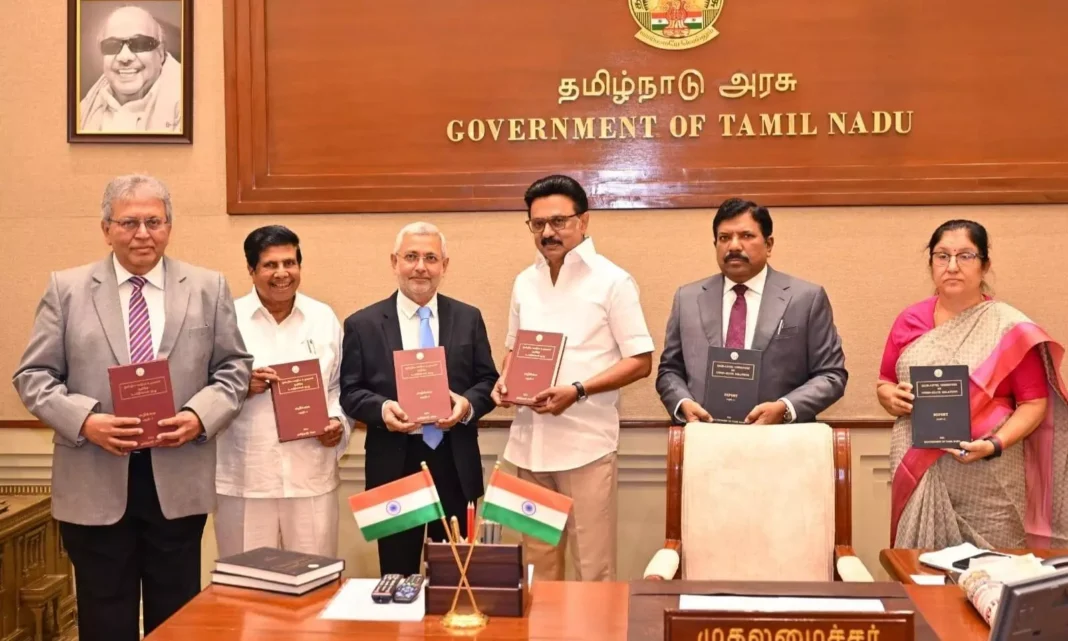
The Tamil Nadu government’s tabling of the Justice Kurian Joseph Committee report on Centre-state relations in the state assembly on February 19 has enjoyed headline space for its recommendations to cut down the powers enjoyed by the Governor and a greater states’ say in constitutional amendments, the report, however, goes further into the federal structure and the language issue.
Chaired by Justice Kurian Joseph, the former Supreme Court judge, the committee’s other members include former Indian Maritime University vice-chancellor and retired IAS officer K Ashok Vardhan Shetty, and former Tamil Nadu Planning Commission vice-chairman Dr M Naganathan.
Set up in April 2025, the committee is the fourth major effort to review Union-state relations at the national-level and the second by the TN government after the Rajamannar Committee (1969-71).
The Sarkaria Commission (1983-88) and the Punchhi Commission (2007-10) had examined the evolving relations between the Union and the states. But given that significant constitutional, fiscal and institutional changes have taken place since then, the committee and its recommendations assumes greater importance. It must be noted that Centre-state ties have been strained under several heads including the GST share and the delimitation exercise.
Among the highlights of the report are decentralisation and federal restructuring, arguments against excessive centralisation that has weakened governance, distorted accountability, and undermined cooperative federalism. The document proposes major amendments to the Constitution across 10 thematic areas.
Framing its proposals as a necessary “federal reset,” the report argues that cooperative federalism must be institutionalised rather than dependent on political goodwill. It envisions the Union and states functioning as equal constitutional partners, with authority matched by responsibility.
Summing up their recommendations, the report’s authors state in the preface of Part 1: “The Committee is firmly of the view that Indian federalism now requires a structural reset comparable in ambition to the economic reforms of 1991. A federation that trusts its States, respects subsidiarity, empowers local governments, and accommodates heterogeneity does not weaken sovereignty; it deepens democracy. Unity in such a system is sustained not by command but by consent, not by enforced uniformity but by negotiated accommodation, and not by the concentration of power but by its principled distribution.”
“The objective is not to diminish the Union, but to right-size it. As K. Santhanam warned in the Constituent Assembly, the Union’s strength lies not in the accumulation of functions, but in the disciplined refusal of responsibilities that do not belong at the national level,” the committee states.
Here are the salient heads under which the recommendations have been made:
Stronger Federal Framework
At its core, the report makes the constitutional case for decentralisation, advancing 11 principles including the “Liberty Argument” (divided power safeguards freedom), the “Resilience Argument” (centralised systems fail under stress), and the “Innovation Argument” (States as laboratories of reform). It also critiques what it terms the “Uniformity Fallacy” and “Control Fallacy” that have justified over-centralisation.
A central proposal is to overhaul Article 368 to make constitutional amendments significantly more rigorous. Most amendments would require a two-thirds majority of the total membership of both Houses of Parliament and ratification by two-thirds of States representing two-thirds of India’s population. The report also calls for codifying the Constitution’s Basic Features within the text itself and mandating public consultation before any amendment is introduced.
Territorial Integrity and State Consent
The recommendations seek to curb unilateral territorial reorganisation under Articles 2 and 3. Any creation or alteration of States would require the consent of affected State Legislatures, with referendums mandated in certain cases. The creation of new Union Territories would be barred under a proposed Article 3A, while existing Union Territories (except Delhi) would face periodic referendums on statehood or merger.
English as Official Language
The report challenges the dominance of Hindi in official policy. It proposes amending Article 343 to permanently entrench English as an official language of the Union and to declare all Eighth Schedule languages as Union official languages, drawing comparisons to the multilingual framework of the European Union.
The document calls for correcting Census classifications that group several languages as “dialects of Hindi” and recommends including all languages with over one million native speakers in the Eighth Schedule. It also advocates replacing the Special Officer for Linguistic Minorities with a National Language Commission and abandoning the “Three-Language Formula” in favour of high-proficiency bilingualism — English and the regional language.
Reforming the Office of Governor
Significant changes are proposed to Articles 155 and 156 to insulate Governors from political influence. The President would be required to appoint a Governor from a panel approved by the State Assembly, with a fixed, non-renewable five-year term. Removal would require a majority resolution of the State Legislature.
A new “Instrument of Instructions” would codify limits on gubernatorial discretion, particularly in government formation and assent to State Bills. Mandatory timelines for assent are proposed, drawing on the Supreme Court’s 2025 ruling in State of Tamil Nadu v. Governor of Tamil Nadu.
Pausing Delimitation Until Fertility Rates Converge
The report recommends extending the freeze on inter-State seat allocation in the Lok Sabha until 2126 or until fertility rates converge nationally. It also proposes equal representation of States in the Rajya Sabha — six seats each — replacing the current population-based disparities and abolishing nominated members. Separate Union and State Delimitation Commissions are proposed to prevent excessive central control.
Electoral Reforms
The document calls for separating Union and state election administration, limiting the Election Commission of India to national polls. It strongly opposes the proposed simultaneous elections reform, arguing it violates federal balance and the Constitution’s basic structure.
Anti-defection laws would be tightened to impose a six-year ban from contesting elections for defectors, with adjudication shifted from Speakers to High Courts. The right to vote would be made a Fundamental Right, alongside a proposed Fundamental Duty to vote.
Education and Health Decentralisation
Education and medical education would be moved back to the State List, reversing the 1976 shift to the Concurrent List. The Union’s regulatory role would be confined to setting minimum standards.
The report recommends dismantling the National Testing Agency and abolishing national entrance exams such as NEET, restoring admissions control to States and universities. It also proposes major amendments to the National Medical Commission Act to repeal NEET and the proposed National Exit Test (NExT).
GST Reforms to Restore Fiscal Federalism
Extensive changes are proposed to Article 279A governing the GST Council. Options include reducing the Union government’s voting weight, raising quorum thresholds, or adopting a “one member, one vote” system.
The recommendations seek to codify the advisory (non-binding) nature of GST Council decisions in line with the Supreme Court’s ruling in Union of India v. Mohit Minerals Pvt Ltd. States would be allowed to vary SGST rates within a limited band, and an independent GST Dispute Settlement Authority would be created.
The report also calls for institutional reforms to GST rate-setting, including a single annual rate calendar and the principle of “One Product, One Rate.”