




By Dr Suresh Kumar
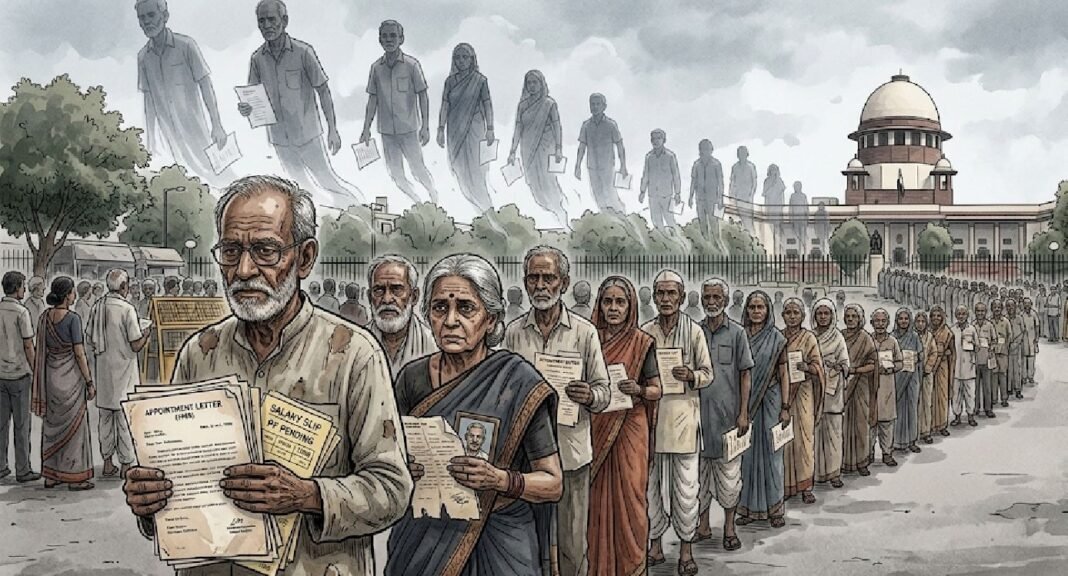
The greatest strength of a system is that it can even convert pain into statistics. In the case of Bihar’s long-pending bifurcation dues, those statistics are stark: 2,192 employees, 329 deaths, and over Rs 500 crore in unpaid salaries and benefits. Behind each number lies a story of hardship, delay and, for many, a lifetime spent waiting.
When Bihar was bifurcated in 2000 and Jharkhand was carved out as a separate state, it marked a major political and administrative shift. But in the process, a critical issue was left unresolved—the payment of salaries, pensions and service benefits to employees of several state-run corporations of undivided Bihar.
A quarter of a century later, that issue remains unsettled. Thousands of employees and their families are still waiting for dues that were never paid.
The matter is now before the Supreme Court in Bihar State Ardh Sarkari Arajpati Karamchari Maha Sangh & Ors vs State of Bihar & Ors. (Writ Petition (Civil) No. 932 of 2022). During the hearings, senior advocate Priya Hingorani told the apex court that the salaries and service benefits of around 2,192 employees have remained unpaid for years.
More disturbingly, she submitted that hundreds had died in the interim—victims, she argued, of poverty, hunger and lack of medical care. What might have appeared as a financial or administrative dispute was laid bare as a profound human tragedy.
The scale of the financial liability is significant. The governments of Bihar and Jharkhand together owe more than Rs 500 crore. Yet, only about Rs 125 crore has reportedly been deposited so far—far short of what is needed even for partial relief.
Petitioners have attributed the prolonged delay to bureaucratic inertia, administrative indifference and the complexities of dividing liabilities between two states.
But, beyond the financial dispute lies a deeper constitutional question. Under Article 21 of the Constitution, the right to life includes the right to live with dignity. Legal experts argue that denying employees the fruits of their labour for decades is not merely an economic lapse—it is a violation of that dignity.
Recognising the gravity of the situation, the Supreme Court took a significant step in March 2025 by appointing an inquiry committee headed by retired judge Dinesh Maheshwari. The committee was tasked with identifying affected employees and families, calculating dues, apportioning liability between the two states, and recommending a mechanism for payment.
Its interim findings have only underscored the urgency. Initially, 316 deaths were recorded among the affected employees. Soon after, that number rose to 329.
The committee also noted that families of the deceased must be included in any compensation framework.
The dispute centres on employees from five state corporations of undivided Bihar, including those in construction, industrial development, electronics, forest development and Panchayati Raj finance. For years, employees of these entities were left without salaries or benefits, their livelihoods effectively suspended in administrative limbo.
The legal struggle itself has stretched across decades. A landmark moment came in 2003 with the Supreme Court’s judgment in Kapila Hingorani vs State of Bihar, which recognised the plight of employees of state-run corporations. Yet, despite repeated litigation, petitions and interventions over the years, a comprehensive resolution has remained elusive.
As the case continues, the human cost becomes harder to ignore. Families of deceased employees continue to wait, hoping that what was earned through years of service will not be lost to procedural delay.
The larger question lingers: in a democratic system, can justice that arrives after a generation truly be called justice?
For now, thousands of families look towards the Supreme Court—and the governments of Bihar and Jharkhand—with a hope that has already endured for 25 years: that this unfinished story will finally reach its conclusion.
—The writer is Editor, Digital Operations and Special Events, at APN News and India Legal