


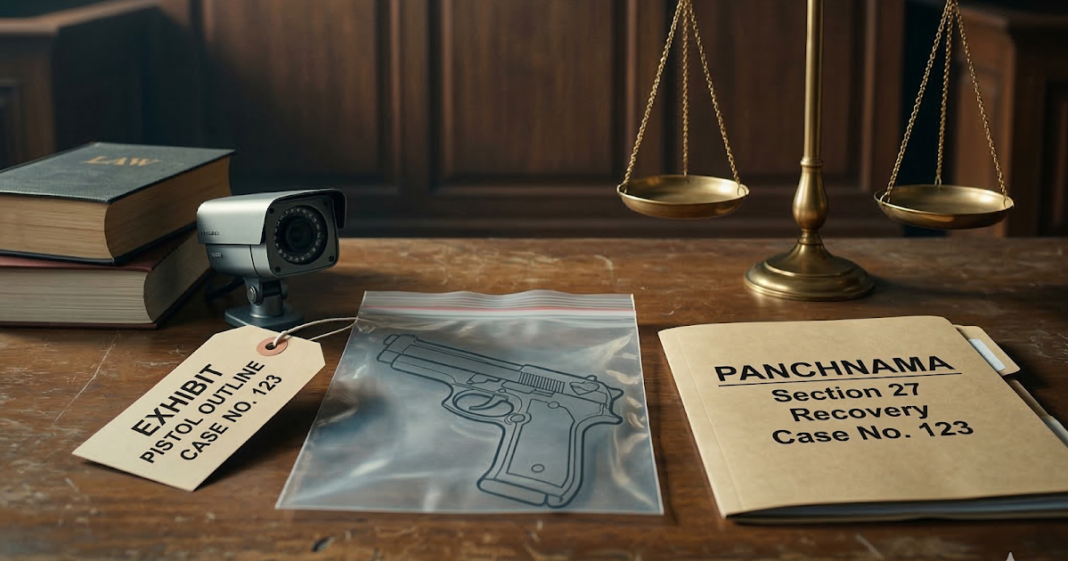

A recent jail‑escape prosecution from India offers a compact tutorial on almost every hard question in criminal evidence: how far a court can go on the word of a solitary witness; what to do with “demonstration panchnamas”; how to treat recoveries from open places; what Section 65B demands from CCTV evidence; and how to apply the Sharad Sarda “panchsheel” to a conspiracy theory built almost entirely on circumstantial proof.

Tried before a Sessions Court, the case involved multiple under‑trial prisoners allegedly escaping at gunpoint from a district jail with outside help, based on a blend of jail‑staff testimony, official panch witnesses, recovery panchnamas, city CCTV footage and forensic reports. The trial judge ultimately acquitted all appearing accused, and the reasoning—if generalised beyond the case‑specific facts—offers important lessons for judges, prosecutors and defence counsel alike.
1. Circumstantial evidence and the “mental distance” from “may be” to “must be”
For the alleged outside conspirators, the prosecution case was almost entirely circumstantial: phone‑based planning; supply of a pistol and ammunition by throwing them into the jail; provision of a motorcycle; and post‑escape shelter and assistance.
The starting point is still Sharad Birdhichand Sarda v. State of Maharashtra, where the Supreme Court distilled five “golden principles” for conviction based solely on circumstantial evidence. In essence:
-
Each circumstance must be firmly and fully established.
-
These circumstances must be consistent only with guilt, and of conclusive tendency.
-
They must exclude every reasonable hypothesis of innocence.
-
The chain must be so complete that in all human probability the act must have been done by the accused.
The Sessions Court correctly asked: do the alleged circumstances—disclosure‑cum‑recovery of a pistol, a motorcycle from a half‑built house, sketchy CCTV, and the movements of various accused—collectively meet this standard? On the record, they did not:
-
The pistol was recovered from a dilapidated, roofless house without door or compound; ownership was never proved; panch witnesses admitted that anyone could enter; and the alleged eye‑witness could not identify it as the weapon used.
-
The motorcycle came from a partly‑constructed open house, again with no proof of ownership or exclusive control and panchnama writing effectively done in the police station.
-
CCTV and hash‑value evidence did not identify any accused nor capture the crucial jail‑gate incident.
This is a textbook instance where the “mental distance between ‘may be’ and ‘must be’” in Sharad Sarda remained unbridged; at best, the evidence showed that some weapon and some vehicle existed in open locations, not that these particular accused formed a conspiracy and executed an escape.
2. Single‑witness testimony: applying Vadivelu Thevar in a hard case
Inside the jail, the prosecution’s star witness was the gate guard who claimed that three prisoners pointed pistols at him, snatched the keys and escaped. He was the only eye‑witness to that core incident; other jail staff were hearsay, and no prisoner testified.
Section 134 Evidence Act makes clear there is no legal requirement of multiple witnesses. But Vadivelu Thevar v. State of Madras remains the controlling authority on when a single witness can safely sustain a conviction. The Court there:
-
Classified witnesses as (i) wholly reliable, (ii) wholly unreliable, and (iii) neither wholly reliable nor wholly unreliable.
-
Held that in category (i) or (ii), courts can convict or acquit on that testimony alone.
-
For category (iii), courts must be “circumspect” and seek corroboration in material particulars.
In the jail‑escape case, the Sessions Judge did not treat the guard as “wholly unreliable”; but nor could the court accept him as “wholly reliable”:
-
Duty‑timing records and musters existed but were not properly proved to show he was posted on main‑gate duty at the exact time; the duty chart produced was riddled with corrections and blanks, and the witness who produced it admitted his statement was never recorded during investigation.
-
Despite an alleged scuffle, there was no seized shirt, no injury certificate, and no medical witness—though the guard claimed to have shown injuries to a doctor.
-
Crucially, the guard admitted that there was a CCTV camera above the main gate and multiple guards posted 24/7, yet the prosecution produced neither that footage nor any other main‑gate eye‑witness.
Applying Vadivelu Thevar, this places the guard in category (iii): “neither wholly reliable nor wholly unreliable”, where corroboration on core aspects is required. Because that corroboration was missing on identity of weapon, duty, injuries and manner of escape, the judge was right to hold that conviction solely on his testimony would be unsafe, without in any way branding him a liar.
3. Panch witnesses and official “independence”
The case also illustrates the recurring controversy over “independent” panchas. Almost all panchnamas here—spot, memorandum, recovery, demonstration, CCTV‑copying—used government servants (ST drivers, depot staff, traffic officers) deputed on oral instructions.
Some defence arguments tried to discredit them solely on that basis. The Supreme Court has rejected any rigid rule that panch witnesses must be private civilians. In Hazari Lal v. Delhi Administration, it emphasised that acquaintance with police or being routinely called as a panch does not, by itself, destroy independence; the real question is whether, in the facts of the case, the witness appears under police influence or has a stake in the outcome.
The Sessions Court applied that nuance: it did not discard official panchas merely because they were government staff. Instead, it looked to their own admissions:
-
No movement registers were produced, despite every office maintaining one.
-
Several panchnamas were plainly drafted in the police station, not at the scene; signatures were taken “as directed”.
-
No effort was made to ascertain ownership or four boundaries of crucial recovery places.
This is exactly how Hazari Lal and “golden rules” for panch evidence would advise a court to proceed: not by formulaic rejection of officials, but by close scrutiny of credibility and internal consistency.
4. Section 27 and the limits of “demonstration panchnamas”
Perhaps the most problematic feature of the investigation was the heavy reliance on “demonstration panchnamas”: accused being taken to various locations to re‑enact how the crime was committed, with long narrative statements recorded in the panchnama itself.
Section 25 Evidence Act bars confessions to police; Section 27 permits proof only of “so much of the information” from a person in custody “as relates distinctly to the fact thereby discovered”. The Privy Council in Pulukuri Kottaya v. King‑Emperor made it clear that the “fact discovered” is the place from which an object is produced and the accused’s knowledge of it—not the entire confessional story. Recent commentary and case law have repeatedly affirmed that Section 27 is about “discovery”, not the narrative of guilt.
Two developments sharpen this further:
-
The Nagpur Bench in Rahul s/o Kisan Jaybhaye v. State of Maharashtra (2025:BHC‑NAG:7427) squarely held that a demonstration by an accused showing how the offence was committed is a confession to police, hit by Section 25, and is not admissible even via Section 27; nor can it be salvaged as “subsequent conduct” under Section 8, because the bar of Section 25 must be crossed first.
-
The Court there relied on Bheru Singh v. State of Rajasthan and Aghnoo Nagesia v. State of Bihar to emphasise that only the non‑confessional, discovery‑related portion of such material can be used.
In the Sessions case, the judge effectively applied this approach:
-
All narrative descriptions in the demonstration panchnamas—who made which phone calls, who threw what over the wall, how the jail‑break was executed—were treated as inadmissible confessional material.
-
Only the bare “fact discovered” portions (e.g., that an accused led police to a certain house from which a pistol was taken out) were considered—and even those were ultimately found weak because the houses were open and ownerless and the weapon was not linked to the incident.
This is a salutary application of Section 27, avoiding the common trap of smuggling entire police‑stage confessions into evidence under the guise of “discovery”.
5. Open‑place recoveries and the Manjunath line
The weakness of the recoveries here is underscored by recent Supreme Court jurisprudence on Section 27 and open‑place discoveries. In Manjunath v. State of Karnataka, Criminal Appeal No. 866 of 2011 (MANU/SC/1212/2023), the Court reiterated that incriminatory objects discovered in places accessible to the public cannot be solely relied upon to establish guilt, citing Jaikam Khan v. State of U.P. and Nikhil Chandra Mondal v. State of W.B., where recoveries from open fields and public areas were found unreliable.l
The logic is simple and powerful: when a weapon is found in a room or field that is “accessible to one and all”, the inference that it was concealed there by the accused—and that only he had knowledge of that spot—becomes extremely tenuous. Section 27 still applies in theory, but the weight of such a circumstance shrinks dramatically.
In the Maharashtra jail‑escape prosecution, both critical recoveries suffered from this vice:
-
The pistol came from a dilapidated, roofless house without a door or compound, with no evidence of ownership and panch admissions that anyone could walk in.
-
The motorcycle was produced from a half‑constructed open structure near a highway, again with no proof of exclusive control or even inquiry into who owned the premises.
Against that backdrop, treating these as mere weak corroborative circumstances—and certainly not as decisive links in a chain—was entirely consistent with Manjunath and its predecessors.
6. Electronic evidence, CCTV and Section 65B
The prosecution also tried to lean on CCTV footage from city cameras, allegedly capturing the movements of some accused before or after the escape. But here too, the statutory architecture and case law are unforgiving.
Anvar P.V. v. P.K. Basheer and Arjun Panditrao Khotkar v. Kailash Kushanrao Gorantyal firmly established that where a party relies on secondary electronic evidence (CDs, DVDs, pen drives), a certificate under Section 65B(4) is generally a mandatory precondition, save where the original device itself is produced and proved by a competent witness.
In the Sessions case:
-
The original DVRs of the CCTV system were never seized or produced.
-
Data was first transferred to some intermediate device and then to a pen drive; hash values were not consistently generated at each stage.
-
Most importantly, no witness identified any of the accused from the footage, nor did the clips show the core incident at the jail gate.
Even if one assumes that a facially valid Section 65B certificate existed, the footage lacked the necessary reliability and specificity; it added little more than a vague impression that four unidentified persons once rode a motorcycle somewhere in the city. The judge was right to treat it, at best, as marginal corroboration, not as a pillar of the prosecution case
7. Why the acquittal was correct—and what it teaches
Put together, this case is less about “benefit of doubt” as a soft doctrine and more about hard failures of proof:
-
The State did not prove basic jail records (warrants, musters, duty timings) to situate the key actors in space and time.
-
It leaned heavily on narrative panchnamas and demonstration‑style re‑enactments that are largely inadmissible under Sections 25 and 27.
-
It relied on recoveries from open places without proving ownership or exclusive knowledge, contrary to the cautionary line in Manjunath, Jaikam Khan and Nikhil Chandra Mondal.
-
It invoked CCTV and digital forensics without building a robust Section 65B foundation or identification evidence as envisaged by Anvar and Arjun Panditrao.
-
It attempted to secure conviction on the solitary testimony of a jail guard who, judged by Vadivelu Thevar, clearly fell into the “neither wholly reliable nor wholly unreliable” category and therefore required material corroboration on central facets of the occurrence.
From a doctrinal standpoint, the Sessions Court’s acquittal is not “soft on crime”; it is faithful to orthodox principles of the law of evidence. For trial judges, it is a reminder to:
-
Separate admissibility from weight: Section 27 and Section 65B have real teeth; they are not formalities.
-
Resist the temptation to convert demonstration panchnamas into back‑door confessions.
-
Be disciplined in applying Sharad Sarda and Vadivelu Thevar where cases rest on circumstantial evidence and solitary witnesses.
For prosecutors, the message is equally sharp:
-
Prove what is easy to prove—duty charts, warrants, registers, injury certificates, original DVRs—before reaching for more exotic inferences.
-
Treat Section 27 “discoveries” from open places as weak corroboration, not as the backbone of your case.
-
Use CCTV and digital tools, but align your practice with Anvar and Arjun Panditrao, not with pre‑2014 habits.
And for defence counsel, the case confirms that a careful, doctrinally grounded attack—on admissibility under Sections 25, 27 and 65B; on the quality of single‑witness evidence under Vadivelu Thevar; and on the chain of circumstances under Sharad Sarda—remains the surest path to vindicating the presumption of innocence in serious trials.