


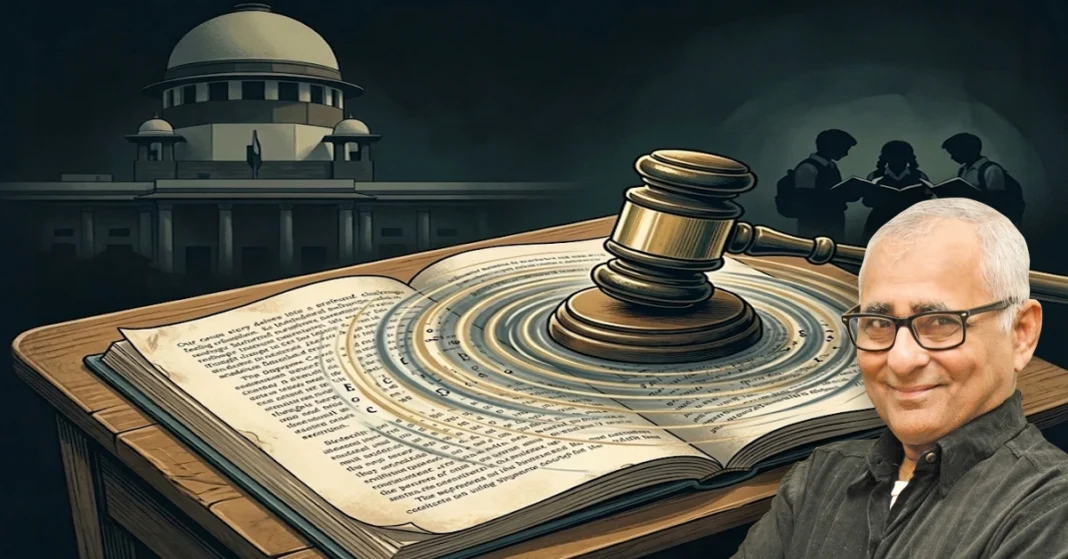


By Inderjit Badhwar
In every democracy there are moments when institutions pause, look inward, and ask whether the systems meant to strengthen society are instead eroding public trust. The recent intervention by the Supreme Court over a controversial NCERT textbook chapter is one such moment.
The apex court’s unusually sharp response—halting the circulation of a Class 8 social science textbook and describing the inclusion of a section titled, “Corruption in the Judiciary” as a possible attempt to undermine the institution—has sparked an intense debate about the boundaries between institutional protection and academic freedom.
At the centre of the storm is Chief Justice of India Surya Kant, whose remarks during the hearing were striking both for their tone and urgency. His metaphor—“They have fired a gunshot. The judiciary is bleeding”—captured the sense within the Court that its credibility was being attacked at a foundational level.
Why did a school textbook provoke such a strong reaction? To understand this, one must first appreciate the role of the judiciary in India’s constitutional architecture. The courts are not simply dispute resolution forums. They are one of the three pillars of democratic governance and, perhaps more importantly, the ultimate arbiters of constitutional rights.
Public trust is therefore the judiciary’s most valuable currency. If citizens begin to doubt the fairness or integrity of the courts, the consequences ripple far beyond legal proceedings. The rule of law itself becomes fragile.
From that perspective, the Court’s anxiety about how young students might perceive the judiciary is understandable. Textbooks are not just repositories of facts; they shape civic consciousness. The narratives presented in classrooms often become the intellectual scaffolding through which citizens interpret public institutions later in life. However, this is only one side of the debate.
Education, by its very nature, must also accommodate inquiry, critique and nuance. Democracies do not strengthen institutions by presenting them as infallible. Rather, they strengthen them by acknowledging imperfections while emphasizing mechanisms for reform and accountability.
This is where the NCERT episode becomes more complex. Critics of the Court’s sweeping ban argue that the response risks creating a chilling effect on academic discourse. If scholars and educators begin to fear institutional backlash, they may avoid discussing difficult but necessary topics altogether.
The result could be a sanitized version of civic education—one that celebrates institutions but avoids examining their challenges. Such an outcome would serve neither the judiciary nor the education system.
The deeper problem lies in the process through which educational material is created and reviewed. NCERT textbooks pass through multiple layers of expert scrutiny before reaching classrooms. That such a contentious section survived these filters suggests a breakdown somewhere along the editorial chain.
Was the content poorly worded? Was it insufficiently contextualized? Did it lack balance?
Most observers agree that the issue was less about discussing corruption and more about how the subject was framed. In any society, allegations or instances of corruption within institutions are part of the public record. Courts themselves have acknowledged this reality in various judgments. What matters is the manner in which the issue is presented—especially to young students who may not yet have the analytical tools to distinguish between systemic critique and sweeping generalization.
The NCERT’s unconditional apology and promise to revise the chapter is therefore an important step. It signals recognition that educational narratives require careful calibration.
But the larger conversation should not end with the withdrawal of a textbook.
Instead, this episode should prompt broader reflection among policymakers, educators and jurists alike.
Educational institutions must ensure rigorous peer review processes that include experts from relevant disciplines—law, in this case—before sensitive topics are introduced in textbooks. Governments, for their part, must resist the temptation to shape curricula according to political or ideological preferences.
And the judiciary must continue to balance its legitimate concern for institutional credibility with a recognition that democratic education thrives on open discussion.
In that sense, the “gunshot” metaphor used by the chief justice should perhaps be interpreted not merely as an accusation but as a warning signal.
A warning that institutions—whether courts, universities, or government bodies—must constantly guard their credibility through transparency, accountability and intellectual honesty.
If this controversy leads to stronger editorial standards in textbooks, deeper respect for institutional boundaries, and a renewed commitment to balanced civic education, then the debate will have served a constructive purpose. In a democracy as large and complex as India’s, institutions cannot afford complacency. Trust, once shaken, is difficult to rebuild. But thoughtful introspection can ensure that it is never lost in the first place.