


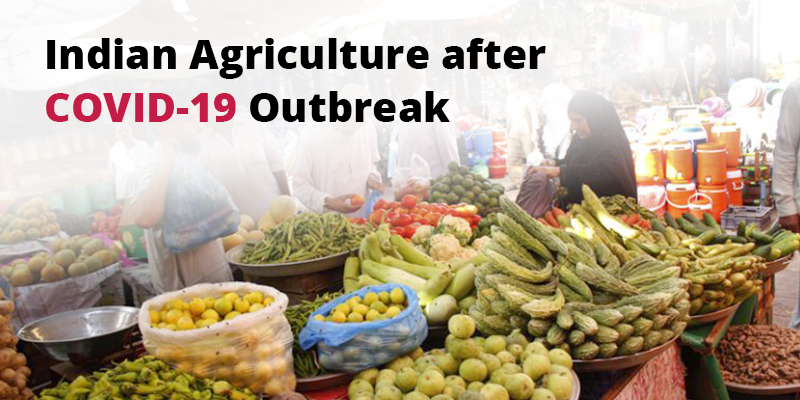
Covid-19, originated in China, has spread across the world in the form of a pandemic. This pandemic has affected many lives around the world. The Indian Government declared a nation-wide lockdown in the country on 25th March, initially for 21 days and gradually extending the number of days to control the spread of the disease. The lockdown restrictions were very strict during the initial phase which affected the various sectors of the economy including the agriculture sector. As the Import and Export practices halted, both the supply and demand got affected which had a great impact on Price and distribution. However, agriculture sector still maintained to be the brightest spot in the economy as compared to the other sector.

Major
Issues
- In
the initial stages of the lockdown in March, the restrictions coincided with
the farming practices as March-April is the peak season of sowing of Kharif
crops like paddy and harvesting of Rabi crops like wheat, this created a lot of
problems for the farmers. - There
arose a shortage of labor as the workers started to return to their towns due
to the panic caused by the pandemic. - As
the transportation halted, the concern arose on how the produce from the fields
will reach the markets. - Hence,
the markets fell short of supply. - The
Prices gradually rose as the supply declined.
Impact
on Production, Consumption and Marketing
Food Market was
entirely disrupted after during COVID-19 alarm. The lockdown followed by the
income shocks which resulted in the altered consumer behaviors. As the concerns
of health issues hiked, people cut off their demands of non essential foods and
started prioritizing the essential food items.
The limited resources
and the lower consumer demand further caused the decline in the agriculture
production. The availability of farm inputs such as seeds, machines,
fertilizers etc. was insufficient and hence the adequate amount of output
became difficult to generate.
The food system is not
just about the production but also includes the supply of the products to the
consumers. During the lockdown, as the transportation activities were
terminated, the issue of supply and the marketing of the produce came up.
During Lockdown
- Wheat
– The prices for wheat were significantly stable in the month of April. But
during unlock-1 in June, there was a decline in prices in the markets where
COVID cases were high. Through the Pradhan Mantri Garib Kalyan Yojana, the
Government decided to provide 5 kg free ration per individual by drawing down
on public stocks beginning in April. This caused a negative effect of the Wheat
demand. - Tomato
– The prices remained same during the initial period of the lockdown, however,
the prices declined in May. - Onion
– The impact on onion was negligible.
Post Lockdown
- Pulses, wheat flour and milk – In
a month post the lockdown, the prices rose by 1-5%. - Edible
oils and staple cereals (rice and wheat)
– For these commodities, prices went 4–9% lower as the import restrictions
were withdrawn and the government interruptions like free distribution of food
grains initiated. - Vegetable
– The tomato prices hiked by 77–78% in a week after a month of unlocking
lockdown.
Government
Policies to support the situation
- The
Reserve Bank of India (RBI) issued that Agriculture terms and Crop loans have
granted a moratorium of 3 months addressing the “burden of debt servicing”. - As
the lockdown initiated, the Indian Finance Minister of India declared an INR
1.7 trillion package to protect the economically weaker section from the
COVID-19 impact. The government also transferred an advance release of INR 6000
to the bank account of the farmers in 3 equal installments for 3 months under
the PM-KISAN scheme. - The
Indian Council of Agricultural Research (ICAR) announced some guidelines for
the farmers mentioning the practices of sowing, harvesting, post-harvesting,
storage and marketing of Rabi crops. - To
empower income to the rural people, Pradhan Mantri Garib Kalyan Yojana was
announced in June 2020.
For more information about Agriculture and Livestock, download Apni Kheti app –
Android,