



Garden Research Team | Reviewed by Agriculture Editorial Board
Topic: Small Garden Vegetable Growing | Updated: April 2026

How to Grow More Vegetables in a Small Garden — Quick Answer

- Use vertical growing (trellis, A-frame, climbers) to double your productive surface
- Plant intensively in grid spacing — not rows — to fill every square foot
- Practice succession planting every 2–3 weeks for a continuous harvest
- Choose high-yield crops: climbing beans, cherry tomatoes, zucchini, chard
- Improve soil with compost before every new planting cycle
- Replace harvested crops within one week — never leave beds empty
To grow more vegetables in a small garden means making every square foot (or square metre) earn its maximum yield — through smart layout, timing, and crop choice, not just by adding more space. It is not about cramming plants in; it is about placing the right crops in the right spots at the right time.
Any garden, from a 10 sq ft (1 sq m) container setup to a compact 200 sq ft (18.5 sq m) backyard plot, can produce a meaningful harvest with the right approach.
In practice, gardeners who combine vertical growing, close spacing, and succession planting consistently harvest more from the same space than those using traditional row planting.
In practice, gardeners who combine vertical growing, close spacing, and succession planting consistently harvest more from the same space than those using traditional row planting.
This guide covers the proven intensive planting vegetables small garden techniques that extension services, commercial market gardeners, and experienced home growers use to increase vegetable yield in small gardens across all climate zones.
Why Small Gardens Often Produce Less (And How to Fix It)
The Real Reason Your Garden Is Not Producing Enough
Most small gardens underperform not because of poor soil or bad weather, but because of poor planning. Growers plant randomly, space crops too generously for large-plot growing, and leave gaps where nothing productive grows.
From practical growing experience, the biggest yield killer in small gardens is unused vertical space. Most growers think horizontally when they should also think upward. A single trellis or A-frame support can double the productive surface area of a 4 ft × 4 ft (1.2 m × 1.2 m) bed.
Common Small Garden Problems (Overcrowding, Poor Planning, Wrong Crops)
Overcrowding is a frequent beginner error — but so is its opposite. Many small gardeners space plants at the full distance recommended for open field growing, wasting enormous bed space. Wrong crop selection compounds this: sprawling crops like pumpkins and sweetcorn produce low food weight per square foot compared to lettuce, spinach, or climbing beans.
Poor planning is the most correctable problem. A simple sketch before planting — crop names, spacing, and harvest dates mapped out — can double your output before you plant a single seed.
What “High Yield Gardening” Actually Means
High yield gardening means producing the maximum useful food from your available space and growing season. It combines intensive planting, smart crop rotation, succession sowing, and vertical growing into a single coordinated system.
Definition — High Yield GardeningHigh yield gardening is the practice of combining intensive spacing, vertical growing, succession planting, and companion planting to produce the maximum amount of food from a limited garden area.
Smart Planning: How to Grow More Vegetables in a Small Garden
Choosing the Right Location and Layout
Full sun is non-negotiable — aim for at least 6 hours per day. In tropical zones (above 20°C / 68°F), morning sun with afternoon shade suits leafy crops to prevent bolting. Raised beds warm up faster in spring (USDA hardiness zones 5–7), improve drainage, and allow precise soil management.
How to Space Plants Without Wasting Space
Forget single-row spacing. Intensive planting vegetables in small gardens works on a grid system — plants are equidistant in all directions. A standard 12-inch (30 cm) grid for medium crops like lettuce fills a 4 ft × 4 ft (1.2 m × 1.2 m) bed with 16 plants instead of 8 or 9 in single rows. Extension observations indicate that correctly spaced intensive beds reduce weed pressure significantly because the crop canopy closes off light before weeds establish.
Not sure how many plants fit your bed size? Use this plant population calculator to get the exact number based on your plot dimensions and crop spacing.
How to Use Vertical Space Effectively

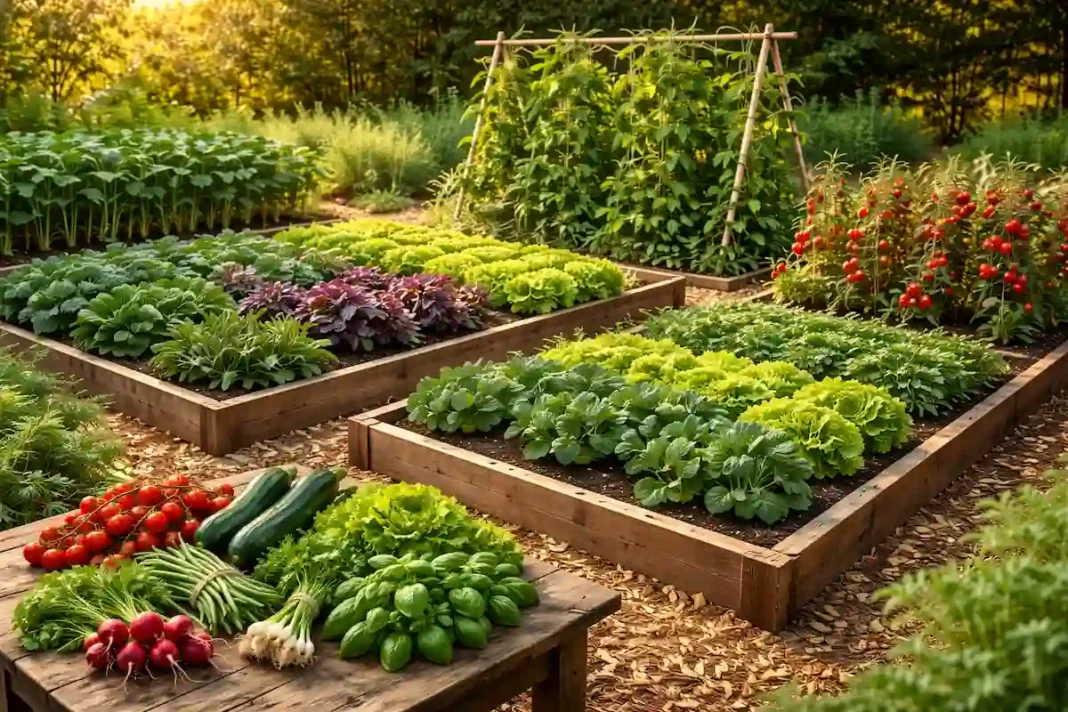
Vertical growing is one of the highest-impact changes a small garden grower can make. Climbing crops — beans (Phaseolus vulgaris, Phaseolus coccineus), cucumbers (Cucumis sativus), peas (Pisum sativum), and indeterminate tomatoes (Solanum lycopersicum) — produce the same yield as sprawling plants while using a fraction of the bed footprint. A simple A-frame trellis or bamboo wigwam supports three to five climbing plants in a 2 ft × 3 ft (60 cm × 90 cm) footprint. This is the fastest single way to grow more food in less space.
High-Yield Techniques to Grow More Vegetables in a Small Garden
Intensive Planting (Grow More in Less Space)

Definition — Intensive planting means growing crops closer together in a grid instead of traditional rows, so every square foot of soil produces food rather than wasted path or bare ground.
The principle is straightforward: space plants at half the recommended single-row distance in all directions. Lettuce recommended at 12 inches (30 cm) in rows? Plant at 6 inches (15 cm) in a grid. Many growers notice a significant improvement in total harvest weight per bed using this method.
Companion Planting for Better Growth
Companion planting pairs crops that support each other’s growth or deter shared pests. The classic Three Sisters — maize, climbing beans, and squash — has been used across tropical and temperate regions for centuries. Beans fix atmospheric nitrogen (N), feeding the maize; squash leaves shade the soil, retaining moisture and suppressing weeds.
Other high-value pairings: basil with tomatoes to repel aphids; marigolds around brassicas to deter cabbage white butterfly (Pieris brassicae); and chives with carrots to reduce carrot fly (Psila rosae) pressure.
According to the Food and Agriculture Organisation of the United Nations (FAO), diverse intercropping systems like the Three Sisters significantly improve soil health and reduce external input dependency in small-scale food production.
Succession Planting for Continuous Harvest

Definition — Succession PlantingSuccession planting means sowing the same crop in small batches every 2–3 weeks instead of all at once, producing a steady continuous harvest rather than a single large glut followed by a gap.
Continuous harvest small garden planning relies on this method. Sow a short row of salad leaves or radishes every 2–3 weeks from early spring through autumn — in tropical climates, nearly year-round.
Before your first succession sowing, use this seed rate calculator to estimate exactly how much seed you need across three or four staggered batches — so you buy the right quantity without waste.
Intercropping: Growing Multiple Crops Together
Intercropping means growing two or more crops in the same bed, matched so their canopy heights and harvest times do not compete — for example, fast-growing radishes between slow-maturing carrots. Grower trials suggest this can increase bed productivity by 20–40%.
Best Vegetables for Small Gardens (High Production Crops)
Fast-Growing Vegetables for Quick Harvest
Radishes (Raphanus sativus) mature in 25–30 days. Spinach (Spinacia oleracea) is ready in 30–40 days. Salad leaves can be cut-and-come-again from 30 days — ideal for filling gaps between main-crop plantings.
High-Yield Crops That Produce More Food
The highest-yielding crops by food weight per square foot: climbing beans, zucchini/courgette (Cucurbita pepo), cherry tomatoes (Solanum lycopersicum), Swiss chard (Beta vulgaris subsp. cicla), and kale (Brassica oleracea var. sabellica). These produce over an extended period, not a single harvest event. In tropical zones (USDA equivalent zones 9–13), sweet potato (Ipomoea batatas), yard-long beans, and amaranth (Amaranthus spp.) are excellent performers.
Vegetables That Grow Well in Containers
Containers extend the productive area of any small garden by using patios, balconies, and windowsills. Most productive container crops: tomatoes, peppers (Capsicum annuum), lettuce, herbs, dwarf beans, and beetroot (Beta vulgaris). Minimum depth for root vegetables: 12 inches (30 cm). For tomatoes and peppers: at least 5 US gallons (19 litres).
| Crop | Good Companions | Bad Companions | Benefit |
|---|---|---|---|
| Tomato | Basil, Marigold, Carrot | Fennel, Brassicas | Repels aphids, improves flavour |
| Carrot | Chives, Leek, Onion | Dill, Parsley | Deters carrot fly |
| Climbing Bean | Corn, Squash, Carrot | Onion, Garlic | Fixes nitrogen (N) in soil |
| Lettuce | Radish, Carrot, Cucumber | Celery | Radish repels leaf miners |
| Brassica | Dill, Marigold, Celery | Climbing Bean, Tomato | Marigold deters cabbage white |
3 Most Important Small Garden Yield Points at a Glance
- Use vertical growing— Train climbing crops upward to double effective planting surface
- Succession sow every 2–3 weeks— Ensures a continuous harvest instead of one large glut
- Improve soil first— Rich compost-amended soil is the foundation every other technique depends on
Mistakes That Reduce Yield in Small Gardens
Overcrowding Plants (Biggest Mistake)
Packing plants too close causes competition for water, nutrients, and light. Plants grown in overcrowded conditions produce smaller fruit, are more susceptible to fungal disease due to poor air circulation, and rarely reach their yield potential. Very common problem. Spacing matters at every stage.
Ignoring Soil Health and Fertility
In warm climates, soil organic matter breaks down rapidly. Intensive planting demands intensive feeding — add a 2-inch (5 cm) compost layer before every new planting and a liquid feed (diluted seaweed or fish emulsion) every two weeks during the main growing season.
Poor Watering and Nutrient Management
Inconsistent watering causes blossom end rot in tomatoes and peppers, tip burn in lettuce, and stunted root development in carrots. Drip irrigation or soaker hose systems maintain consistent moisture and reduce leaf disease. In arid zones or during heat waves above 35°C (95°F), mulching to 2–3 inches (5–8 cm) depth reduces moisture loss dramatically.
Use this plant watering calculator to work out the exact water requirement for your crops based on soil type, climate, and plant size — particularly useful during heat waves above 35°C (95°F).
Not Planning Crop Rotation
Growing the same crop family in the same spot year after year builds up soil-borne diseases. Even a simple two-bed rotation — brassicas one year, everything else the next — significantly reduces clubroot (Plasmodiophora brassicae) pressure and improves average yields.
The Royal Horticultural Society (RHS) recommends a minimum four-year crop rotation cycle for brassicas to effectively break disease cycles — even in small gardens, a simplified two-bed rotation delivers measurable results.
How to Plan for Continuous Harvest All Season
Staggered Planting Schedule Explained
A staggered planting schedule means dividing your full planting quantity into three or four smaller batches, sown 2–3 weeks apart. Instead of 20 lettuce plants maturing in the same week, you get 5 plants maturing each week over a month. In temperate climates (USDA hardiness zones 5–8), the sowing window runs from early spring (after last frost) to late summer (8–10 weeks before first autumn frost).
Replacing Crops After Harvest
Every time a crop is cleared, replant within a week. Do not let beds sit empty. Fast-maturing gap-fillers — radishes, salad leaves, spring onions (Allium cepa), and spinach — mature in 30–45 days and can plug gaps between main crops.
How a Garden Planner Helps Optimise Space
A garden planner removes the guesswork from small garden high-yield techniques. By mapping your beds before sowing, you can identify gaps in your succession schedule and ensure high-canopy crops do not shade low-growing neighbours. Even a hand-drawn grid forces better decisions before planting begins.
Try This Companion Planting Tool
Use this interactive planner to map your beds, identify ideal crop combinations, and build a succession sowing schedule tailored to your plot size and climate.
Quick Tips to Instantly Increase Garden Production
Fast Fixes to Boost Yield Today
- Add a 2-inch (5 cm) compost layer to every empty bed before replanting
- Switch from single-row spacing to a square grid — double plant density immediately
- Install a trellis or bamboo wigwam for climbing crops in every bed that lacks one
- Start a succession sowing tray for salad leaves every two weeks
- Sow fast-maturing gap-fillers (radishes, spinach) in any bed with empty ground
- Sketch next season’s rotation plan now so you do not repeat the same family in the same bed
FAQs About Growing More in Small Gardens
1. How many plants can I grow in a small space?
Using intensive grid planting, a 4 ft × 4 ft (1.2 m × 1.2 m) bed holds 16 lettuce plants, 9 spinach plants, or 4 tomato plants. Mixing crop sizes — tall climbers with ground-level leafy crops — increases plant count further. Beginners often get this wrong by spacing as if planting in large open rows.
2. What is the most productive vegetable for a small garden?
Climbing beans, cherry tomatoes, and zucchini (Cucurbita pepo) consistently rank highest by weight per square foot across temperate and warm climates. Climbing beans fix nitrogen while producing, making them especially valuable. In tropical zones, yard-long beans and amaranth are comparable high performers.
3. Can I grow enough food in a small backyard?
A well-managed 100 sq ft (9.3 sq m) intensive garden provides a significant portion of a household’s salad, herbs, beans, and summer vegetables. It will not feed a family entirely, but combined with a local market or CSA share, even a small plot meaningfully reduces food costs during the growing season.
4. Do I need special soil for intensive planting?
No special soil blend is required, but high fertility is essential. Intensive planting places more plants per square foot, which means more nutrient demand per square foot. Add generous compost before each planting, use liquid feeds for heavy-feeding crops, and avoid compacting the bed by walking on it.
5. Can I use these techniques in all climate zones?
Yes, with adaptation. In tropical zones, use shade management and heat-tolerant varieties. In temperate climates, cold frames extend the season. In arid zones, mulching and drip irrigation become priorities. All core techniques apply globally.
Key Takeaways
- Switch from single-row to grid spacing to immediately increase plant density without extra space
- Train climbing crops vertically — fastest way to increase productive surface area
- Succession sow every 2–3 weeks to replace a single harvest glut with a continuous harvest flow
- Pair crops using companion planting to reduce pest pressure without added inputs
- Replace harvested crops within a week — never leave a bed empty
- Prioritise high-yield crops: climbing beans, cherry tomatoes, zucchini, Swiss chard
- Improve soil with compost before every new planting — intensive planting demands intensive feeding
Final Thoughts: Grow More with Less Space

The methods in this guide are not new. They are the same techniques that market gardeners, extension educators, and experienced home growers have used for generations to produce meaningful food harvests from compact plots.
Start with the easiest wins: grid spacing, one trellis structure, and a staggered sowing tray for salad leaves. These three changes alone produce a noticeable difference before the season ends. Soil health is the foundation — invest in compost, mulch consistently, and rotate crops each season.
A small garden with a good plan consistently outperforms a large garden without one. When you grow more vegetables in a small garden by combining grid spacing, vertical structures, and succession planting, the space you already have is enough.
Note: The techniques in this guide improve growing success but should be combined with proper soil fertility management, regular watering, and crop rotation for best results. Yield outcomes vary by climate zone, soil type, local pest and disease pressure, and variety selection. Always source locally adapted seed varieties where possible.