
[ad_1]
Courtroom practice is unpredictable. Many times, a matter is called out suddenly, or preparation remains incomplete due to workload, client delays, or multiple listings. In such situations, the ability to argue effectively without full preparation becomes an important practical skill for every young lawyer.

This article explains how to handle such situations calmly and professionally, while protecting the client’s interest and maintaining credibility before the court.
Why This Situation Happens Often in Litigation
In real court practice, perfect preparation is not always possible. A lawyer may face situations such as:
- The matter being listed earlier than expected, leaving little time to prepare.
- Receiving incomplete instructions or documents from the client.
- Handling multiple cases on the same day.
- Sudden change in law or facts just before the hearing.
These situations are common, especially for lawyers practising in trial courts, district courts, or tribunals. Therefore, learning how to manage such moments is part of developing strong advocacy skills.
How to Argue in Court When You Are Not Fully Prepared
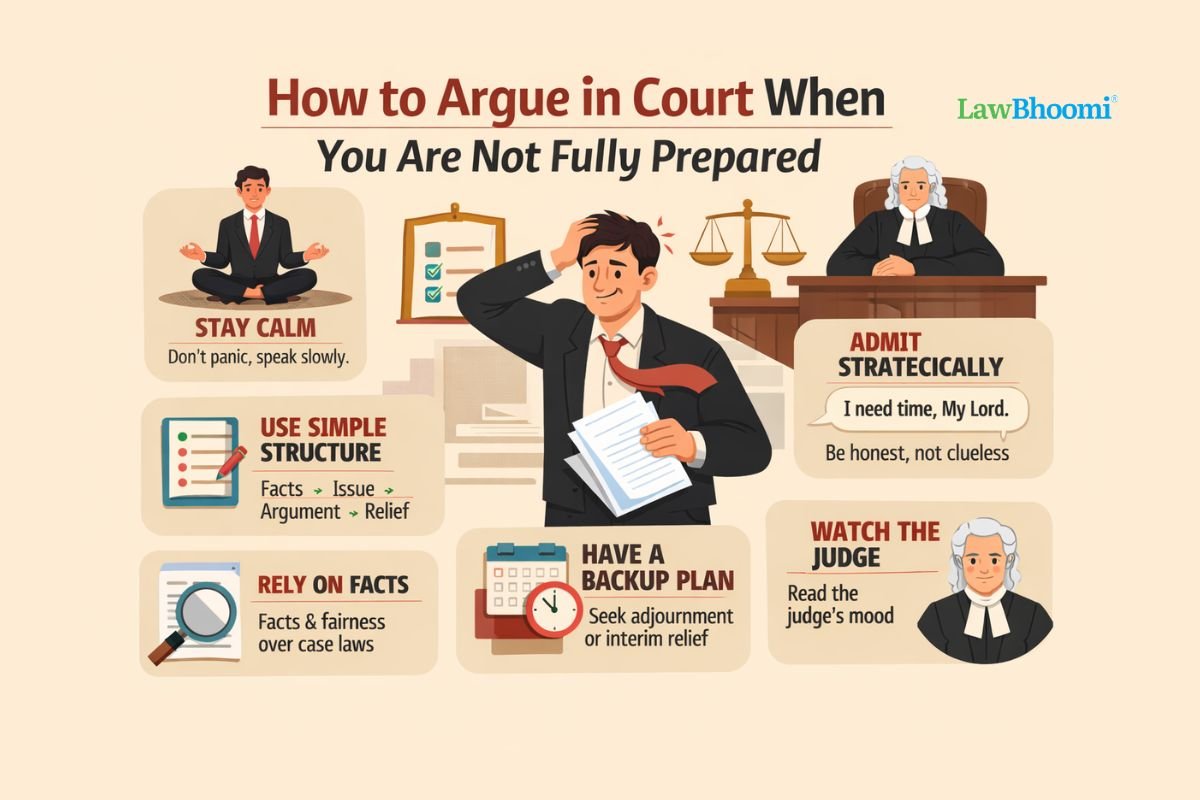
The First Rule: Do Not Panic
The biggest mistake in such situations is panic. When nervousness takes over, arguments become unclear, and mistakes increase.
Instead, it is important to:
- Stay calm and composed.
- Speak slowly and clearly.
- Focus only on what is known, instead of worrying about what is not known.
A calm lawyer appears more confident, even if preparation is not complete.
Focus on Core Issues Only
When preparation is limited, it is not advisable to argue every point. Instead, focus only on the most important issues.
- Identify the main legal or factual issue in the case.
- Support it with one or two strong points.
- Avoid discussing unnecessary details unless the court asks.
For example, in a bail matter, the focus can be on the nature of the offence and cooperation of the accused, rather than going into every fact of the case.
This approach helps in presenting a clear and effective argument, even with limited preparation.
Use a Clear Structure While Arguing
A structured argument always creates a better impression. Even if preparation is incomplete, following a basic structure can help.
A simple format can be:
- Brief facts of the case
- The main issue involved
- Your argument
- The relief being sought
For example:
“My Lord, the short issue in the present matter is whether the petitioner is entitled to interim relief. The facts briefly are… The petitioner submits that… Therefore, it is prayed that…”
This format helps the court understand your case easily and gives you time to organise your thoughts.
Be Honest Without Weakening Your Case
If there is something you do not know, it is better to be honest rather than giving incorrect information.
Instead of guessing, it can be said:
- “I will assist the court on that point, My Lord.”
- “I may require a short passover to check the record.”
Courts appreciate honesty. At the same time, it is important to remain confident and not appear completely unprepared.
Handle Questions Smartly
Judges often ask questions during arguments. These questions can be difficult, especially when preparation is incomplete.
In such situations:
- Listen carefully to the question.
- Repeat or reframe the question to gain time.
- Answer in parts, starting with what is known.
For example:
“My Lord, there are two aspects to this issue…”
This technique gives time to think and helps in structuring the answer properly.
Rely More on Facts Than Case Laws
When case laws are not fully prepared, arguments can be based on facts and logic.
- Highlight the important facts of the case.
- Explain why those facts support your client.
- Use simple reasoning and fairness.
In many lower courts and tribunals, judges often focus more on facts and practical outcomes than on extensive case law citations.
Concede Minor Points, Protect Major Ones
It is not necessary to oppose everything. Sometimes, conceding a small point can make the argument stronger.
For example:
“Even if that point is accepted, the main issue still remains…”
This approach shows fairness and honesty. It also helps in focusing the court’s attention on the main issue.
Read the Courtroom Situation
Understanding the judge’s mood and approach is an important skill.
- If the court is busy, keep arguments short and precise.
- If the judge is asking questions, it indicates interest, and arguments can be slightly detailed.
- If the court is not inclined, it may be better to request time rather than forcing arguments.
Observing the courtroom environment helps in adjusting the style of argument.
Always Have a Backup Relief
When the main argument is weak due to lack of preparation, a fallback option should always be kept ready.
Such fallback options can include:
- Seeking adjournment for filing reply or additional documents, so that the case can be presented properly later.
- Requesting interim protection such as stay, no coercive action, or status quo, to protect the client’s immediate interest.
- Asking for a short date to complete arguments or place relevant materials on record.
This ensures that even if the main relief is not granted, the client’s position is not harmed.
Control Your Behaviour in Court
Behaviour plays a very important role, especially when preparation is not complete.
A lawyer should:
- Avoid speaking too fast or too much.
- Not interrupt the judge or opposing counsel unnecessarily.
- Maintain respect and patience at all times.
Good behaviour often creates a positive impression, even when arguments are not very strong.
Prepare a Quick One-Page Note
Even in a short time, preparing a small note can make a big difference.
This note can include:
- Key facts of the case in brief
- The main issue
- Two or three points to argue
- The relief to be sought
This acts as a guide during arguments and prevents confusion.
Practical Courtroom Lines That Help
There are certain standard lines which can help manage the situation effectively:
- “My Lord, without going into unnecessary details…”
- “The short issue involved is…”
- “Even otherwise…”
- “At least interim protection may be granted…”
Such lines help in maintaining flow and sounding confident.
When to Ask for Time
There are situations where arguing without preparation can harm the case. In such cases, it is better to request time.
Time can be requested when:
- Important documents are missing.
- Legal position is not clear.
- Detailed arguments are required.
A polite request for time is always better than presenting a weak argument that may affect the case negatively.
Limitations of Arguing Without Preparation
It is important to understand that arguing without preparation is only a temporary solution.
- It cannot replace proper case preparation.
- It may work for short hearings but not for final arguments.
- Repeated lack of preparation can harm professional reputation.
Therefore, this skill should be used only when necessary.
Conclusion
Courtroom practice requires both preparation and presence of mind. While preparation remains the foundation of effective advocacy, situations often arise where a lawyer has to argue with limited preparation.
In such situations, staying calm, focusing on core issues, using a clear structure, and maintaining honesty can help manage the hearing effectively. The objective should not be to appear fully prepared, but to protect the client’s interest and assist the court properly.
With experience, these skills improve, and handling such situations becomes easier. However, consistent preparation remains the key to long-term success in the legal profession.
Attention all law students and lawyers!
Are you tired of missing out on internship, job opportunities and law notes?
Well, fear no more! With 2+ lakhs students already on board, you don’t want to be left behind. Be a part of the biggest legal community around!
Join our WhatsApp Groups (Click Here) and Telegram Channel (Click Here) and get instant notifications.

[ad_2]
Source link

