

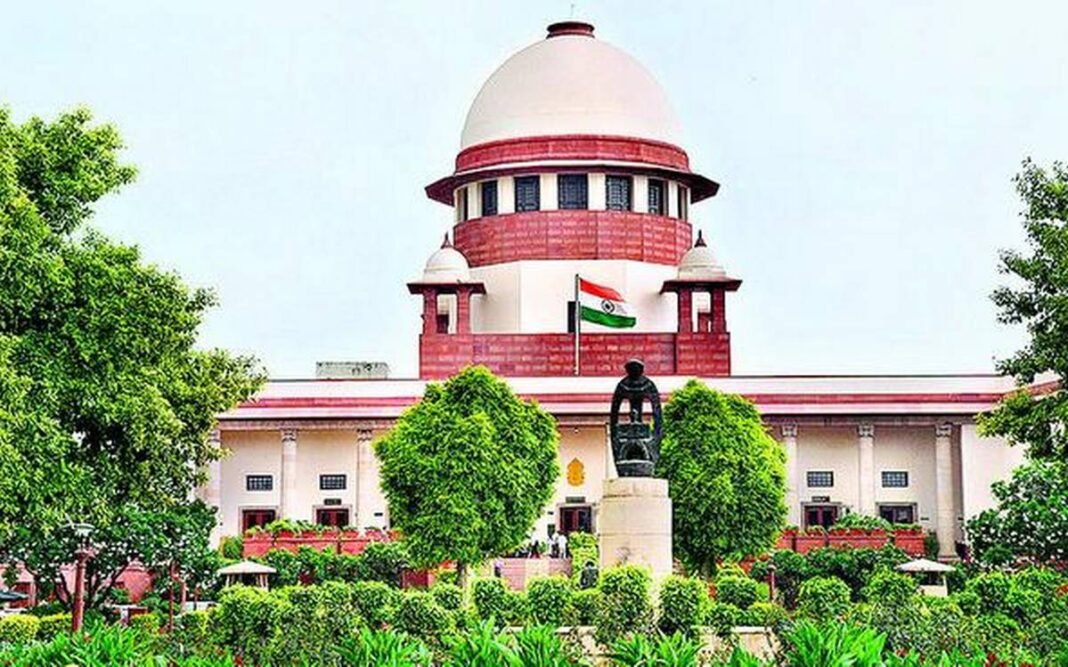
HIGH COURT CANNOT DILUTE RELIEF ALREADY GRANTED BY SUPREME COURT: FINALITY OF APEX COURT ORDERS REAFFIRMED

INTRODUCTION
In Dr. Jiji K.S. & Ors. v. Shibu K. & Ors., 2026 INSC 207, decided on 27 February 2026, the Supreme Court of India, comprising Justice Dipankar Datta and Justice Aravind Kumar, held that a High Court cannot effectively revisit or dilute the benefit of relief already granted by the Supreme Court in earlier proceedings.
The Court emphasized that once an order of the Supreme Court attains finality and has been implemented, subordinate courts cannot disturb the consequences flowing from that order.
BRIEF FACTS
The dispute arose from service matters relating to promotions in the Kerala Technical Education Service. Rule 6A of the Kerala Technical Education Service Rules granted certain relaxations regarding the requirement of a Ph.D. qualification for promotions.
Earlier litigation challenging the Rule had reached the Supreme Court in Christy James Jose v. State of Kerala, where the Court held that failure to acquire a Ph.D. within the stipulated period could at best lead to stoppage of increments and could not invalidate appointments. Following this Judgment, the Appellants in the present case were granted similar relief by the Supreme Court and were subsequently promoted to the cadre of Associate Professor with retrospective effect by a government order.
However, subsequent proceedings before the Kerala Administrative Tribunal and the Kerala High Court concerning other government orders led to directions that potentially affected the Appellants’ promotional benefits, even though they were not parties to those proceedings.
Aggrieved by the High Court’s decision dated 3 December 2020, which effectively undermined the benefits already granted to them pursuant to the Supreme Court’s earlier Judgment, the Appellants approached the Supreme Court.
ISSUES OF LAW
The principal issue before the Court was whether a High Court judgment in subsequent proceedings could adversely affect the rights of individuals who had already obtained relief from the Supreme Court in earlier litigation.
Another issue concerned the remedies available to persons who were not parties to earlier proceedings but whose rights may be affected by judicial decisions rendered therein.
ANALYSIS OF THE JUDGMENT
The Supreme Court observed that the Appellants had already secured relief through an earlier Order of the Court, which had been implemented by the State Government through retrospective promotions. A contempt petition filed earlier had also been disposed of after the Court noted compliance with its directions.
In these circumstances, the Court held that the High Court could not have indirectly revisited or disturbed the effect of the Supreme Court’s earlier Order. Judicial discipline requires that the finality attached to an order of the Supreme Court be respected by all subordinate courts.
At the same time, the Court noted that the Appellants were not parties before the High Court when the impugned directions were issued. Had they been impleaded and the earlier Supreme Court Judgment been brought to the High Court’s notice, the present dispute might not have arisen.
Consequently, the Court allowed the Appeal and clarified that nothing in the High Court’s Judgment would affect the Appellants’ career prospects or the benefits already granted to them pursuant to the earlier Supreme Court decision.
With respect to other individuals who sought intervention or filed connected proceedings, the Court observed that persons affected by judgments passed in cases where they were not parties are not without remedy. Referring to earlier precedents such as K. Ajit Babu v. Union of India, Rama Rao v. M.G. Maheshwara Rao, and Union of India v. Nareshkumar Badrikumar Jagad, the Court reiterated that such persons may approach the appropriate forum seeking review or appropriate relief if they can demonstrate that they are aggrieved by the decision.
CONCLUSION
The Judgment reinforces the principle that orders of the Supreme Court carry finality and cannot be diluted or indirectly altered by subsequent judicial proceedings in lower courts. By protecting the Appellants’ promotional benefits, the Court reaffirmed the importance of judicial hierarchy and institutional discipline.
At the same time, the decision clarifies that individuals who are affected by judicial decisions in proceedings where they were not parties retain the right to seek appropriate remedies before competent forums. The ruling thus balances the finality of judicial decisions with the need to ensure that affected parties are not left without recourse in law.
SARTHAK KALRA
Senior Legal Associate
The Indian Lawyer & Allied Services
Our Chief Consultant, Mrs. Sushila Ram Varma, Advocate was recently interviewed in a podcast by the CEO Magazine for Women’s day. You can see the same in the link below-