


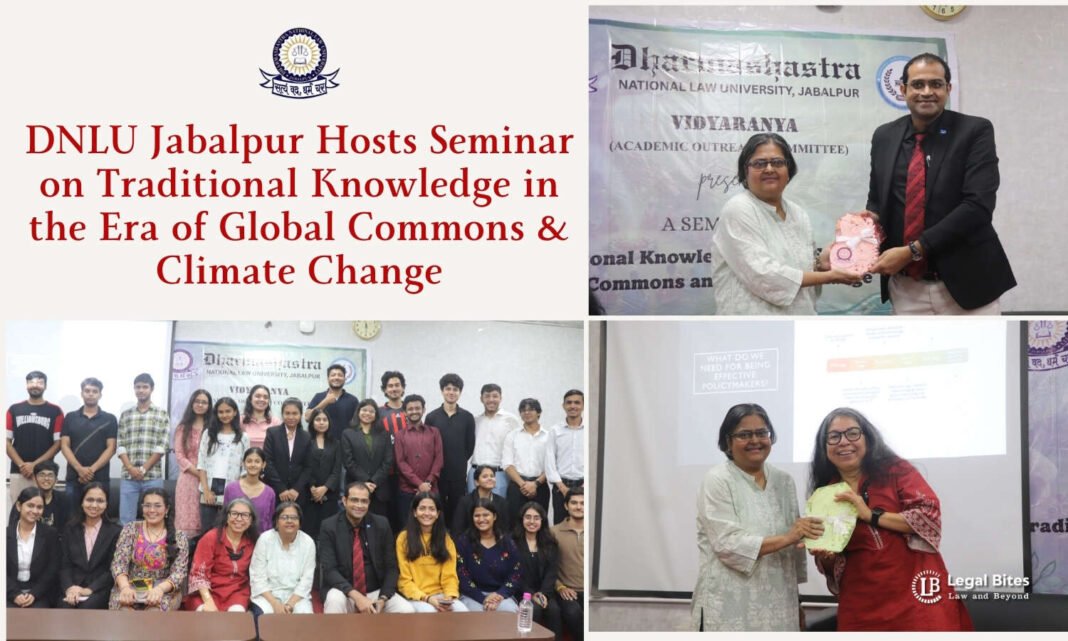
Dharmashastra National Law University (DNLU), Jabalpur successfully organised a seminar titled “Traditional Knowledge in the Era of Global Commons and Climate Change” on 24 February 2026. The seminar was conducted by Vidyaranya – The Academic Outreach Committee (AOC) and focused on the growing relevance of traditional knowledge systems in addressing global environmental challenges. The programme was organised under the leadership of Hon’ble Vice-Chancellor Prof. (Dr.) Manoj Kumar Sinha, Registrar Dr. Praveen Tripathi, and Dr. Gargi Chakrabarti, Faculty Advisor AOC and Controller of Examinations.
The programme commenced with a welcome address by Dr. Gargi Chakrabarti, who formally welcomed the distinguished speakers Prof. (Dr.) Ana Penteado and Prof. (Dr.) Shambhu Prasad Chakrabarty and introduced the central theme of the seminar. She emphasized the growing relevance of traditional knowledge in addressing contemporary environmental challenges and highlighted the need for effective legal mechanisms to preserve indigenous wisdom in an era marked by rapid technological advancement and ecological degradation. Her address set the tone for a thoughtful discussion on the role of traditional knowledge in sustainable development and climate governance.
In the first half of the session, Prof. (Dr.) Shambhu Prasad Chakrabarty, Dean of the School of Law at the University of Engineering & Management, Kolkata, presented empirical studies examining the relationship between traditional knowledge, climate change, and the evolving global legal order. Drawing from international examples, he discussed the lived experiences of indigenous communities, including island communities in Panama, and explained how rapid industrialization and unregulated development have contributed to the extinction of wildlife, degradation of oceans, shrinking wetlands, and declining fisheries. He observed that these developments threaten ecological balance and the survival of traditional communities whose livelihoods depend on natural ecosystems.
Turning to the Indian context, Prof. Chakrabarty presented case studies from West Bengal, including Joynagar Moya, a Geographical Indication (GI)-tagged winter delicacy, and traditional date palm jaggery production. He explained that the shrinking winter cycles in South Bengal due to climate change have adversely affected the production of these traditional food products. He noted that food products remain underrepresented within India’s Geographical Indication framework and observed that until 2020 only a limited number of food items had received GI recognition.
Prof. Chakrabarty also referred to legislative efforts in India aimed at strengthening the protection of traditional knowledge systems. He emphasized the importance of language preservation and intergenerational oral transmission of knowledge and suggested that Artificial Intelligence could be constructively used to document and revive threatened languages and knowledge systems. In this context, he cited preservation efforts relating to the Toto community as an example of initiatives aimed at safeguarding endangered cultural knowledge.
In the second half of the session, Prof. (Dr.) Ana Penteado, Adjunct Associate Professor at Notre Dame University, School of Law, Australia, delivered a lecture on “Traditional Knowledge and Climate Change: Environmental Impacts on Landscapes and Communities.” She adopted a multidisciplinary and transdisciplinary approach to examine the relationship between traditional knowledge, environmental change, and legal regulation. Referring to Article 8(j) of the Convention on Biological Diversity (CBD), she highlighted the importance of respecting, preserving, and maintaining the knowledge of indigenous and local communities. She also examined Article 27(3)(b) of the TRIPS Agreement, pointing out its limitations in providing effective protection for community-held knowledge and biological resources.
Prof. Penteado emphasized the importance of integrating scientific data with legal frameworks and referred to the work of the Intergovernmental Panel on Climate Change (IPCC) to demonstrate how climate science must inform policy and regulation. She also addressed contemporary environmental concerns relating to data centres and Artificial Intelligence-based platforms, including the environmental risks posed by large-scale storage infrastructures and marine-based facilities.
Her lecture further explored the “taxon problem” in biodiversity data and the complexities surrounding patentable subject matter in biological resources. She raised important questions relating to ecological metrics, biodiversity accounting, and intellectual property frameworks and emphasized that effective policymaking requires identifying vulnerabilities and protecting both economic and biological assets through competent intellectual property legislation and rigorous legal research.
The seminar concluded with an interactive question and answer session during which participants engaged in meaningful dialogue on balancing economic growth with environmental protection. Students raised concerns regarding sustainable development, biodiversity governance, and the role of law in harmonizing ecological preservation with technological advancement. The discussion reflected strong academic engagement and highlighted the importance of interdisciplinary approaches to environmental governance.
The event reaffirmed Dharmashastra National Law University Jabalpur’s commitment to fostering informed academic discourse on pressing global challenges and underscored the critical role of traditional knowledge systems in shaping equitable and sustainable climate governance frameworks.
The event was coordinated with support from faculty advisors Dr. Gargi Chakrabarti, Dr. Animesh Jha, Assistant Professor, and Mr. Utkarsh Kumar Mishra, along with student coordinators Mr. Rakesh Bhadoria and Ms. Gungun Ajay Khursel, whose efforts contributed significantly to the successful organisation of the seminar.