



Dhurandhar: The Revenge
Director: Aditya Dhar
Cast: Ranveer Singh, R Madhavan, Arjun Rampal, Sanjay Dutt, Rakesh Bedi, Sara Arjun
Rating: ★★★★
Dhurandhar: The Revenge was never meant to exist, if one goes by industry whispers. The original vision was a single, sprawling film. Somewhere along the way, just before the release of Dhurandhar last year, the makers sensed something bigger at play. The material had the weight of a saga. The result is what we now have: a three-hour Dhurandhar: Part One, followed by a three hour fifty minute continuation in The Revenge.

The obvious question: was the split justified?

The premise
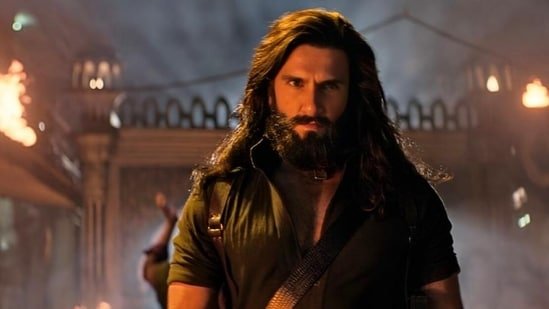
The latest film wastes no time delving into the origins of Hamza Ali Mazari, aka Jaskirat Singh Rangi (Ranveer Singh), and builds an emotional backstory that explains his motivation. Driven by a deeply personal tragedy, Hamza’s journey takes a sharp turn when he finds himself recruited by the government to operate as a spy for India. From there, the narrative circles back to where the first film ended. With Rehman Dakait (Akshaye Khanna) dead, the throne of Lyari stands vacant.
Hamza is deep in his mission, inching closer to becoming the numero uno while dismantling the Pakistani underworld from within. But this is anything but smooth. Every step forward comes at a cost, forcing him to gamble with his cover, his relationships… his life.
The canvas is larger
This instalment, too, unfolds in chapters, six this time, but the episodic rhythm in the first one was far more nuanced. Most of the principal characters return, with one notable absence: Akshaye Khanna as Rehman. His absence will certainly be felt by viewers here, even if the story moves on.
The first half moves briskly, with director Aditya Dhar ensuring the intrigue rarely dips. And yet, there is a subtle shift in texture. The world-building, which felt so rooted in reality in Dhurandhar, appears slightly less assured this time. The canvas is bigger, but the detailing is not always as precise.
The narrative occasionally relies on convenience, with a few visible loopholes that momentarily pull you out of the experience. And for a film that had, in its first chapter, become something of a benchmark for meticulous detailing, even spawning its own share of memes, the absence of it is hard to ignore.
The post-interval resurgence
What really saves the film is everything after the interval. The interval point hits well, and from there, the second half is far more engaging, building up nicely to a climax that lands exactly as it should.
Aditya, the director, also shows some good restraint. He doesn’t rely on obvious callbacks or flashbacks from the first film just to get cheers. The story moves forward instead of looking back, which works in its favour. Where the film does feel a bit heavy-handed, though, is in how often it praises the government in power. It starts to feel a little too deliberate, and you do wonder if it was needed.
Character development takes a bit of a hit this time. Uzair (Danish Pandor), Ulfat (Saumya Tandon), and Alam (Gaurav Gera) don’t get a lot of screen time, but they still manage to make an impact in the bits they have.
Performance-wise, Ranveer Singh carries the film. Playing both Jaskirat Singh Rangi and Hamza, he switches between the two with amazing ease. You feel his pain and conflict, and that’s really the best way to sum up his performance. He gets it right throughout.
Arjun Rampal as Major Iqbal is meant to be a menace, but he remains the benchmark for himself. His presence was far more terrifying in the first film. Sanjay Dutt as SP Aslam gives a good performance. R Madhavan has more screen time in this one, and he leaves a solid impact. So does Rakesh Bedi as Jameel Jamali, who is a delight to watch. I would have loved to see more of Sara Arjun as Yalina, but given that this character was meant to exist in just one film, she’s good yet again in the limited scenes.
The music by Shashwat Sachdev, which was the backbone of Dhurandhar 1, isn’t nearly as good this time. While yesteryear chartbusters do make an appearance, it still doesn’t create the same magic. The background score, however, especially in the climax, adds a lot of weight.
Overall, Dhurandhar: The Revenge is a film of two very different halves. For its ambition, it doesn’t quite recreate the immersive world-building that made the first part stand out. The writing feels looser at places, and the detailing, which once felt like its biggest strength, isn’t as consistent this time. And yet, just when it begins to feel like the film is slipping, it regains control. The second half delivers with far more confidence, and the climax ensures you walk out after an ovation. Add to that Ranveer Singh’s committed performance, and the makers have a winner. It may not be as memorable and cool as Dhurandhar 1, but it does enough to justify why this story was stretched into a two-part saga.
PS- Thank you for not forcing a Dhurandhar 3- an extra half star for just that, Aditya!