


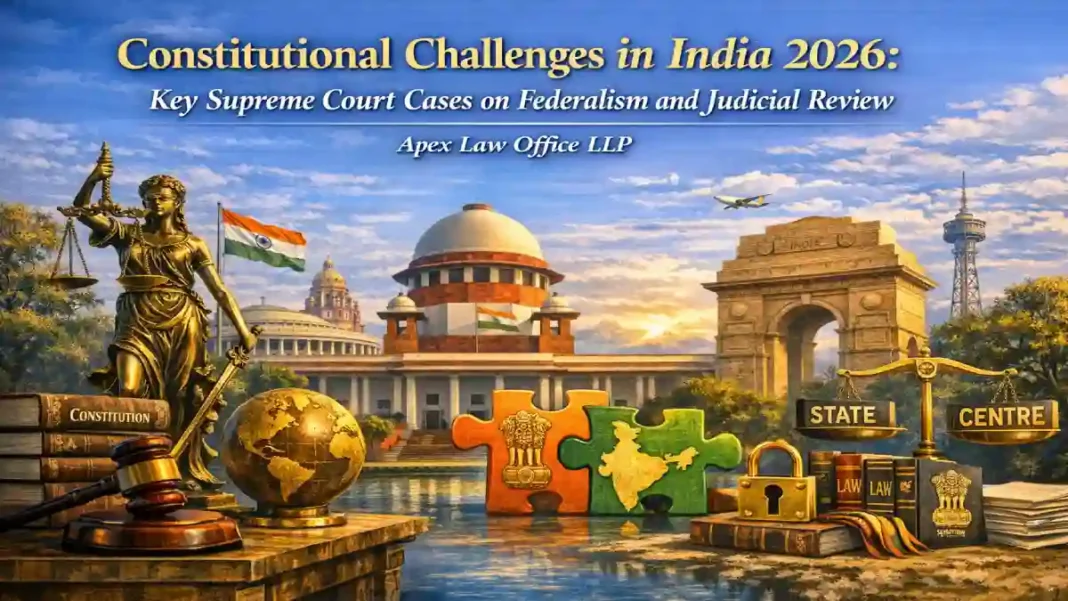

Constitutional Challenges in India – India’s Constitution is a living document. It evolves with time, responds to challenges, and adapts to the needs of society. However, as India grows politically and economically, constitutional disputes have also become more complex. In 2026, two major themes continue to dominate constitutional litigation—federalism and judicial review.
On one hand, there are increasing tensions between the Centre and the States. On the other hand, the judiciary continues to play a crucial role in reviewing laws and protecting constitutional values. Therefore, understanding recent Supreme Court trends is essential for citizens, lawyers, and policymakers alike.

Constitutional Challenges in India 2026: Key Supreme Court Cases on Federalism and Judicial Review – Apex Law Office LLP

Understanding Federalism in India
To begin with, federalism refers to the division of powers between the central government and state governments. The Indian Constitution clearly defines this structure through three lists:
- Union List
- State List
- Concurrent List
However, in practice, conflicts often arise. For instance, disagreements may occur over taxation powers, law enforcement authority, or control over administrative agencies.
Although India follows a “quasi-federal” structure, the balance of power is constantly tested. As a result, the Supreme Court frequently steps in to interpret constitutional boundaries.
What is Judicial Review?
At the same time, judicial review is one of the most powerful tools available to the courts. It allows the judiciary to examine laws and government actions and strike them down if they violate the Constitution.
Importantly, judicial review ensures that:
- Fundamental rights are protected
- Government actions remain lawful
- Constitutional limits are respected
Without judicial review, there would be no effective check on legislative or executive power. Therefore, it plays a central role in maintaining the rule of law.
Rising Federal Tensions in 2026
In recent years, Centre-State conflicts have increased significantly. These disputes often relate to:
- Control over investigative agencies
- Allocation of financial resources
- Implementation of central laws by states
- Role of Governors in state administration
Consequently, many of these issues have reached the Supreme Court, making federalism a key constitutional battleground in 2026.
Role of Governors – A Constitutional Debate
One of the most debated issues involves the role of Governors. Governors are appointed by the central government, but they function within states.
However, controversies arise when:
- Governors delay assent to state bills
- Governors interfere in legislative functioning
- Political considerations influence decisions
As a result, several cases have questioned whether such actions violate the spirit of federalism.
The Supreme Court has increasingly emphasized that Governors must act within constitutional limits and not as political agents.
Control Over Investigative Agencies
Another important issue is the control of central agencies like investigative bodies. Some states have withdrawn general consent for central agencies to operate within their jurisdiction.
This has led to legal questions such as:
- Can the Centre override state consent?
- Does it affect the federal balance?
In response, the courts have tried to balance national interest with state autonomy. Therefore, these cases highlight the delicate nature of Indian federalism.
Financial Federalism and Taxation Disputes
Financial matters have also become a major source of conflict. States often argue that they do not receive a fair share of revenue.
For example:
- Disputes over GST compensation
- Allocation of centrally sponsored schemes
- Conditions attached to financial grants
These issues directly impact governance and development. Hence, the judiciary sometimes steps in to ensure fairness and transparency.
Judicial Review and Its Expanding Scope
While federalism remains a key concern, judicial review continues to expand in scope. The Supreme Court has been actively reviewing laws related to:
- Personal liberty
- Free speech
- Economic regulations
- Administrative actions
As a result, the judiciary plays a proactive role in shaping public policy.
Doctrine of Basic Structure
One of the most important principles in constitutional law is the doctrine of basic structure. According to this doctrine, Parliament cannot alter the core features of the Constitution.
These core features include:
- Democracy
- Rule of law
- Separation of powers
- Federalism
- Judicial review
Therefore, even constitutional amendments can be struck down if they violate the basic structure.
In 2026, this doctrine continues to guide the Supreme Court in major constitutional cases.
Recent Trends in Supreme Court Judgments
In recent times, the Supreme Court has shown a balanced approach. On one hand, it respects the powers of the legislature and executive. On the other hand, it does not hesitate to intervene when constitutional principles are at risk.
Some key trends include:
- Strengthening individual rights
- Clarifying limits of executive power
- Protecting state autonomy
- Promoting transparency and accountability
Thus, the Court acts as both a guardian of rights and an interpreter of constitutional boundaries.
Challenges to Judicial Independence
Despite its important role, the judiciary itself faces challenges. Questions are often raised about:
- Judicial appointments
- Delay in cases
- Transparency in decision-making
However, judicial independence remains a cornerstone of democracy. Without it, judicial review would lose its effectiveness.
Therefore, maintaining the credibility of the judiciary is crucial in addressing constitutional challenges.
Balancing Power Between Institutions
One of the biggest challenges in 2026 is maintaining balance between the three organs of government:
- Legislature
- Executive
- Judiciary
While each organ has its own role, conflicts are inevitable. However, the Constitution provides mechanisms to resolve these conflicts.
The Supreme Court, through judicial review, ensures that no organ exceeds its authority. At the same time, it avoids unnecessary interference in policy matters.
This balance is essential for a healthy democracy.
Impact on Citizens and Governance
These constitutional issues are not just theoretical—they directly affect citizens.
For example:
- Federal disputes can impact state development projects
- Judicial decisions can protect individual freedoms
- Financial conflicts can influence public welfare schemes
Therefore, the outcome of these cases shapes everyday governance.
Importance of Legal Awareness
Given the complexity of constitutional law, legal awareness is more important than ever. Individuals, businesses, and public institutions must understand their rights and obligations.
Moreover, timely legal advice can help in navigating disputes effectively.
How Apex Law Office LLP Can Help
At Apex Law Office LLP, we specialize in constitutional and public law matters. We assist clients in understanding complex legal issues and provide strategic solutions.
Our services include:
- Constitutional litigation
- Advisory on Centre-State disputes
- Legal opinions on policy matters
- Representation before courts
We focus on clarity, precision, and strong legal reasoning to protect our clients’ interests.
Frequently Asked Questions
Federalism refers to the division of powers between the central government and state governments. It is important because it ensures balanced governance and allows states to function independently in certain areas. In India, maintaining this balance is essential to protect regional interests while preserving national unity.
Judicial review is the power of courts, especially the Supreme Court, to examine laws and government actions. If any law violates the Constitution, the court can strike it down. This process ensures that all authorities act within constitutional limits and that citizens’ rights are protected.
Centre-State conflicts have increased due to disagreements over financial distribution, control of agencies, and political differences. Issues like GST compensation, role of Governors, and implementation of central laws often create disputes. As a result, many such matters reach the Supreme Court for resolution.
The basic structure doctrine means that certain core features of the Constitution cannot be changed, even by Parliament. These include democracy, rule of law, federalism, and judicial review. The Supreme Court uses this doctrine to ensure that constitutional amendments do not destroy essential principles.
These issues directly impact governance, public policies, and individual rights. For example, financial disputes between governments can affect welfare schemes, while judicial decisions can protect freedoms like speech and liberty. Therefore, constitutional cases play a vital role in shaping everyday life in India.
Conclusion
In conclusion, 2026 presents significant constitutional challenges in India, particularly in the areas of federalism and judicial review. As tensions between the Centre and States continue to evolve, the role of the Supreme Court becomes even more critical.
At the same time, judicial review remains a powerful tool to uphold constitutional values and protect individual rights. However, maintaining balance between institutions is equally important.
Ultimately, the strength of India’s democracy lies in its Constitution and the institutions that uphold it. With careful interpretation and responsible governance, these challenges can be addressed effectively.