



Arjun Singh

Source: The Hindu

Abstract: Section 44(3) of the Digital Personal Data Protection Act, 2023, does not merely restrict the right to information. It invokes Puttaswamy to destroy the proportionality floor that Puttaswamy itself created. The author applies the doctrine of non-retrogression to expose this subversion, and argues that proportionality demands the Constitution Bench read it down.
I. Introduction
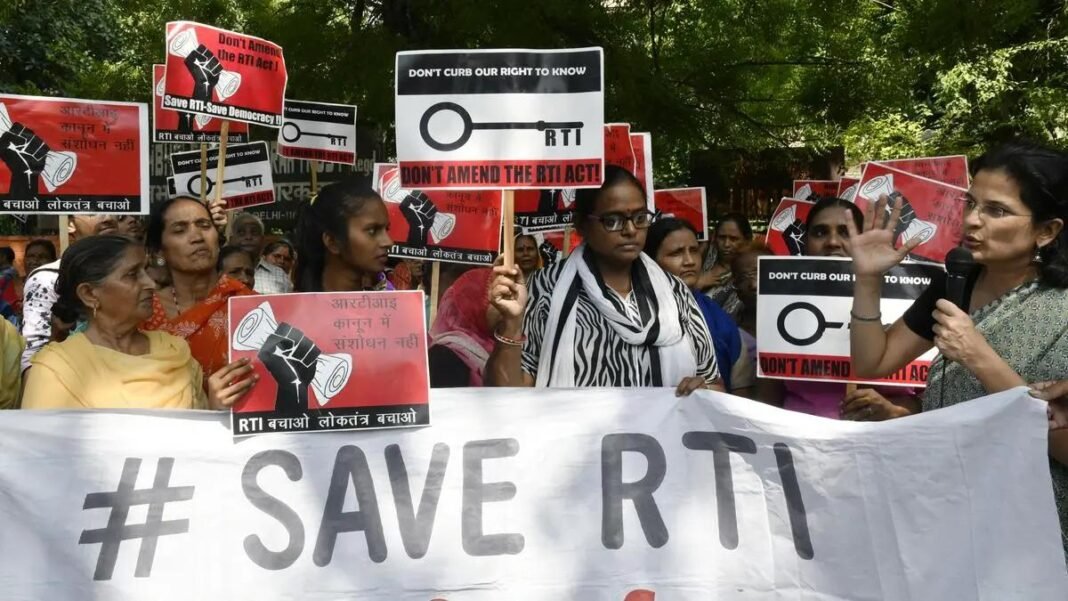
In 2017, a nine-judge bench of the apex court held that privacy is a fundamental right. In 2023, the parliament cited that very judgment to pass a law that amends Section 8(1)(j) of the Right to Information Act, 2005 ( ‘RTI’ Act), replacing a carefully calibrated public interest override with a blanket exemption for all information relating to personal data, making the right to information functionally unenforceable. This is not a coincidence. It is the most precise form of constitutional retrogression that Indian jurisprudence has yet produced, and it demands a doctrinal response that Indian constitutional law already has, but has not yet fully deployed.
That response rests on the doctrine of non-retrogression, hereinafter “the doctrine.” Its premise is that once a constitutional right has been progressively realised, neither the legislature nor the judiciary may permit that realisation to be reversed. A great deal of debate in recent Indian jurisprudence has centred on the majoritarian will and whether it should be heeded to ensure the progressive realisation of rights. Courts’ attempts to balance these propositions have resulted in both retrogression and progression of rights, and it is from this tension that the doctrine emerges as a constitutional necessity. In Navtej Singh Johar v. Union of India, the Supreme Court relied on the doctrine to resolve the deadlock between majoritarian conceptions of the ‘natural’ and the biological reality of non-normative sexual identities, concluding that every majoritarian thought is not necessarily desirable for a progressive society. The overruling of Suresh Kumar Koushal v. Naz Foundation in Navtej Singh Johar corrected precisely such an atavism. The ruling in Suresh Kumar Koushal entrenched a majoritarian conception of ‘unnatural lust’ to criminalise homosexual sodomy, situating the rights of a sexual minority at the behest of the majoritarian, homophobic thought. India’s commitment to the doctrine extends internationally as well, through Article 2(1) of the ICESCR, which obligates states to progressively realise rights of their citizens, to which India is a signatory.
Against this backdrop, the article proceeds as follows: Part II situates the doctrine as the core premise of what this article will argue, by identifying the two types of constitutional retrogression that form the analytical backbone of this article. Part III examines the Puttaswamy Paradox, analysing how Section 44(3) produces both normative and will-based retrogression under the DPDP Act. Part IV develops the argument for reading down Section 44(3) by deploying the doctrine of proportionality as evidence of its engagement in constitutional retrogression. Part V concludes.
II. Situating the doctrine in the argument
Upon review, two types of retrogression are actively practised by the courts in India. The first type is normative retrogression, wherein the proper and progressive implementation of a right regresses if any extension of that right is ignored. This precise retrogression can be pertinently observed in the argument to extend the ambit of Article 21 to include ‘Right to be Forgotten’ (RTBF). The second type is will-based retrogression, where a present majoritarian legislative or judicial will displaces a constitutional baseline established by an earlier, rights-expanding exercise of constitutional authority. The Delhi High Court’s refusal to criminalise marital rape in RIT Foundation v. Union of India, where the sanctity of marriage was held to outweigh a woman’s fundamental right to consent, illustrates the second form precisely: a present judicial will displacing the constitutional baseline of bodily autonomy and the right to refuse sexual activity under Article 21, finding its judicial expression in cases like Suchita Srivastava v. Chandigarh Administration.
Both types are simultaneously at work in the constitutional challenge to Section 44(3) of the Digital Personal Data Protection Act, 2023, hereinafter “the DPDP Act”, the provision that effectively amended the RTI Act to exempt all personal data from disclosure, regardless of public interest, currently pending before a Constitutional Bench of the Supreme Court. But the article’s argument goes beyond mere identification of regression. It contends that the doctrine, properly understood, is not merely a lens for identifying constitutional regression. It is an evidentiary tool demonstrating the existence of a prior, constitutionally compliant, less restrictive regime, which proves that proportionate means were available and deliberately abandoned. That proof, it is argued, is constitutionally fatal to Section 44(3) under Puttaswamy’s own proportionality standard.
The DPDP Rules, 2025, notified on 14 November 2025, marked the full operationalisation of the Act. The Rules build an enforcement architecture for the Act to be effectively implemented by mandating consent notices, breach notifications, and data erasure obligations, among other measures. Yet, Section 44(3)’s blanket exemption still remains intact. Therefore, the retrogression this article identifies is no longer merely legislative, but has found an enforcement regulatory footing. Simultaneously, the apex court has issued notice in The Reporters Collective Trust v. Union of India, referring the matter to a larger bench, making the argument advanced in the article not merely academic, but consequential in contemporary jurisprudence.
III. The Puttaswamy Paradox: Situating the doctrine under the DPDP Act
In the Supreme Court case of Justice K.S. Puttaswamy (Retd.) v. Union of India, the Supreme Court did two things that are usually referred to separately, but must be read in tandem. First, the right to privacy is a fundamental right under Articles 14, 19, and 21 of the Constitution; and second, refusing to make privacy absolute. The Supreme Court has held that the rights of privacy and transparency go hand in hand, neither of which may categorically extinguish the other, and that any infringement of a fundamental right must satisfy a three-part proportionality test. The infringement must pursue a legitimate aim, take the least restrictive means, and contain safeguards against misuse. It is the second prong that the Parliament has violated, in enacting Section 44(3) of the DPDP Act, and it is the doctrine that proves it.
A. Normative Retrogression: The Erosion of 19(1)(a)’s Practical Content
The right to information under Article 19(1)(a) has been progressively constructed through decades of constitutional interpretation, culminating in the Right to Information Act, 2005 (RTI Act). Section 8(1)(j) of the RTI Act is key to the disclosure of information regarding ‘personal information’ in the possession of a public authority. While the initial position was that ‘personal information’ was exempt from disclosure if it had no relation to public activities and/or if disclosure of the information would cause an unwarranted invasion of privacy, disclosure was mandatory if the “larger public interest” justified disclosure. This public interest override effectively operationalised Puttuswamy’s balancing act of privacy and transparency, giving it a practical effect at the point of decision-making.
Section 44(3) of the DPDP Act replaced this intricately drafted text with a single broad phrase: “information which relates to personal information.” This resulted in the elimination of the mandatory public interest override and the proportionality test. What remains, then, is a general and unqualified exemption, which is indifferent to whether the data is of a public official, is in the nature of public interest, or is in the nature of the wrongdoing. Penalties of up to Rs. 250 crores have also been provided for violations of the Act by data fiduciaries, including public authorities. Public Information Officers, in the face of this penalty and exemption, are structurally incentivised to deny information on personal data, which virtually covers all government data. Therefore, while the right to information is not abolished, it is functionally inoperable.
This, in effect, is normative retrogression. The right to information exists, but its practical protection has shrunk far short of what accountability requires in a democracy. A right to information that excludes the personal conduct of public officials in public roles is a right out of step with the world it governs. The doctrine identifies this not as a policy failure, but a constitutional one. The progressive realisation of Article 19(1)(a), built across two decades of RTI jurisprudence, has been legislatively rendered redundant.
Before proceeding, posing a caveat is essential. The doctrine is not an instrument of absolute constitutional conservatism, given that sometimes overcorrection in the name of the progressive realisation of rights can itself produce constitutional harm. This dilemma can be clearly traced in cases like D.S. Nakara v. Union of India,where a uniform pension scheme to protect Article 14 resulted in the restriction of future higher pensions. This caveat makes the argument against Section 44(3) even stronger, as this is not a case of marginal regression. It is the deliberate dismantling of a constitutionally compliant framework, with no less restrictive alternative being even considered for in its place.
B. Will-Based Retrogression and the Puttaswamy Paradox
The normative dimension of the unconstitutionality of Section 44(3) demonstrates a breach of the constitutional floor. The will-based dimension, however, establishes something more troubling: its breach has been done in the name of the very judgment that created it.
The Parliament’s justification relies on Puttaswamy, for enacting the DPDP Act, presenting the Act as the statutory realisation of the fundamental right to privacy. This justification is incorrect. Puttaswamy did not hold that privacy categorically trumps transparency or that personal information is immune from public disclosure. What it held, unanimously across nine judges, was that competing fundamental rights must be balanced proportionately, and that the right to information was one such right. The original Section 8(1)(j) of the RTI Act was already compliant with Puttaswamy; it protected personal information as the default, while preserving the constitutional space for transparency when public interest demanded it. Section 44(3), on the contrary, does not realise Puttaswamy, violating it in its own name.
This is the Puttaswamy Paradox, in which a rights-expanding judgment is deployed to reach a rights-curtailing conclusion. It is an instance of will-based retrogression and, in theory, calls for proportionate balancing. The constitutional will in Puttaswamy demands balancing restrictions, whereas the current majoritarian legislature has provided a categorical exemption. Where the constitutional wills in Puttaswamy and Section 44(3) are in conflict, it is the constitutional will that is in line with the constitutional future of the nation that must prevail, and it is the constitutional will in Puttaswamy, not in Section 44(3).
The procedural history of Section 44(3) strengthens this interpretation. The DPDP Bill was passed by both Houses of Parliament in four days in August 2023, in the questionable political atmosphere of a nationwide no-confidence motion brought in the context of Manipur. Moreover, none of the expert bodies that considered data protection, including the Justice Srikrishna Committee and the 2019 Joint Parliamentary Committee, suggested any amendment to the RTI Act. The removal of the public interest override was not a well-considered decision; it was well manufactured article of legislative chicanery. Section 44(3)’s majoritarian will is illegitimate on two counts: it flouts the constitutional threshold of proportionality and bypasses legislative deliberation through which even the majoritarian will gains legitimacy.
IV. Non-Retrogression as Proportionality’s Proof: Reading Down Section 44(3)
The argument so far has demonstrated what Section 44(3) does and why it is constitutionally impermissible. What remains is for the Constitution Bench to decide what to do about it. This section argues that the doctrine, when properly situated within Puttaswamy’s proportionality standard, produces a clear constitutional remedy: the reading down of Section 44(3), restoring the public-interest override.
Proportionality stricto sensu, as outlined in Puttaswamy and developed in Modern Dental College v. State of Madhya Pradesh, requires that the restriction on a fundamental right must deploy the least restrictive means available to achieve its legitimate aim. The legitimate aim of the DPDP Act is to protect personal data privacy, and this is clearly unobjectionable. What is objectionable is the means chosen to achieve it.
This is where the doctrine situates proportionality in constitutional theory, acting as its proof. Original Section 8(1)(j) and its proportionate override of public interest is not merely historical facts, but constitutional evidence. It demonstrates that a less restrictive means to the constitutional legislative goal was not only possible but was in place for nearly two decades. A system that prioritised the protection of personal information while providing transparency in the service of public interest was constitutional, workable, and less restrictive. Parliament’s decision to abandon this system in the absence of evidence of unconstitutionality or impracticability is not a passing test under the least restrictive standard of proportionality in Puttaswamy.
The appropriate remedy is not the complete striking down of Section 44(3), which would leave the DPDP Act’s data protection framework with a significant gap, but it is reading down to restore the public interest override. The most appropriate outcome would be the Constitutional Bench holding that Section 44(3) must be read to preserve the obligation of Public Information Officers to disclose personal information where the public interest justifies it, consistent with the proportionality standard mandated by Puttaswamy. The process of reading down existing laws does not stop Parliament from its mission to create data protection legislation. The process requires constitutionally acceptable methods to achieve its purpose while maintaining the balance established by Puttaswamy.
V. Conclusion
The doctrine, at its core, espouses that the constitutional gains of the past will not be silently surrendered to the hurdles of the present. The challenge to Section 44(3) of the DPDP Act tests whether that promise has any institutional enforcer left.
The Puttaswamy Paradox reveals something more unsettling than a statutory overreach. It reveals the ease with which a judgment that expanded constitutional protection can be cited, in the same breath, to constrict it. The doctrine provides the analytical framework to name this manoeuvre for what it is, and proportionality provides the constitutional standard to correct it. But the process of naming something exists separately from the process of correcting it, and the latter depends entirely on whether the Constitution Bench in the pending petitions is willing to hold the line.
History counsels caution about confident predictions. The Warren’s Court, the observance of whose decisions gave birth to the doctrine, in its most celebrated progressive interventions, from Furman v. Georgia’s abolition of the death penalty to Roe v. Wade’s liberalisation of abortion rights, did not stand the test of time. The doctrine thus is not a guarantee of permanence. It is a standard of constitutional fidelity; whether that standard has an institution behind it is precisely what is upon the Constitutional Bench to answer.
Arjun Singh is a third-year law student at WBNUJS and takes a keen interest in matters relating to Constitutional and Public International Law.