


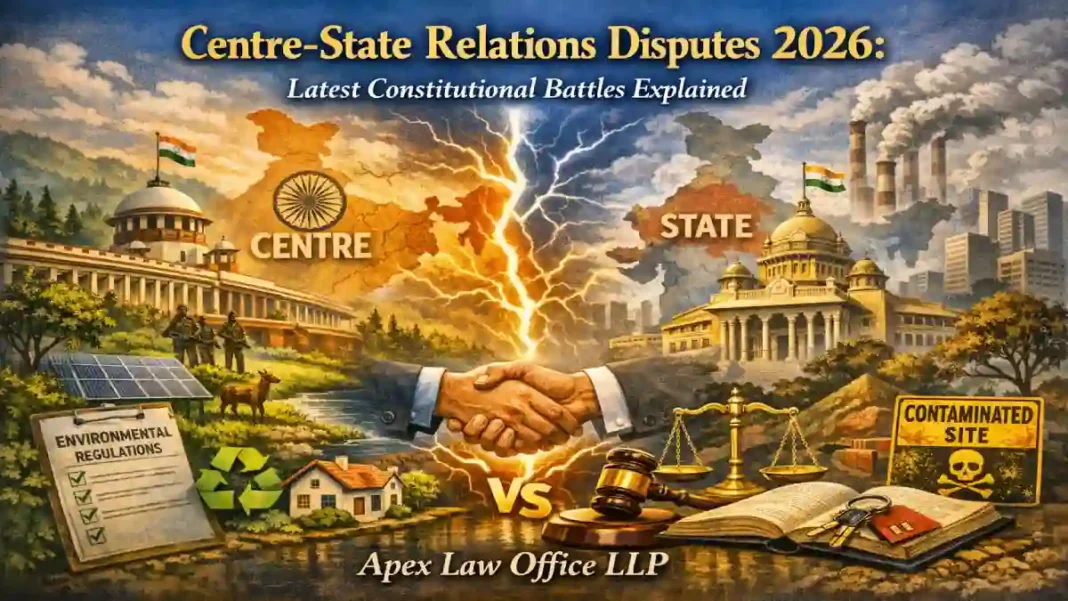

Centre-State Relations Disputes 2026 – India’s federal structure is built on a careful balance between the powers of the Centre and the States. However, this balance is not always smooth. In recent years, especially in 2026, disputes between the Union Government and State Governments have increased. These conflicts often raise serious constitutional questions and affect governance, policy implementation, and citizens’ rights.
At Apex Law Office LLP, we help individuals, businesses, and institutions understand these evolving legal issues. In this article, we explain the nature of Centre-State disputes, the constitutional framework, recent trends, and their real-world impact.

Centre-State Relations Disputes 2026: Latest Constitutional Battles Explained – Apex Law Office LLP

Understanding Centre-State Relations in India
India follows a federal system, which means that power is divided between the Central Government and the State Governments. However, unlike some other countries, India has a “quasi-federal” structure. This means that while States have autonomy, the Centre holds stronger powers in certain areas.
The Constitution clearly divides powers into three lists:
- Union List (controlled by the Centre)
- State List (controlled by States)
- Concurrent List (shared powers)
Although this division seems clear, conflicts often arise. Therefore, interpretation of these powers becomes a key legal issue.
Why Are Centre-State Disputes Increasing in 2026?
In 2026, several factors have contributed to rising disputes. Firstly, political differences between the Centre and States have intensified. Secondly, economic challenges have created disagreements over revenue sharing and taxation. Thirdly, governance issues such as law enforcement and administrative control have led to conflicts.
Moreover, as India grows, new areas like digital regulation, environmental policies, and public welfare schemes create overlapping responsibilities. As a result, disputes become unavoidable.
Key Areas of Constitutional Conflict
1. Governor’s Role and Powers
One of the most debated issues involves the role of Governors. Governors are appointed by the Centre but function within States. However, disputes arise when Governors delay or refuse to approve State legislation.
For example, withholding assent to bills or interfering in State administration often leads to constitutional challenges. Therefore, questions about neutrality and constitutional limits are frequently raised.
2. Use of Central Agencies
Another major area of conflict involves central investigative agencies. States sometimes allege misuse of agencies for political purposes. On the other hand, the Centre argues that these agencies act within legal boundaries.
As a result, courts often step in to examine whether such actions violate federal principles.
3. Financial Disputes and GST Issues
Financial relations are a common source of tension. States depend on the Centre for funds, especially under schemes like GST compensation.
However, delays or disagreements in fund allocation create disputes. States argue that financial autonomy is essential, while the Centre emphasizes fiscal discipline.
4. Legislative Overlap
Sometimes, both the Centre and States pass laws on similar subjects. This overlap creates confusion about which law will prevail.
In such cases, constitutional provisions and judicial interpretation become crucial. Therefore, courts play a key role in resolving these conflicts.
5. Control Over Law and Order
Although law and order fall under the State List, the Centre can intervene in certain situations. This often leads to disputes, especially when States feel that their authority is being undermined.
Role of the Judiciary in Resolving Disputes
The judiciary acts as the final authority in Centre-State conflicts. Courts interpret constitutional provisions and ensure that both levels of government act within their limits.
Importantly, the Supreme Court plays a central role in:
- Interpreting the Constitution
- Resolving disputes between governments
- Protecting federal balance
Therefore, judicial decisions shape the future of Centre-State relations.
Recent Constitutional Battles in 2026
In 2026, several important disputes have gained attention. While each case is unique, they reflect broader constitutional concerns.
1. Disputes Over State Bills
Many States have approached courts regarding delays in approval of bills by Governors. These cases raise questions about timelines and constitutional duties.
2. Federal Taxation Conflicts
States have raised concerns about revenue sharing and GST compensation. These disputes affect State budgets and development projects.
3. Administrative Control Issues
Conflicts over control of services and bureaucrats have also increased. These disputes directly impact governance and policy implementation.
4. Environmental and Policy Disputes
Differences in environmental regulations and development policies have led to legal battles. States often challenge central guidelines that affect local projects.
Impact on Citizens and Businesses
Centre-State disputes are not just legal issues; they affect everyday life. For instance:
- Delays in policy implementation can slow development
- Financial disputes can impact welfare schemes
- Legal uncertainty can affect business investments
- Administrative conflicts can disrupt governance
Therefore, resolving these disputes quickly is essential for stability and growth.
Role of Legal Experts in Constitutional Disputes
Handling constitutional disputes requires deep legal knowledge and strategic thinking. At Apex Law Office LLP, we assist clients in navigating these complex issues.
Our services include:
- Constitutional interpretation and legal advice
- Representation in High Courts and Supreme Court
- Drafting and reviewing legal documents
- Advising on Centre-State compliance matters
With proper legal guidance, clients can understand how these disputes affect their rights and interests.
Importance of Cooperative Federalism
While conflicts are natural, cooperation between the Centre and States is essential. The concept of “cooperative federalism” encourages both levels of government to work together.
For example:
- Joint decision-making in policy matters
- Transparent financial arrangements
- Respect for constitutional boundaries
When cooperation improves, disputes reduce, and governance becomes more effective.
Challenges in Maintaining Federal Balance
Maintaining balance between the Centre and States is not easy. Several challenges exist:
- Political differences
- Economic inequalities
- Administrative complexities
- Evolving legal issues
Therefore, continuous dialogue and legal clarity are necessary to address these challenges.
Future Trends in Centre-State Relations
Looking ahead, Centre-State relations are likely to evolve further. Some key trends include:
- Increased judicial intervention
- Greater focus on fiscal federalism
- Expansion of digital and regulatory laws
- Stronger demand for State autonomy
As these trends develop, constitutional interpretation will play an even bigger role.
Why Choose Apex Law Office LLP
At Apex Law Office LLP, we understand the complexities of constitutional law and federal disputes. Our approach focuses on clarity, strategy, and effective representation.
We offer:
- Expert legal analysis
- Practical solutions
- Strong courtroom advocacy
- Client-focused service
Whether you are an individual, business, or institution, we help you navigate constitutional challenges with confidence.
Frequently Asked Questions
Centre-State relations refer to the distribution of powers and responsibilities between the Central Government and State Governments under the Constitution. These relations are defined through the Union, State, and Concurrent Lists. They ensure governance is balanced, but conflicts may arise when powers overlap or are interpreted differently.
In 2026, disputes have increased due to political differences, financial disagreements, and administrative conflicts. Issues such as GST compensation, Governor’s powers, and control over services have created tensions. Additionally, new policy areas like digital regulation and environmental governance have led to overlapping authority.
The judiciary, especially the Supreme Court, acts as the final authority in resolving Centre-State disputes. It interprets constitutional provisions, ensures both governments act within their limits, and maintains the federal balance. Court decisions often set important precedents for future cases.
These disputes can delay policy implementation, disrupt government schemes, and create legal uncertainty. For businesses, this may affect investments and regulatory compliance. For citizens, it may impact welfare benefits, public services, and overall governance efficiency.
Legal experts provide guidance on constitutional provisions, represent clients in courts, and help interpret complex laws. They also assist in drafting petitions, advising on compliance, and protecting rights affected by such disputes. With expert support, individuals and organizations can navigate these issues effectively.
Conclusion
Centre-State disputes are a natural part of India’s federal system. However, in 2026, these conflicts have become more frequent and complex. Issues related to governance, finance, legislation, and administration continue to shape constitutional debates.
Therefore, understanding these disputes is essential for anyone affected by government policies or legal developments. At the same time, the role of the judiciary and legal experts becomes crucial in maintaining balance.
At Apex Law Office LLP, we are committed to helping clients understand and respond to these evolving constitutional battles. With the right legal support, it is possible to protect your rights and navigate even the most complex disputes effectively.