


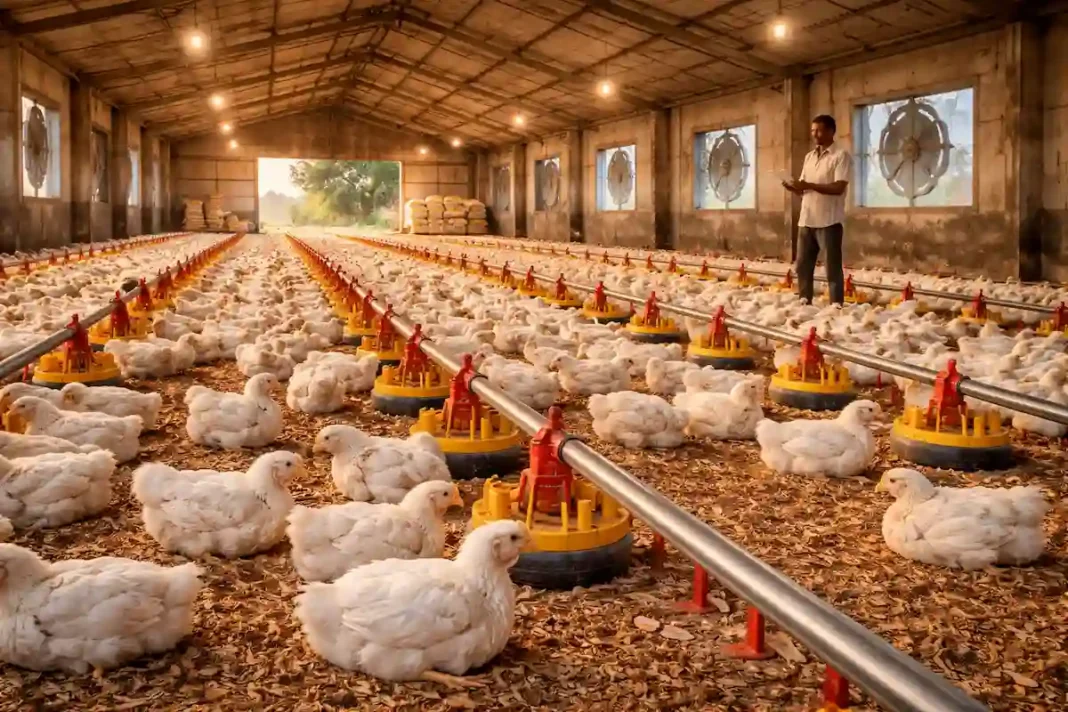

Reviewed by: Agri Farming Editorial Team
Topic: Broiler farming profit per bird calculation
Content type: Poultry farming profit guide
Data sources: ICAR, KVK training material
Last updated: April 2026
Quick answer: how much profit per broiler bird?
On average, a broiler farmer in India earns a net profit of ₹20 to ₹40 per bird per cycle under contract farming, and ₹50 to ₹90 per bird under independent farming — depending on feed cost, mortality rate, market price, and farm management. A flock of 5,000 birds can return ₹1.5 lakh to ₹4.5 lakh net profit per cycle in favourable conditions.

Quick profit summary
- Average profit: ₹20–₹100 per bird
- Cycle duration: 42–45 days
- Break-even price: ₹95–₹105/kg
- Best season: October–December

Broiler farming profit per bird is one of the most searched questions among new and experienced poultry farmers across India. And honestly — for good reason. The numbers look attractive on paper, but the actual returns depend heavily on how well you manage costs, mortality, and market timing.
From field observations and farmer reports, many beginners underestimate feed cost and overestimate live weight gain. That gap between expectation and ground reality is where most early losses happen. This article breaks down the real numbers — batch by batch, cost by cost — so you know exactly what to expect before you invest.
What is broiler farming profit per bird?
Broiler farming profit per bird refers to the net income you earn from a single broiler chicken after subtracting all costs of rearing — chick cost, feed, medication, litter, electricity, labour, and overhead — from the sale price of the live bird at market weight.
In India, most broiler birds are sold at 6 to 7 weeks of age, weighing between 1.8 kg to 2.2 kg live weight. The selling price fluctuates by season, region, and market demand. This makes per-bird profit calculation essential before each new batch.
Broiler Farming Profit Per Bird Calculation Formula

Profit per bird = Sale price per bird – Total cost per bird
Where:
Sale price per bird = Live weight (kg) × Market rate (₹/kg)
Total cost per bird = Chick + Feed + Medicine + Labour + Overhead
This simple formula is the foundation of every broiler batch evaluation. Track it for every cycle and you will quickly see which cost component is eating your margin.
Use our poultry profit calculator to estimate your exact per-bird profit before starting a new batch.
Broiler farming at a glance
- Typical cycle duration: 42 to 45 days
- Market weight achieved: 1.8 kg to 2.2 kg
- Feed conversion ratio (FCR): 1.7 to 2.0
- Mortality rate (target): below 3–4%
- Average chick cost: ₹38 to ₹50 per chick (recent market averages)
- Typical feed cost: ₹28 to ₹33 per kg
- Live bird market rate: ₹90 to ₹130 per kg (varies by season)
- Profit under contract farming: ₹20 to ₹40 per bird
- Profit under open market farming: ₹50 to ₹100+ per bird (when market is good)
Complete cost breakdown per broiler bird

This is where most farmers need to be very honest with themselves. Undercounting costs is the biggest mistake beginners make.
| Cost component | Cost per bird (₹) |
|---|---|
| Day-old chick (DOC) | ₹40–₹50 |
| Feed cost (total cycle) | ₹100–₹130 |
| Medication and vaccines | ₹8–₹15 |
| Litter material (wood shavings) | ₹4–₹8 |
| Electricity (brooder, fans) | ₹5–₹10 |
| Labour cost | ₹8–₹15 |
| Water and miscellaneous | ₹3–₹6 |
| Depreciation (shed, equipment) | ₹5–₹10 |
| Total cost per bird (approximate) | ₹173–₹244 |
Note: Costs vary by state, season, and procurement method. These are realistic averages based on recent Indian market conditions.
Income calculation per broiler bird
The income side depends entirely on two variables — the live weight of the bird and the market rate on sale day. Both can change significantly within a single batch.
From field observations and farmer reports, a well-managed bird reaches 2.0 to 2.2 kg in 42 days. A poorly managed bird — with bad feeding, stress, or disease — may only hit 1.6 to 1.8 kg. That 400 g difference at ₹110/kg is ₹44 per bird. On 5,000 birds, that is ₹2.2 lakh vanished.
| Scenario | Weight (kg) | Rate (₹/kg) | Sale income/bird |
|---|---|---|---|
| Poor batch (low weight, low market) | 1.7 kg | ₹90 | ₹153 |
| Average batch | 2.0 kg | ₹110 | ₹220 |
| Good batch (good weight, good market) | 2.2 kg | ₹125 | ₹275 |
| Peak season batch (summer, festivals) | 2.2 kg | ₹145 | ₹319 |
Net profit per broiler bird: the real calculation
Let us now put cost and income together for a realistic profit picture. Many farmers see high gross income and assume high profit. The net number is what matters.
| Scenario | Income/bird | Cost/bird | Profit/bird |
|---|---|---|---|
| Loss scenario | ₹153 | ₹200 | –₹47 |
| Break-even | ₹200 | ₹200 | ₹0 |
| Average market | ₹220 | ₹195 | ₹25 |
| Good batch | ₹275 | ₹200 | ₹75 |
| Peak season | ₹319 | ₹205 | ₹114 |
Very common observation — farmers who sell 2 to 3 days late because they are waiting for prices to rise often end up paying extra feed cost that eats directly into profit. Timing the sale is as important as growing the bird.
Contract farming vs open market: which gives better broiler farming profit per bird?
This is the most common question new farmers ask at Krishi Vigyan Kendra (KVK) poultry training sessions. The answer is nuanced.
Contract farming
- Chicks, feed, medicines supplied by integrator
- Fixed service charge: ₹18–₹35 per kg live weight
- Low risk, low reward
- Stable income of ₹20–₹40 per bird
- Best for beginners and small farms
Open / independent market
- Farmer buys own chicks and feed
- Full exposure to market price fluctuation
- Higher reward: ₹50–₹120 per bird in good cycles
- Higher risk: losses possible in bad seasons
- Suitable for experienced farmers with market contacts
From field observations and farmer reports: most farmers in Andhra Pradesh, Telangana, Maharashtra, and UP tend to prefer contract farming in the early years, then shift to independent farming once they understand the market cycle.
Indian seasonal impact on broiler profit

India’s tropical climate directly impacts broiler farming profitability. This is very commonly overlooked by new farmers.
- Summer (March–June): Heat stress raises mortality and reduces feed intake. Birds drink more, eat less, gain weight slowly. FCR worsens. However, consumer demand for broiler meat rises during summer weddings and festivals — often pushing prices to ₹130–₹150/kg. Net result: can be profitable if mortality is controlled.
- Monsoon (July–September): High humidity promotes disease — Ranikhet disease (Newcastle disease), infectious bronchitis, and coccidiosis are very common. Litter management becomes critical. Medication costs rise. Profit margins thin. Happens during monsoon — nothing to worry if vaccination is done correctly.
- Winter (November–February): Ideal growing conditions. Birds gain weight efficiently. Mortality is lowest. FCR improves to 1.7–1.8. Most farmers report highest per-bird profit during October–December batches.
What is FCR and why it directly controls your profit
Feed Conversion Ratio (FCR) is the kilograms of feed consumed to produce 1 kg of live bird weight. If your FCR is 1.8, the bird consumed 1.8 kg of feed to gain 1 kg. A lower FCR means less feed cost per kg of meat produced.
You can also estimate flock size and feed requirements using a livestock population or feed calculator before starting a batch — this helps plan procurement and avoid over or under-ordering feed stock.
In practical terms:
- FCR of 1.7: excellent — feed cost around ₹85–₹90 per kg of meat
- FCR of 1.9: acceptable — feed cost around ₹95–₹100 per kg
- FCR of 2.2+: poor management — feed cost around ₹110–₹120 per kg, margins disappear
Want to reduce feed cost at farm level? Read our detailed broiler feed formulation guide to understand how to mix your own feed.
Common beginner mistake — not monitoring daily feed intake. If intake drops suddenly, it usually signals a health problem or heat stress. Catching it in 24–48 hours versus 4–5 days can save ₹30–₹50 per bird.
5,000-bird broiler farm: projected income per batch
| Metric | Value |
|---|---|
| Birds per batch | 5,000 |
| Surviving birds (4% mortality) | 4,800 |
| Average weight per bird | 2.0 kg |
| Selling price | ₹110/kg |
| Total income | ₹10,56,000 |
| Total cost (@ ₹195/bird) | ₹9,75,000 |
| Net profit per batch | ₹81,000 |
| Net profit per bird | ~₹17–₹25 |
A 5,000-bird farm running 7 to 8 batches per year can generate ₹5.5 lakh to ₹7 lakh annual net income in average market conditions. That is not a huge number — but it is reliable and scalable.
Recovery timeline: how long to recover your investment
- Month 1–6: Learning curve. Focus on reducing mortality and improving FCR. Many beginners run 1–2 loss batches.
- Month 6–12: Operations stabilise. Profits begin. Target ₹1–2 lakh net in first year.
- Year 2–3: Full cost recovery on shed and equipment investment (typically ₹8–₹15 lakh for 5,000 birds).
- Year 3+: Pure profit phase. Expansion possible.
Quick checklist: before you start a broiler batch
- Shed cleaned and disinfected completely
- Litter spread — 3 to 4 inches deep
- Drinkers and feeders cleaned and placed
- Brooder heating arranged and tested
- DOC chicks sourced from reliable hatchery
- Vaccination schedule confirmed
- Feed stock procured (at least 15 days)
- Market contact confirmed for sale timing
When not to worry
- Mortality of 1–2 birds in the first 2 days — normal stress from transport
- Slight feed drop during summer afternoons — heat avoidance behaviour
- Birds clustering near drinkers in summer — natural cooling behaviour
- Market price dipping for 1–2 weeks — cyclical, not permanent
- FCR slightly above target in first batch — experience will improve it
Common mistakes that kill broiler farming profit per bird
- Overcrowding the shed — more than 8–10 birds per square metre causes stress, poor FCR, and high mortality
- Buying cheap DOC chicks — poor genetics means poor weight gain; saving ₹5 per chick costs ₹30 in feed waste
- Skipping vaccinations —Ranikhet disease, Gumboro, and infectious bronchitis can wipe out 20–40% of a flock in a week. Follow a proper broiler vaccination schedule from day one without fail.
- Ignoring ventilation in summer — heat stress above 35°C is one of the top causes of mass mortality in Indian summer broods
- Panic selling at low prices — experienced farmers hold for 3–5 days to wait for better rates, but manage feed cost tightly during the wait
- No record keeping — without batch-wise records of cost, FCR, and profit, it is impossible to improve performance over cycles
Key takeaways
- Broiler farming profit per bird in India ranges from ₹20 to ₹100+ depending on model, season, and management
- Feed cost is the single biggest variable — control FCR to protect margins
- Contract farming is safer for beginners; open market farming is more rewarding for experienced growers
- Winter batches (October–December) consistently deliver best results across Indian states
- A 5,000-bird farm can generate ₹5–₹7 lakh annual net profit under normal conditions
- Vaccination, biosecurity, and record-keeping are non-negotiable for sustainable profitability
Frequently asked questions about broiler chicken profit
1. Is broiler farming profitable in India?
Yes, broiler farming is profitable in India when managed correctly. Contract farming offers stable, lower-risk returns of ₹20–₹40 per bird per cycle, while independent farmers in good market conditions can earn ₹50–₹120 per bird. A 5,000-bird farm running 7–8 cycles per year can generate ₹5–₹7 lakh annual net income. Profitability depends heavily on FCR, mortality rate, market timing, and season. It is one of the fastest-growing livestock segments in India.
2. What is the average broiler farming profit per bird in India?
Under average market conditions, broiler farmers earn approximately ₹20 to ₹40 per bird in contract farming, and ₹50 to ₹90 per bird in open market farming. Good batches sold during peak demand seasons — like summer weddings or festival periods — can push profits to ₹100 to ₹120 per bird. Poor market timing or high mortality can result in losses. Profit varies significantly between states due to feed prices and local demand.
3. How much does it cost to raise one broiler chicken in India?
The total rearing cost for one broiler bird in India ranges from ₹170 to ₹240 per bird depending on chick cost, feed price, medication, litter, electricity, and labour. Feed is the largest single cost, accounting for 55–65% of total input. In high-inflation periods when maize and soybean prices are elevated, total cost per bird can touch ₹250. Efficient FCR management is the best way to reduce per-bird cost.
4. Is broiler farming profitable for small farmers with 1,000 birds?
Yes, a 1,000-bird broiler unit can be profitable, but margins are thinner because fixed costs are spread over fewer birds. Net profit per batch typically ranges from ₹15,000 to ₹25,000 in good market conditions. Many farmers use this size to learn the business before scaling up. Contract farming is strongly recommended at this scale to reduce market risk and capital requirement.
5. Which season is best for broiler farming profit in India?
October to December is consistently the most profitable period for broiler farming across India. Cool temperatures improve FCR, reduce mortality, and allow birds to reach market weight efficiently. Additionally, demand remains stable during this period. Summer batches (March–May) can also be very profitable if heat stress is managed well, because market prices rise sharply during wedding and peak demand season.
6. What FCR should a beginner broiler farmer target?
A beginner should target FCR of 1.9 to 2.0 in the first few batches. With experience, the target should move to 1.7 to 1.8, which is considered good performance in Indian conditions. An FCR above 2.2 signals a problem — usually feed wastage, disease, or poor chick quality. Every 0.1 improvement in FCR translates to approximately ₹6 to ₹8 savings per bird, which is significant at scale.
7. How does mortality affect broiler farming profit?
Every 1% increase in mortality above the 3–4% target reduces profit by approximately ₹7 to ₹10 per surviving bird when you account for lost income plus sunk costs. In a flock of 5,000 birds, going from 3% to 8% mortality means 250 additional dead birds, which can cost ₹50,000 to ₹70,000 in combined lost income and wasted input. Vaccination and biosecurity are non-negotiable for controlling this.
8. Should a beginner choose contract farming or independent broiler farming?
Almost every agriculture expert and KVK advisor recommends contract farming for beginners. The integrator supplies chicks, feed, and medicines, and guarantees a buyback price — removing market risk entirely. Income is predictable at ₹20 to ₹35 per bird. Independent farming offers higher potential returns but requires capital, market knowledge, and experience to manage price cycles. Shift to independent farming only after completing 4 to 6 successful contract batches.

For a full cost breakdown, refer to our 1000 broiler chicken farming project report.
Final thoughts
Broiler farming profit per bird in India is real, reliable, and scalable — but it is not a guaranteed income. The farmers who consistently make money are the ones who track every batch carefully, manage FCR obsessively, vaccinate without fail, and do not panic during price troughs.
Many Indian farmers observe that the biggest gains do not come from growing more birds — they come from losing fewer and feeding smarter. A farm with 5,000 birds at 1.75 FCR and 2% mortality will outperform a 10,000-bird farm with 2.1 FCR and 7% mortality every single cycle.
Start with contract farming. Learn the biology and management. For a step-by-step overview before you invest, read our guide on how to start a broiler chicken farm business in India. Watch market prices for at least one full year before switching to independent farming. Build your network with traders and processors early. And always keep batch-wise records — that data will become your most valuable farming asset over time.
If you are serious about scaling up, connect with your nearest Krishi Vigyan Kendra (KVK) for hands-on training, or reach out to the ICAR Central Avian Research Institute (CARI), Izatnagar, for scientific guidance on high-performance broiler breeds suited to your region’s climate.
Note:
This article is written based on field observations and farmer reports from broiler farms across Andhra Pradesh, Telangana, Maharashtra, and Uttar Pradesh, and publicly available data from ICAR, and KVK poultry training resources. Figures reflect recent Indian market conditions and are indicative. Actual results will vary based on location, farm management, and seasonal market conditions. Always consult your local KVK or poultry extension officer for region-specific guidance.