

[ad_1]
About the Book
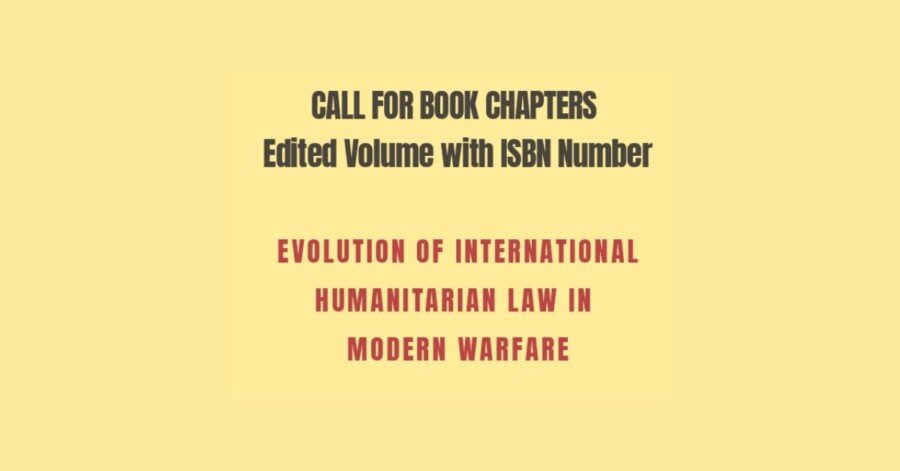
The book examines the evolving challenges faced by humanitarian law in modern armed conflicts. The book
explores how emerging technologies such as artificial intelligence, cyber warfare and autonomous weapons interact with established IHL principles.
It also highlights the growing importance of protecting the environment and safeguarding civilians in increasingly complex conflict settings. Through legal analysis and contemporary case studies, the volume offers insights into strengthening humanitarian protections in today’s rapidly changing battlefield.
Themes & Sub themes
- Evolution of International Humanitarian Law in Modern Warfare
Historical development of IHL and customary humanitarian law
Expansion of IHL after the Geneva Conventions
Development of Additional Protocols and modern interpretations
Changing nature of warfare in the 21st century
Influence of international organizations on IHL evolution - Application of the Principles of Distinction, Proportionality and Military Necessity
Meaning and scope of the principle of distinction
Determining military objectives in urban warfare
Proportionality and collateral damage assessment
Military necessity versus humanitarian considerations
Precautionary measures in attack
Challenges in applying these principles in modern conflicts - Artificial Intelligence and Autonomous Weapons Systems in Armed Conflict
Concept and types of autonomous weapons systems
Human control and accountability in AI warfare
Compliance of AI weapons with IHL principles
Ethical issues surrounding AI-based military decisions
Global debates on regulating autonomous weapons
Role of the International Committee of the Red Cross in AI regulation - Protection of the Environment during Armed Conflicts
Environmental damage caused by military operations
Legal protection of natural resources during war
Prohibition of methods causing widespread environmental harm
Environmental consequences of weapons and explosives
Long-term ecological impact of armed conflicts
International legal frameworks for environmental protection in war - Protection of Civilians in Urban Warfare
Civilian vulnerability in densely populated areas
Protection of civilian infrastructure such as hospitals and schools
Human shields and legal implications
Evacuation and humanitarian corridors
Responsibility of parties to protect civilians
Monitoring civilian harm in modern conflicts - Legal Status and Responsibilities of Non-State Armed Groups
Definition and recognition of non-state armed groups
Application of IHL to non-international armed conflicts
Obligations of armed groups under customary international law
Challenges in enforcing compliance with IHL
Engagement between humanitarian organizations and armed groups
Peace negotiations and accountability - War Crimes and Accountability Mechanisms
Definition of war crimes under international law
Jurisdiction of the International Criminal Court
Universal jurisdiction for prosecuting war crimes
National courts and domestic accountability
Evidence collection and documentation of war crimes
Role of international tribunals and commissions of inquiry - Case Studies of Recent Armed Conflicts and Their Implications for IHL
Legal issues in the Russia–Ukraine War
Humanitarian law challenges in the Israel–Hamas War
Civilian protection issues in recent conflicts
Role of international humanitarian organizations
Allegations of war crimes and investigations
Lessons for the future development of IHL - Cyber Warfare and Protection of Civilian Infrastructure
Definition and scope of cyber warfare
Cyber attacks on critical infrastructure
Legal classification of cyber operations under IHL
Attribution challenges in cyber attacks
Protection of humanitarian digital systems
International efforts to regulate cyber warfare - Humanitarian Access and Protection of Aid Workers
Legal basis for humanitarian assistance in conflict zones
Protection of humanitarian personnel under IHL
Attacks on aid workers and legal consequences
Negotiating humanitarian access in conflict areas
Role of organizations such as the International Committee of the Red Cross
Challenges in delivering aid in active conflict zones
Eligibility
- Academicians and researchers
- Legal practitioners and policy professionals
- Social Scientists
- Students
Submission Guidelines
- Abstract should be there of 200-300 words with at least 3 keywords.
- Word limit: 4,000–6,000 words (including footnotes).
- Language: English only.
- Original, unpublished work only.
- Chapters must be analytical, critical and research- oriented.
- Last Date for Full Paper Submission: April 30, 2026.
- Publisher will be a National Publisher.
Formatting Guidelines
- Font: Times New Roman
- Font Size:Main text: 12; Footnotes: 10
- Line spacing: 1.5
- Margins: 1 inch on all sides.
- Citation Style: Bluebook (21st Edition)
- Use footnotes (preferred for legal chapters)
- All submissions must have plagiarism below 10% and must be AI-free.
How to Submit?
Full papers should be sent at ihlbook11@gmail.com.
Contact
Kindly mail your queries at ihlbook11@gmail.com.

Disclaimer: WEF April, 2021, Lawctopus will not publish any ‘Call for Papers/Blogs’ by journals that charge money at the time of submission. If you find any journal doing so, please intimate us at tanuj.kalia[at]lawctopus.com
[ad_2]
Source link

