

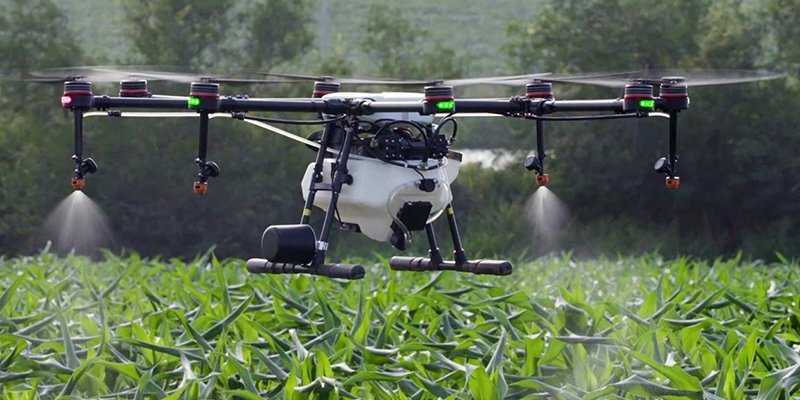
India has a rich history of agriculture, and to date, a massive portion of its rural population depends upon farming for their livelihood. Over time, Indian farmers have been embracing new agriculture methods, advanced tools, and the latest farming equipment, vehicles to catch up with other progressive farmers around the globe. And now is the time to utilise modern agriculture technology in the form of agricultural drones.
Drones or Unmanned
Aerial Vehicles (UAVs) have the potential to bring revolution in the
agriculture sector, increasing farming efficiency, enhancing crop quality, all
while lowering the overall expenditure.
Why should farmers consider using agriculture drones?
The world is
changing fast, and a lot is happening around it. In such times, adaptation is
vital for all, and so is for farmers. Moreover, given the frequent and often
unexpected climate changes, farmers need a next-generation technology solution
to meet various challenges they usually face.
Drones have come up
as that solution, which can be a crucial component required to encourage smart
farming, helping farmers improve crop quality, boost yield, prevent damage, cut
down costs, and reap a series of other significant benefits.
Let’s now discuss
how you, as a farmer, can use drones for agriculture.
Best practices for using drones for farming purposes
Soil quality
assessment
Data on soil is
fundamental to smart farming as it helps farmers to get accurate and detailed
information to assess soil quality or condition, enabling them to take the best
possible actions in the first place. Farmers need to visit their farm, collect
a sample, and do the evaluation manually; some even hire professional services
for soil testing. In comparison, the same process can now be performed by a
drone equipped with smart agriculture sensors in a more efficient, speedy and
cost-effective manner with greater data accuracy – all you need to make
effective decisions on time.
Crop monitoring
You must keep track
of your crops’ health, and the early you spot plagues (bacterial or fungal),
the easier it becomes to save them. You can monitor your crops (from the
comfort of your home) using agricultural drones that can detect the plants
reflecting different amounts of green light and near-infrared spectroscopy NIRS
light.
This data is
essential to keep a tap on crop health, and drones with crop monitoring
features can even provide multispectral images, making this practice a lot
easier.
Damage detection
Agricultural drones
with in-built multispectral and RGB sensors can help monitor farms, crops and
detect weeds, pests and infections. Having these insights, you can determine
the quantity and type of chemicals required to rectify or treat infestations,
leading to cost savings.
Regular, quick and precise
monitoring helps you discover any defects in advance so that you can save your
crops before they get spoiled. Additionally, in case of damaged crops, you can
also present the information collected from the drone to make your insurance
claim authentic and stronger.
Agricultural
spraying
After providing you
with reliable information on farms, crops, plants, etc., an agricultural drone
can do the crop spraying effectively.
This will help you
not only spray faster but also keep away from chemicals that might be harmful
to your skin, lungs or overall health.
Even professionals
say that a drone can speed up aerial spraying up to five times compared to
other traditional ways.
Livestock
monitoring
Livestock farmers
are aware of the hassles associated with livestock management. If you are also
tired of keeping an eye on your livestock, a specialised drone can make your
life a lot easier. Drones can monitor the movement of your animals while they
graze around on the pastures. As a result, you will need not ride horseback or
fuel-run motor vehicles, leading to cost savings.
Moreover, drones
with thermal sensor technology can search and spot cattle that are lost, sick
or injured, in addition to calculating the exact number of members in your
herd. Considering that, we can say that drones can perform a better job than
herding dogs regarding livestock monitoring and surveillance.
Planting
In the near future,
drones can prepare the soil and shoot seeds in, helping you get rid of tiring
and time consuming manual methods. Many companies are working on this approach,
and soon we will get specialised drones for the same.
As now you know how
to use drones for agriculture in the best possible manner to maximise crop
yield, you should also become aware of drone operating laws in India.
General
Rules and Regulations of Drone Usage in India
- You must be at least 18 years old or above and have a certificate to use a drone
- You cannot fly your drone in sensitive areas like near airports or areas where aircraft traffic is expected, military zones, and regions including government offices and government officials’ residence areas.
- All drones must have a license plate that can provide enough information about the owner/operator and their contact details.
- You cannot fly more than one UAV at a time.
- All drones necessitate liability insurance.
For more detailed information on Indian drone usage rules, visit here – www.civilaviation.gov.in
Agricultural drones
can turn out to be excellent support for all farmers, especially for small- and
medium-scale farmers who might not have the required financial resources to
afford expensive tools, machines, vehicles, or labour. With the help of a
drone, you can also cut your agriculture costs while saving a lot of time spent
on various farming processes.
Like what you read? Learn more about the latest trends in the Indian agriculture sector or get answers to your agriculture-related queries from industry experts – download Apni Kheti App now.
For more information about Agriculture and Livestock, download Apni Kheti app –
Android,