




By Kumkum Chadha
“The days of TMC’s gundagardi are coming to an end…the TMC runs on the support of goons and criminals… the days of hooliganism are ending. Such criminals will have only one place—jail, jail, jail. The countdown has begun.”
It was on March 15, that Prime Minister Narendra Modi spewed venom at the Mamata Banerjee-led state government. The battleground: West Bengal. The jail spiel was merely a curtain-raiser.
Continuing his tirade Modi said: “TMC has made politics of fear its weapon. Voters are threatened… If someone does not vote for the TMC they are told they are not Bengali…they are told they will not receive government benefits.
“These people oppose SIR so that names of infiltrators cannot be removed from the voter list and the voter list cannot be purified. They are not even ready to remove the names of those who have already died…
“Due to unchecked infiltration by the TMC, the demography of Bengal has changed… TMC is deliberately making Hindus a minority in many areas…
“This election is not just about changing a government. This election is about ending cut money… this election is about saving Bengal’s soul…”
The same evening the Election Commission announced the poll dates to five states headed for polls, namely Assam, Kerala, Tamil Nadu, Puducherry and West Bengal.
Whether “Bengal’s soul” will be saved by the BJP or remain under the care of Mamata remains to be seen, but the battle lines are sharp and divisive: much deeper than they are in the other four states.
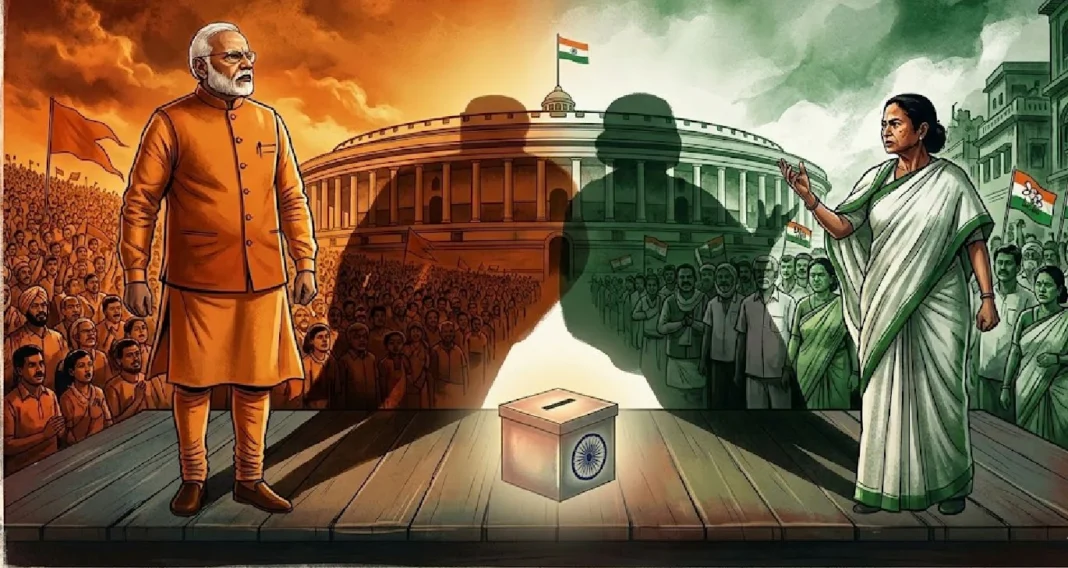
Why is a win in Bengal so important for the BJP? Why is the Bengal battle, so to speak, person-specific rather than it being state-specific? The one line answer is: for the BJP, the focus is Mamata; it is about defeating her, with a capital H. As against this in other states, the electoral contest is not targeted at a person; it is between parties, be it the Left in Kerala, the Congress in Assam or the DMK in Tamil Nadu.
So why is the BJP making the West Bengal election Mamata-centric? There can be several explanations for this. For one, West Bengal is kind of synonymous with Mamata. But more importantly, she could, in the days to come, emerge as a challenger to Modi at the national level. Add to this the talk of her leading the INDIA alliance and the threat is even more potent.
Ostensibly, the BJP wants to wrest the state because of its stated position of it being the birthplace of Jana Sangh founder Syama Prasad Mookerjee.
At the national level, there is a security concern because West Bengal shares a border with Bangladesh and hence serves as a transit point for infiltrators, a point Modi has been hammering. “TMC gives reservation to the radicals and invites infiltrators to grow its criminal network. Roti, Beti and Maati have come under the biggest threat due to the infiltrators. The infiltrators are snatching jobs in Bengal…. Infiltrators are being given rights on the land here,” say BJP leaders.
Politically, of course, it is to vanquish Mamata and unseat her: as of now an uphill task even though BJP’s vote share has jumped up dramatically within a decade: from a single digit to a double. For record, in 2011, the BJP vote share was 4.06 percent; in 2021 it rose to 37.97 percent.
Statistics apart, for Mamata this is a do-or-die battle. Her own seat apart, Mamata cannot lose a state she has ruled for three terms. Yes, her hold may have weakened
but she still remains a force to reckon with. Therefore, while the BJP is likely to improve its tally, make some gains and damage Mamata’s prospects, unseating her may remain a pipe dream—at least as of now.
That Mamata remains a fighter is a given: rather a street fighter who thought nothing of storming into the office of her election strategist when the Enforcement Directorate (ED) raided the I-PAC premises at Kolkata in January this year. High drama had followed when Mamata kind of defied the officials, walked right to where the raid was taking place, picked up the files and walked out leaving the officials astounded. Mamata allegedly entered the premises from the back door, and if reports are anything to go by, she “forcibly removed” documents and electronic evidence.
On her part, Mamata has alleged that the ED raids were politically motivated and aimed to access TMC’s election strategy, candidates list for the elections and confidential documents. Irrespective, Mamata demonstrated that she will stop at nothing, even if it means taking the law in her hands.
Fast forward to a month later when Mamata took it on herself to appear before the Supreme Court to argue against the Special Intensive Revision, or SIR, of electoral rolls. Dubbed as a “dramatic twist”, Mamata is perhaps the first chief minister to argue in person before the apex court.
“Bolbo to aaj hi” (I will speak today) is what she told one of her colleagues, even as she watched the proceedings in the apex court for well over 20 minutes before interjecting. “Sir …allow me…” she asked the Court. “Justice is crying behind closed doors…” she said, making full use of theatrics at her command. She went to the extent of folding her hands before the bench even as she asked: “Please protect the people’s rights, Sir”. When the opposing counsel interrupted Mamata, Chief Justice of India Surya Kant stopped him: “Ma’am has come all the way to say something”.
Mamata’s latest salvo is fired at the Election Commission of India which transferred senior police officers and IPS, IAS and other civil servants dubbed as an “overdrive”. Hours after announcing the poll dates, the Commission moved out the chief secretary and home secretary, among others, to what was described as a bid to “cleanse the administration”.
Mamata was hopping mad. She alleged that the Commission was working at the behest of the BJP. Mamata being Mamata, she went a step further and gave a regional and gender twist to the transfers. She said that removing a “Bengali woman” is being both “anti-Bengali and anti-women”.
That it was a midnight reshuffle and that too without following the norm of consulting the state government was enough for Mamata to train her guns at the EC-BJP combine. For record, the chief secretary, a woman, Nandini Chakravorty, is also a Bengali.
Mamata may be right or wrong. The point is that she captures the imagination of the people as one who would do what it takes to be heard and get her way. Add to that the gender advantage of being a woman and one whose political growth began from the street makes her different from the run-of-the-mill politician. Therefore, political issues apart, it is her persona and the people-connect that poses a challenge to her political rivals, read the BJP.
So, while Mamata and West Bengal are a prestige battle for the BJP who is on a “win we must at all cost” mode, there are challenges in other states as well.
Like it does not in West Bengal, even in the states of Kerala and Tamil Nadu the BJP does not have a chief ministerial face. In Tamil Nadu, the BJP-led NDA has stitched an alliance with AIADMK, but here the NDA is a junior partner. The chief ministerial face E Palaniswami will face DMK’s MK Stalin who remains the state’s tallest leader despite allegations of corruption against his government.
In Kerala, the BJP can at best emerge as the main opposition to the ruling LDF headed by CPI-M’s Pinarayi Vijayan, though even this is not a given. While BJP will bank on the anti-incumbency factor, given that the government has been in power for two consecutive terms, the Left is banking on a “changed Kerala” pitch under Vijayan. On its part, the BJP has played on the nomenclature sentiment by changing the state’s name from Kerala to Keralam. For record, the Union cabinet approved the name change on February 24, this year. That this was done with keeping in mind the forthcoming elections is a given.
Assam is comparatively easier given that Chief Minister Himanta Biswa Sarma’s hardliner image could work to the BJP’s advantage. Also, Sarma being pitched against a comparative lightweight Congress’ Gaurav Gogoi may make it possible for Sarma to sail through. Also, this is Gogoi’s first foray in a state election. Gogoi’s only hope: anti-incumbency and corruption in the state. The downside: Sarma’s tirade over Gogoi’s links to Pakistan.
At this point one needs to ask: why is this, like every other election, BJP-centric? One reason is that it is the party in power but the other and more important is that the saffron party converts every election, be it local bodies or the state and general elections, into a blood thirsty battle—actually a war that it is hell bent on winning at any cost. It is this electoral hunger, if one may use the term, that makes this and every election a do-or-die for the BJP. This time with West Bengal in the fray, it is even more lethal.
—The writer is an author, journalist and political commentator