




By Sanjay Raman Sinha
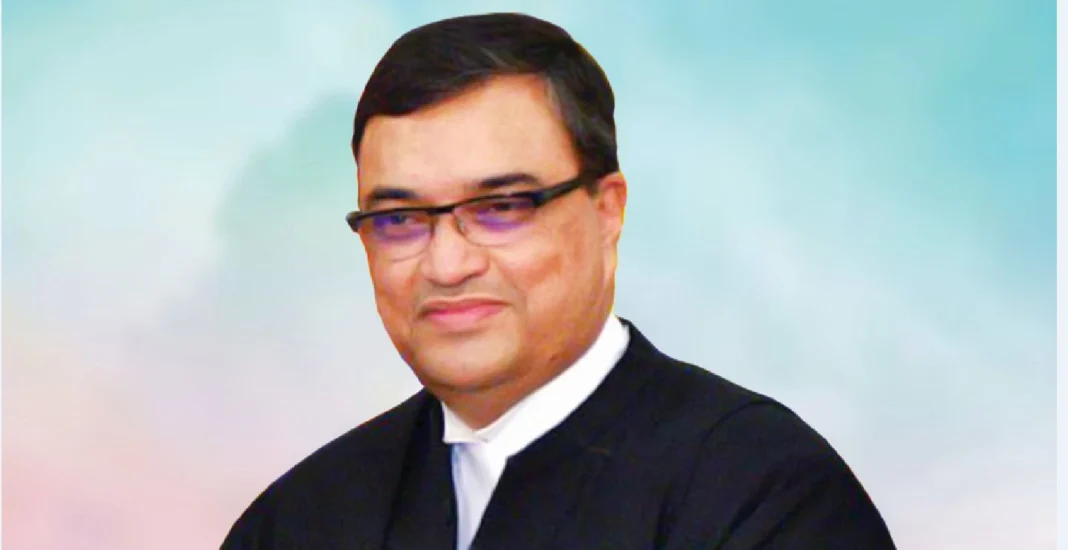
It is not often that a sitting Supreme Court judge openly questions the system of which he is a part. Yet, Justice Dipankar Datta did exactly that—looking squarely at the country’s top judges and making an impassioned appeal for institutional courage.
Speaking with unusual candour, Justice Datta urged the judiciary’s leadership to stand firmly behind judges who display integrity and moral courage, even when doing so may harm their own career prospects. “Many judges have had the mental courage and conviction to take the hit for the greater good,” he said. “However, how many judges in present times would prioritise ethics over career growth? Do you expect them to have the rectitude to practise what is preached?”
His remarks were not merely rhetorical. Justice Datta pointed to a troubling pattern in recent judicial history where upright judges appeared to have been left exposed when they faced executive displeasure. “There have been instances in the past where those who took this path were not protected by the Collegium. We have to ensure that they are not victimised for their righteousness. As members of the Collegium, rise and protect these judges,” he urged.
Justice Datta’s intervention resonates strongly with several controversial episodes in recent years. One such instance frequently cited is that of Justice Akil Kureshi. While serving at the Gujarat High Court, Justice Kureshi ordered police custody for then Gujarat minister Amit Shah in a controversial case. Years later, when the Collegium recommended him as chief justice of the Madhya Pradesh High Court, the Union government reportedly objected.
The recommendation was eventually withdrawn, and Justice Kureshi was instead transferred to the much smaller Tripura High Court. Despite being among the most respected judges of his generation, he was never elevated to the Supreme Court.
In his farewell address, Justice Kureshi offered a pointed reminder of what judicial independence ultimately means. “The independence of the judiciary is not for the personal benefit of the judge,” he said. “It is the right of the citizens.” Ironically, it was precisely such instances of executive interference that led to the evolution of the Collegium system in the first place.
The memory of the 1977 supersession of Justice Hans Raj Khanna—after he delivered his historic dissent during the Emergency—remains etched in India’s constitutional history. Justice Khanna was overlooked for the post of chief justice of India in favour of the junior Justice MH Beg. That episode eventually contributed to the landmark Three Judges Cases, which created the Collegium system as a safeguard against executive dominance in judicial appointments.
Over the years, the Collegium has introduced certain reforms. Greater consideration is now given to judges from smaller High Courts, as well as advocates from diverse professional backgrounds. “Consultant judges” are often consulted to provide feedback about candidates. Yet, the process remains opaque and frequently controversial.
Former Chief Justice MN Venkatachaliah, who chaired the Constitution Review Commission, once proposed replacing the Collegium with a more transparent National Judicial Appointments Commission (NJAC), while still ensuring judicial primacy. “The Constitution Review Commission suggested that in the NJAC there should be a preponderance of the judicial element,” he told India Legal. “Ultimately, the test is what kind of people you are able to select to shape the future of the judiciary.”
As chairman of the National Court Management Systems Committee of the Supreme Court, Justice Datta had devised a formula to reduce pendency. Drawing from his experience, he commented on another pressing crisis confronting the judiciary: the staggering backlog of cases. The number of judges has remained the same at 34 since 2019, but case filings have increased from 40,000 to 60,000 as of March 15, 2026. To address this, Justice Datta suggested increasing the number of judges from 34 to 40 to manage the growing caseload.
Justice Datta also argued that selecting judges purely on merit—defined by competence, integrity, temperament and industry—would be essential to strengthening the judicial system. “Merit should be the primary criteria for selecting candidates,” he said. “Decisions should be based on objective materials—judgments, professional evaluations, written work and documented conduct. Personal affiliations, social proximity, lobbying and perceived closeness to power must be excluded.” He also suggested structural reforms such as increasing the strength of the Supreme Court bench and improving judicial compensation.
Inadequate funding for judicial infrastructure is another issue. State governments contribute less than one percent of their budget to the judiciary, hindering its efficiency due to inadequate infrastructure.
Delayed judicial appointments by the government further exacerbate the issue. Judicial appointments are often kept pending for 5-6 months by the government., he said.
The judiciary’s struggles with case backlog have been visible for years. In 2016, then Chief Justice TS Thakur broke down emotionally during a public event while urging the government to accelerate judicial appointments. Addressing Prime Minister Narendra Modi, he pleaded for urgent action as courts struggled under the weight of millions of pending cases. “You cannot shift the entire burden to the judiciary,” he said. “There is a limit to judges’ capacity.” The crisis of pendency has only deepened since then.
In fact while in office former Attorney General KK Venugopal had flagged the crisis of rising pendency: “Justice delivery system cannot be one where a litigant cannot see the results of the case on which he has placed his aspirations and hopes. The rich and powerful and corporate will not be affected by the delay. But individuals from the middle class and poor, it is a daunting task to wait for 30 years. Their money and patience will be exhausted.”
Justice Datta also highlighted the immense workload, high stress, and long hours judges face, arguing that judges need rest and manageable work load to dispose cases faster and in a qualitatively better manner.
Speaking to India Legal, Senior Advocate and former SCBA Vice-President Pradeep Rai said: “There’s a lot of confusion and, at times, unfair criticism about how our courts function. While no system is perfect, criticism without understanding the ground reality doesn’t help. Justices BV Nagarathna, Dipankar Datta, and Ujjal Bhuyan have clearly explained the judiciary’s side, reminding us that a judge’s work goes far beyond just court hours. Ideally, the Bar should take the lead in informing people and correcting such narratives, but the judges’ own effort to put facts forward is truly commendable. One important issue remains the government being the biggest litigant—along with vacancies and unnecessary cases. This adds to delay. Fixing these issues is key to making the system more efficient.”
Ultimately, Justice Datta’s remarks underline a central dilemma confronting the Indian judiciary today. The Collegium must not only guard its institutional independence from executive pressure, but also ensure that judges who demonstrate courage are not left to fend for themselves. Maintaining that delicate balance will require both institutional integrity and collective resolve.
Chief Justices’ take on Collegium
“The Collegium system significantly limits interference by the Executive and Legislature, thereby preserving the judiciary’s autonomy and insulating judges from extraneous pressures that could otherwise compromise their impartiality.”
—Justice Surya Kant, chief justice of India
“The idea is to make the process of appointment in the Supreme Court more transparent. Not by sharing our discussions in the public realm, which we obviously cannot do, but by laying down objective parameters for selection to the Supreme Court and High Courts.”
—Justice DY Chandrachud, former chief justice of India
“There may be criticism of the Collegium system, but any solution must not come at the cost of judicial independence. Judges must be free from external control.”
—Justice BR Gavai, former chief justice of India
“We don’t have a system better than the Collegium system. If we don’t have anything qualitatively better than the Collegium system, naturally, we must work towards making it possible that this Collegium system survives. Today, the model as per which we work is a near perfect model.”
—Justice UU Lalit, former chief justice of India
“Nobody can say that the Collegium system for the appointment of judges is the most perfect system, but the Collegium system itself can be improved. Simply criticising the system without coming up with an alternative does not lead us anywhere.”
—Justice TS Thakur, former chief justice of India