

INTRODUCTION
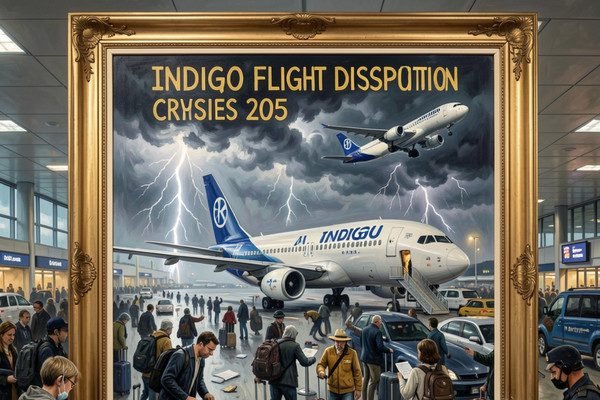
Airline overbooking is a common tactic airlines use to sell more tickets than seats available, aiming to fill planes despite no-shows that average 5-15% of bookings. The 2025 IndiGo crisis brought this issue into sharp focus, disrupting thousands of passengers.
Airlines started overbooking more after big changes like the U.S. Airline Deregulation Act.[1] of 1978 and India’s Air Corporations Act repeal in 1994, which opened doors for private players like IndiGo. This helps them avoid empty seats and cut losses from no-shows.[2].
But the IndiGo flight crisis from December 2-8, 2025, showed the downside: over 2,000 cancellations, delays, baggage problems, refund hassles, and huge stress on staff and passengers. People who booked early ended up helpless, sparking complaints under rules like DGCA compensation up to ₹20,000 and the Consumer Protection Act, 2019.
This blog breaks it down step by step: first, what overbooking is and how it evolved; then, global rules from ICAO and India’s DGCA setup; next, challenges exposed by the IndiGo mess; key court cases like InterGlobe Aviation Ltd. V. N. Satchidanand (2011) and Ravneet Singh Bagga (1999); and finally, ideas for fixes inspired by EU and U.S. models.
CONCEPT & HISTORICAL EVOLUTION
Flight Overbooking is a very common practice among airlines, which consists of selling more seats than the aircraft’s capacity to fill to the maximum capacity in case someone does not show up, misses, or cancels the flight. In a nutshell, this practice is meant to avoid empty seats on a plane.[3]
The Airline Deregulation Act of 1978[4] In the USA & the Air Corporations (Transfer of Undertakings & Repeal) Act, 1994[5] In India led to the space of Airline Operations becoming more open to the Private Players, who then started their own Airlines.
According to the International Air Transport Association (IATA), the average no-show rates in the Airline Operations move around 5%-15% depending on route & season.[6] To cover probable losses that can be incurred on account of that, the Airlines across the world rely on Overbooking of Tickets so that they can continue their operations without any hassle & financial problems. Rather, it is sometimes used to unethically prevent some passengers from traversing on their designated flights, which infringes upon their rights.
LEGAL FRAMEWORK OF PASSENGER RIGHTS
The International Framework regarding the working & regulation of Airline Operations is controlled by the International Civil Aviation Organisation (ICAO), a specialised UN Body dealing with ensuring that all Airline Passengers are treated equally, irrespective of their Gender, Nationality, or Ticket Price, etc.[7] It also advocates for various other principles to be followed by all Airline Operators so that Air Travel becomes more Passenger-Friendly.
These include :[8]
- Providing Quick & Accurate Information regarding the Status of Tickets’ Availability & Prices.
- The Provision of Equal Access must be made available to the Disabled Persons so that they can also access the Airline Facilities equally.
- There should be a Commuter-Friendly Dispute Resolution Mechanism in place in every airline.
- All these steps must be enforced properly, but their enforcement shouldn’t put a disproportionate burden on the Airline Operators.
Although these principles have limited enforceability due to their being non-binding on Nations, they still have an important persuasive influence over the Laws & Regulations related to Airline Operations worldwide.
The Indian Airline Arena is governed by the 1994 Air Corporations Act [9]as well as the Directorate General of Civil Aviation (DGCA). The DGCA Civil Aviation Requirements (CAR) provide passengers with significant rights in case of Flight Disruptions due to Overbooking, Denial of Boarding, Cancellations, etc., by providing Compensation up to Rs. 20000 & Another Flight’s Tickets among other things.[10] Apart from this, there are various protections given to the Baggage of the Passengers from getting stolen or mishandled.
These guidelines, although strictly enforced, are still violated by many operators, which leads to cases being filed against them in the various Consumer Courts of India under the Consumer Protection Act, 2019, which allows the passengers to successfully obtain compensation by proving that there was a ‘Deficiency in Service’ on account of the operator.[11]
In spite of all these protective measures, still there occurs violations of Passenger Rights in India by various Airlines, including IndiGo. To prevent such events from taking place, there is a need for various kinds of reforms, like Proper Management of Ticket Booking, etc. & also learning from the various International Regulations, like the EU’s “The Air Passengers Rights Regulation 2004” & the US Department of Transport (DOT) Rules.
LEGAL CHALLENGES & JUDICIAL DECISIONS
1.Legal Challenges: Issues Exposed Through the IndiGo Crisis
The various Legal Challenges related to the enjoyment of Passenger Rights & prevention of their violation lie in their Enforcement Difficulties. This was further exemplified by the recent IndiGo Flight Disruption Crisis of 2025, which caused various problems & distress to both the Passengers as well as the Employees of the IndiGo Airlines, showing the Fragile Nature of Trust & Obligations that exist in this Sector.
Between 2 and 8 December 2025, IndiGo cancelled over 2000 flights, which affected thousands of passengers, disrupting their plans.[12] It also involved various other problems like baggage mishandling, flight delays & extreme pressure on the Staff of IndiGo as they were unable to handle the Passengers’ Requests.
It was followed by Refunds & Baggage Issues & Delays, which further aggravated the Crisis & led to the DGCA taking cognizance of the matter & directing IndiGo to initiate responsive measures in order to make the situation better & prevent such things from happening again.
This issue reflected the Practical Challenges involved in such Airline Crises such as problems related to assessment of violations, proofs, vouchers, effect on the Mental Health of both Passengers & Employees of the Airline Operators & most importantly the Difficulties in the Enforcement of Rules, Regulations & Laws in the matters of Air Travel, thus raising questions related to the regulatory capacity of DGCA.
2. Judicial Decisions: How Courts Impact the Discourse
The various courts in India have also helped in the enforcement & interpretation of Passenger Rights in Air Travel through their Judgements. Some of these include:
- InterGlobe Aviation Ltd. vs. N. Satchidanand (2011)[13] : In this case, IndiGo Airlines appealed against a Lok Adalat decision favouring Satchidanand in the SC & won the case due to the court applying the principle of “force majeure” (beyond control) affirming that the delay & the resultant problem caused was not in IndiGo’s control but suggested that the Airlines should provide their passengers with essentials like water, food etc. so that they can travel without any issue even if any delay takes place.
- Ravneet Singh Bagga Case (1999)[14]In this case, the SC clarified the meaning of “deficiency in service”, a remedy used by many passengers & in which situations it is to be enforced, as seen in the Court Judgement dismissing the claims of Bagga, wherein he claimed compensation from the Airlines on account of his important flight getting delayed.
CONCLUSION
In conclusion, airline overbooking underscores a tension between operational efficiency and passenger rights, as evidenced by the 2025 IndiGo crisis that disrupted thousands through systemic failures.
The IndiGo flight disruption crisis from December 2-8, 2025—marked by over 2,000 cancellations, delays, baggage mishandling, refund delays, and staff pressures—exposes enforcement gaps in India’s aviation sector. Despite DGCA Civil Aviation Requirements providing up to ₹20,000 compensation for overbooking disruptions and the Consumer Protection Act, 2019, enabling redress for service deficiencies, airlines like IndiGo falter in ticket management.
Judicial precedents reinforce accountability: InterGlobe Aviation Ltd. V. N. Satchidanand (2011) 7 SCC 463 upheld force majeure for delays but mandated essentials like food and water; Ravneet Singh Bagga v. KLM Royal Dutch Airlines (1999) defined “deficiency in service.”
At last, India can curb grievances by reforming laws for real-time inventory controls and higher penalties, mandating digital redressal platforms, and adopting the EU Air Passenger Rights Regulation 2004/U.S. DOT-inspired transparency. Aligning with ICAO principles will also help in building a passenger-centric regime, thus ensuring equity and trust in airlines.
Author(s) Name: Mohammad Yasir Bhat (University of Kashmir)
Refenences:
[1] Airline Deregulation Act 1978 (US)
[2] Air Corporations (Transfer of Undertakings and Repeal) Act 1994 (India)
[3] What Is Airline Overbooking?’ (AXA Travel Insurance) < https://www.axatravelinsurance.com/resources/101/what-is-overbooking > accessed 17 December 2025.
[4] Airline Deregulation Act 1978
[5] The Air Corporations (Transfer of Undertakings and Repeal) Act 1994
[6] Loris Mazloum, ‘How Airlines Can Use eVisa Data to Reduce No-Show Rates’ (Simplevisa) <https://simplevisa.com/how-airlines-can-use-evisa-data-to-reduce-no-show-rates/> accessed 17 December 2025
[7] Thomas Reynaert, ‘Ten Years of ICAO’s Core Principles on Consumer Protection’ (International Air Transport Association, 10 September 2025) <https://www.iata.org/en/pressroom/opinions/ten-years-icaos-core-principles-consumer-protection/> accessed 17 December 2025
[8] Ibid
[9] Ibid
[10] Viji, ‘Guidelines for Air Passenger Compensation due to Cancellation and Delay in Flight’ (Vikaspedia, 02 February 2024) <https://socialwelfare.vikaspedia.in/viewcontent/social-welfare/social-awareness/consumer-education/guidelines-for-air-passenger-compensation-due-to-cancellation-and-delay-in-flight?lgn=en> accessed 17 December 2025
[11] Consumer Protection Act 2019
[12] ‘IndiGo Crisis 2025: Analysis of Aviation Safety and Operational Challenges’ (Vision IAS, 8 December 2025) <https://www.visionias.in/blog/current-affairs/indigo-crisis-2025-analysis-of-aviation-safety-and-operational-challenges> accessed 17 December 2025
[13] InterGlobe Aviation Ltd v N. Satchidanand (2011) 7 SCC 463
[14] Ravneet Singh Bagga v KLM Royal Dutch Airlines and Anr. (1999) SCR 320