
[ad_1]
Beawar, largely famous for its til-patti, gazak, and kachori, is a small town about fifty kilometers west of Ajmer in Rajasthan. I don’t know the political motivation behind the decision, but this town, which grew in the shadow of being in Ajmer District, itself became a district on the seventh day of August, 2023. The population immensely benefited, as they got immediate access to offices and courts, which were privileges of only a district. A lot of effort was put into making Beawar a district, including the efforts of a senior citizen lawyer, who had quietly moved out of the town in 2021.

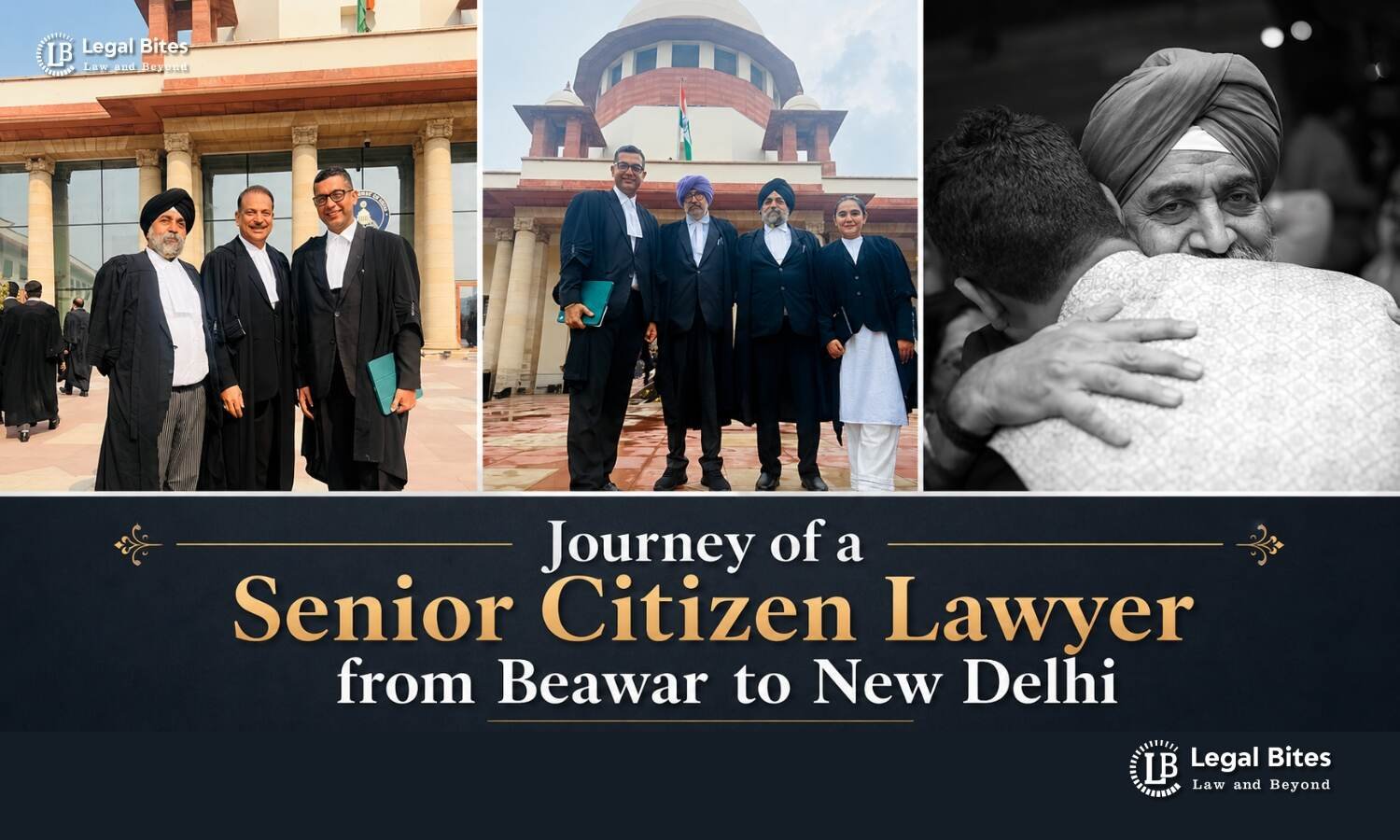
My father, Mr. Mahinder Singh Hura, completed his law degree in 1986, a year after becoming a father. Surprisingly, he got enrolled with the Bar Council in 1991, a year after becoming a father for the second time. On the lighter side, I am not sure if he would have made more landmark progressions (master’s, doctorate, elevation into the judiciary, or designation as a senior) a year after bringing another child into this world. Be that as it may, Mr. Hura has only two kids and hence had a routine practice in the courts of Beawar, District Ajmer, for more than three decades. Being the eldest son among eight siblings, he also blended his professional commitments smoothly with his personal responsibilities. Not only that, despite his modest income, he ensured that his kids never felt deprived of anything necessary.
It was only in 2021, when Mr. Hura lost his beloved wife, that he chose (or was repeatedly requested to choose) to move largely to Delhi. To keep his lifestyle active, we also requested him to accompany us to the office and courts, and encouraged him to read office briefs. We thought that this would keep him busy and active, and that he would smoothly blend into the Delhi lifestyle. In India, often, the education system assigns more marks for theory and less for practicals. In hindsight, I feel it should be the other way around, as both in education and in life, implementing theory into practice is a constant challenge.
When I first came to Delhi as a teenager for my first legal internship, the capital intimidated me. While you are still amused by the mere size of the city, the population, the towering buildings, and the cross-linked flyovers, what scares you more is the lifestyle of your contemporaries. Their confidence, their command over language (English), their exposure (from sushi to theatres to brands), their presentation, and their perspective on life put a small-town person into an inferiority complex zone. This shock and lack of confidence afflicts an otherwise assured and ambitious teenager at an age where usually the risk appetite is maximum. Now imagine the intimidation that may be caused to a senior citizen who has spent most of his life in a small town and has moved to the capital of the country.
To put things into perspective, a few illustrations would explain life in Beawar. Mr. Hura would leave home at 9:45 am to reach the court premises before 10 am, and of course, by worshipping at the Gurudwara en route. Mr. Hura did not wear a band or black blazer in Beawar, and when this was pointed out to him by his National Law University graduate son once, he commented (in vernacular, obviously),
“we don’t wear all this here in Beawar. If I do, fellow advocates will tease me. I have a blazer and one band in the wardrobe, which I use whenever I go to Jodhpur/Jaipur courts.”
Mr. Hura would charge fees in hundreds for the majority of legal services, including daily appearances, filing exemptions from personal appearance, cancellation of non-bailable warrants, as well as issuance of legal notices, etc. I would be amused if Mr. Hura neither knew a particular resident of Beawar nor knew of any common connection with such a resident.
When Mr. Hura shifted to Delhi with a suitcase and a home-stitched bag, he was not only carrying his clothes, but also a handful of fear, hesitation, loneliness, lack of confidence, and very little excitement about moving to a new city. His struggles commenced with the starkly different COVID protocols being followed in Beawar vis-à-vis Delhi (read it as ‘our home’). Mr. Hura told me with a depressing smile, within a week of shifting, that any client who came looking for him in Beawar courts was now told that “Sardaar Ji has shifted to Delhi. Please engage some other lawyer.” He would keep looking into his Beawar WhatsApp group, assuring everyone that he had not moved to Delhi permanently and would spend more time in Beawar.
Slowly and gradually, he started coming to the office, accompanying us to courts, and also taking charge of highlighting nuances of criminal law to the associates. On each of such days, he would come back home with some anecdotes and opinions.
When I was a child, I also found Mr. Hura to be extremely satisfied and grateful for what he had, rather than competing in a rat race. He once told me,
“A human should work for both satisfaction and success. While success is a parameter largely judged by others, satisfaction is within. Try to achieve both in balance, as achieving one without the other is meaningless. Though, in case of conflict between the two, choose satisfaction.”
This largely defines his life philosophy.
When I introspect, I wonder how difficult it must be for a man who lived his life on his own principles, who gave shade to his family like a banyan tree for many years, to now come under somebody else’s shadow. I can bet my life on the fact that each lawyer, each judge, and each court staff member knows Mr. Hura in Beawar; however, here in Delhi, his identity is known to very few, and that too more as the father of his son. It is not easy to make that shift. In Beawar, he dictated the rules of his profession, his kitchen, as well as his investments, whereas in Delhi, he is mostly clueless about online delivery of groceries, expensive fine dining (the prices as well as the menu items), and social etiquettes (sometimes his humor is purely honest and raw, and considered offensive in social circuits).
I write this piece as a dedication to Mr. Hura’s struggles of moving from a small town to the National Capital, as well as to draw immense inspiration from the way he has done it, as some of us may have to do it too, since “kyunki saas bhi kabhi bahu thi.” We, the so-called ‘settled children’ of Delhi, should understand that our parents were also settled in their hometowns, and respect the emotional physics of ‘inertia.’ If we can’t think of moving back to our birthplaces with ease, we shouldn’t expect the same from our parents. We ought to hold their hands to make the journey of shifting the base of our ‘banyan tree’ a slow and organic process, as initially these trees have high moisture needs; however, once established, they are even drought-tolerant.
[ad_2]
Source link

