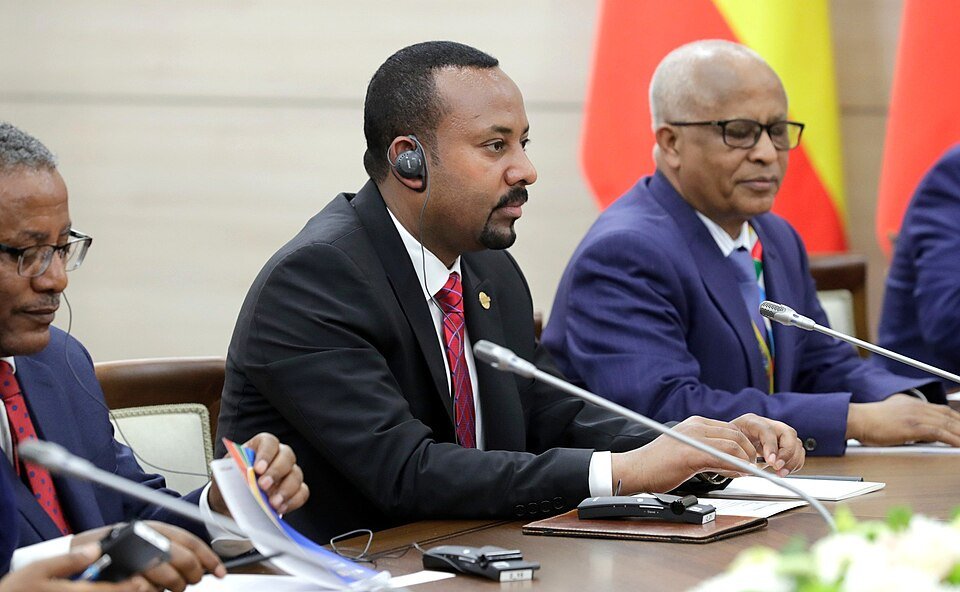

Recently, Members of Parliament confronted Abiy Ahmed over the unrelenting domestic insecurity, hyperinflation, rising unemployment, and uneven access to development that is severely affecting the country. Bertema from Abiy’s own party hinted at chaotic displacement of citizens and accused the leadership of favoritism toward those close to the center whilst others face intimidation and harassment. One outgoing opposition MP argued that these pressures have effectively eliminated Ethiopia’s middle class. They have left behind a small wealthy elite and an impoverished majority. Official state claims of double-digit economic growth were challenged by lawmakers as being disconnected from the lived realities of citizens.
This parliamentary confrontation is the latest in a series of manifestations of a structural transformation in Ethiopian politics. Back in 2021, as damning evidence of atrocities in Tigray emerged despite months of communications restrictions, Abiy Ahmed’s international standing faced increasing scrutiny. Alex de Waal argued that the war marked a counterrevolution against Ethiopia’s institution-building state, accelerating the country’s shift into a political marketplace where power depends less on established institutions and more on a continuous and transactional management of elite bargains.

Abiy initially ascended to power from relative obscurity. His personal charisma helped drive his rapid rise, granting him a brief window of immense domestic and international goodwill. Following a short lived peace with neighboring Eritrea that earned him the Nobel Prize, a series of overpromises to constituents and international stakeholders and dissolution of the cartel-esque EPRDF; Abiy managed to amass quick political capital. He would proceed to draw on this reserve of diplomatic goodwill, public optimism, and international financial backing to consolidate his power.
The central question, however, remains whether Abiy could sustainably support his budget over the long term, or if he is now being outpriced by the exponentially rising political costs of the very marketplace he helped unleash. Within de Waal’s political marketplace, a ruler’s budget is sustained by a mix of coercion, systemic legitimacy, patronage networks, and external finance.
Abiy has been attempting to actively replenish his capital through a mix of domestic, regional, and international initiatives. With measures such as aggressive pursuit of red sea access, balancing competing rival constituencies (e.g.,Tigrayan elites against Amhara nationalists), adopting agile social media-driven communication, visual mega-projects that transformed the landscape of cities, most notably, Addis Ababa; he has managed to buy considerable public patience and elite buy-in. While his moves on liberalisation, and early peace deals have earned him external bailouts and a diplomatic lifeline.
However, the demand side is exploding with fragmentation and hyper-inflation of loyalty mirrored also in the macroeconomic reality of the country, resulting in a spiraling cost of power.
Whether he can continue to meet the demand now depends on two forces mostly outside his control: an internal political market where rivals are converging rather than staying divided, and an external subsidy from International financial institutions and Gulf patrons that is crucial but conditional and entangled in its own risks.
The clearest sign that Abiy’s internal costs are rising faster than his revenue is the apparent coming together of previously competing rivals. Ethiopia’s Foreign Minister, Gedion Timothewos, has formally alleged, in a letter to the UN Secretary-General, that the TPLF and Eritrea have formed an alliance known as “Tsimido”. The alliance is accused of actively mobilizing and directing armed insurgencies, including Fano militias in Amhara. Even though Independent reporting frames “Tsimido” itself as contested, its political significance is the same either way. A political marketplace ruler survives by pricing and negotiating with rivals individually and never letting separate rivals work together. Coordination among rivals, whether real or merely perceived to be real, removes that option and weakens the position of the central state.
Nearly four years after the Pretoria Agreement, the war in Tigray has ended only on paper while Insecurity has spread to Amhara, Oromia, Gambella, and Benishangul-Gumuz leading to an accelerated exhaustion of revenue.
The fact that even loyalist MPs are voicing their discontent in parliamentary hearings cements that the regime’s patronage payouts are no longer covering the cost of quieting the ruling party’s own base.
If Abiy’s domestic political budget is cracking under mounting pressure, the external marketplace offers only limited relief. Abiy Ahmed continues to draw on diplomatic, financial, and military support from international and regional partners and Gulf states. But sources of external revenue are increasingly strained, forced to compensate for the rapid erosion of domestic legitimacy.
Abiy’s departure from the strategic frameworks that characterized Meles Zenawi’s regional foreign policy stands out in demonstrating the squandering of regional diplomatic capital that the country has accumulated over decades. Abiy Ahmed opted for unilateral handling of the GERD dispute, specifically turning toward Trump administration mediation, which alienated a reliable ally in Sudan. This ultimately led to a partial suspension of U.S. aid when domestic pressure forced Ethiopia to reject Washington’s proposed terms.
Simultaneously, the relationship with Eritrea has degraded into an exorbitant and asymmetrical alignment with both nations reverting to their historical hostility. Eritrean President Isaias Afwerki’s enduring objective of militarily defeating TPLF stood in contrast to strategic priorities that align with Ethiopia’s broader national interests such as pursuing a negotiated settlement with TPLF. This divergence arguably exacerbated the destructive Tigray war delaying a sooner peace settlement during the two year conflict. The mistrust between the two countries is only deepening with their polar opposite stances in regional affairs such as Sudan’s war and Ethiopia’s continued effort to gain Red Sea access.
Despite Ethiopia’s democratic backsliding and worsening authoritarianism, Western governments and international financial institutions have continued to support the country. A recent example being the IMF financing and debt restructuring under the G20 Common Framework. This support appears to be driven by the calculation that a collapsed, food-insecure state of over 120 million people in the Horn of Africa would produce a far costlier humanitarian crisis. This would inevitably lead to mass migration to Europe and neighboring regions, considered to be more politically explosive to manage than the price of keeping Abiy afloat.
Gulf financing, mainly from the United Arab Emirates, has been regarded as a form of “bailout diplomacy”. Gulf support is exploiting Ethiopia’s debt distress and ambitious development goals for geopolitical leverage; the consequences of which are emerging to be catastrophic to Ethiopia. Reporting through 2026 has tied Ethiopian territory, including the regions Benishangul-Gumuz and Bahir Dar, to drone operations supporting the UAE’s client, the Rapid Support Forces, in Sudan’s war. This has resulted in a direct diplomatic rupture: Sudan’s government formally recalled its ambassador from Addis Ababa in May 2026 after accusing Ethiopia and the UAE of complicity in drone strikes on Khartoum’s airport. A former Ethiopian diplomat has gone further to characterize Abiy’s role as a pawn in UAE’s “Port Imperialism”.
This entanglement carries the catastrophic risk of pulling Ethiopia into a wider regional war merging its internal conflicts, its tensions with Eritrea, and Sudan’s war into what experts have warned could become a “regional mega-war“.
Besides, Gulf subsidy is proving to be highly unreliable at the exact moment Abiy’s internal containment costs are peaking. Analysis from March 2026 suggests that Gulf states’ attention toward the Horn may be contracting as they turn inward to manage the fallout of the wider Middle Eastern conflict. This could translate to reduced diplomatic visits, investment, and mediation that Addis Ababa has come to rely on.
The conclusion is that Abiy Ahmed’s political business is barely functioning and approaching structural insolvency. He is servicing a rapidly appreciating political debt with an external subsidy that is unreliable and subject to its own risk. In the short term, he can likely continue to buy time; the West’s fear of state collapse and the UAE’s immediate tactical interests in Sudan both point toward a continued, reluctant support.
But neither patron is underwriting a solution to the core problem, which is that Abiy has dismantled the institutional mechanisms that once allowed Ethiopia’s rulers manage the marketplace’s costs collectively rather than as fragmented rivals and crises. Barring a radical pivot toward institutional rebuilding, the marketplace’s price will likely keep rising faster than Abiy’s revenue, external or internal, can keep pace.
[Photo by the Kremlin, Moscow, CC BY 4.0, via Wikimedia Commons]
The views and opinions expressed in this article are those of the author.

Adey Moges is a Berlin-based writer and economist whose work explores political economy, democracy, and social change. She holds a Master’s in International and Development Economics and is currently studying social work. Her recent essay, The Man Who Refused to Be Silenced, was published by African Arguments and subsequently republished by Addis Standard and AllAfrica.


