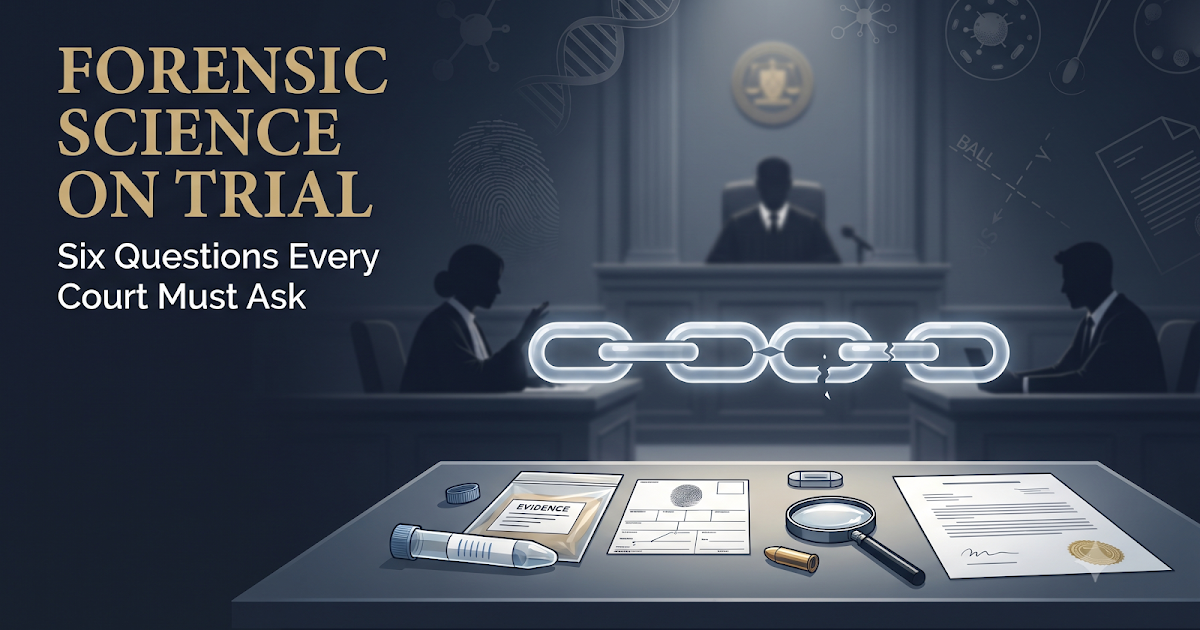


Forensic reports often arrive in court clothed with an aura of
science, certainty and neutrality, particularly in cases involving DNA,
fingerprints, ballistics, toxicology and digital forensics. Yet appellate
courts have repeatedly reminded that such reports are only as reliable as the
process by which samples are collected, preserved, transmitted, tested and
interpreted. If any link in this process is weak, the probative value of the
entire forensic edifice may collapse.
This article sets out a practical framework for trial judges,
public prosecutors and defence counsel to scrutinise forensic evidence across
six critical stages:
(1) chain of custody,
(2) contamination and preservation,
(3) scientific methodology,
(4) expert’s qualifications and neutrality,
(5) documentation and procedural trail and
(6) gaps, alternative sources and innocent explanations.
It draws
upon Indian case law and standard forensic guidelines to convert abstract
principles into concrete courtroom questions.
Forensic evidence as a process, not a paper
Modern criminal trials increasingly rely on forensic science to
link accused persons with scenes, weapons, substances and victims. However,
courts have stressed that forensic evidence is not infallible and cannot be
treated as “gospel truth” in isolation from the surrounding facts and
procedures. The Supreme Court has held that when the chain of custody is not
proved, even seemingly conclusive DNA matches may be regarded as worthless in
law.
Therefore, the focus should shift from merely reading the final
laboratory report to reconstructing the entire journey of the sample—from
seizure at the crime scene to its presentation in court. Each transfer, seal,
storage condition, test and interpretation is a potential point of error,
manipulation or innocent mistake. A robust defence (and a fair prosecution)
must test every link, not just the last one.
Legal significance of chain of custody
“Chain of custody” refers to the documented and unbroken trail
showing who collected the sample, how it was sealed and labelled, where it was
stored, who handled it thereafter and how it reached the forensic science
laboratory (FSL) and then returned to court. The Supreme Court has repeatedly
emphasised that an unexplained break in this chain can fatally undermine the
reliability of forensic evidence, including DNA profiles in serious cases.
In a recent judgment, the Court rejected DNA evidence in a death
penalty case because the prosecution could not prove how the samples were
collected, sealed, stored or transmitted, nor examine the malkhana in‑charge or
produce necessary records to show continuity of custody. Similarly, decisions
such as Prakash Nishad v. State of
Maharashtra MANU/SC/0613/2023 : 2023:INSC:561,reiterate that where custody documents are absent or
inconsistent, a forensic report cannot form the sole basis of conviction.
Judges, prosecutors and defence counsel should insist on clear
answers to the following:
· Who exactly seized each exhibit, at what time and from which
precise location?
· Was the exhibit immediately sealed, labelled and signed by the
seizing officer and witnesses as per police and forensic manuals?
· Where was it stored (malkhana or other facility), under whose
custody, and are there malkhana registers, seal impression registers and
forwarding memos to corroborate this?
· When and how was it transported to the FSL, and by whom? Is there
an acknowledgment from the FSL noting the condition of seals on receipt?
Any unexplained
gap—such as missing entries, unexamined custodial witnesses, or seals not
tallying—creates a reasonable possibility of tampering or substitution. Courts
have held that in such circumstances, even a technically sound analysis at the
FSL cannot cure defects in the custody trail.
2. Challenge contamination and preservation
Vulnerability of physical and biological evidence
Most forensic samples—blood, semen, saliva, tissue, hair, fibres,
narcotics, firearms, documents or digital media—are susceptible to
contamination or degradation if not handled properly. Standard forensic guides
mandate that investigators document the crime scene, isolate it from onlookers,
collect delicate trace evidence first, dry wet samples before packing, use
clean containers, and avoid mixing exhibits.
Improper preservation can yield false results: bacterial growth
may alter blood or urine composition, moisture may destroy fingerprints or DNA,
and casual handling can transfer foreign DNA or trace material to exhibits.
Courts have cautioned that where the possibility of contamination is high and
precautions are not proved, the evidentiary value of the forensic report is
significantly weakened.
Key questions on contamination
To assess whether contamination has been reasonably ruled out, the
following aspects merit scrutiny:
· Was the crime scene promptly secured and access restricted to
authorised personnel?
· Were gloves and appropriate tools used, or did officers directly
touch exhibits later sent for fingerprint or DNA examination?
· Were bloodstained
clothes or biological samples dried before packing, and placed in paper bags
rather than plastic to prevent bacterial degradation?
· Were narcotic samples and seals protected from substitution or
mixing during storage and transport, as emphasised in NDPS jurisprudence and
forensic toxicology guidelines?
Where
cross‑examination reveals careless handling, missing preservation records or
obvious risk of contamination, courts may justifiably give less weight to the
laboratory findings.
3. Examine the scientific methodology
Validity and reliability of methods
Not all forensic techniques are equally reliable. DNA profiling,
if conducted with validated kits and proper controls, is considered highly
discriminating, whereas some pattern‑matching techniques (such as bite‑mark and
certain types of hair comparison) have been criticised internationally for
subjectivity. Indian courts have increasingly referenced global concerns about
the misuse or over‑statement of forensic science and have emphasised the need
to test the underlying methodology.
Standard operating procedures (SOPs) issued by forensic
laboratories and police departments lay down the accepted methods, equipment,
control tests and documentation requirements for different types of analysis.
Deviation from these SOPs without adequate justification may render the result
questionable, particularly if the deviation creates a realistic risk of error.
Points for judicial and adversarial scrutiny
During examination‑in‑chief and cross‑examination of experts,
stakeholders should explore:
· Which exact technique was used (e.g., STR DNA profiling, GC‑MS for
toxicology, comparison microscope for ballistics) and whether it is widely
accepted and validated.
· Whether the laboratory followed its own written SOPs, including
use of positive and negative controls, calibration of instruments, and
participation in proficiency testing.
· The laboratory’s accreditation status and any external quality
assurance mechanisms to which it is subject.
· The statistical or probabilistic language used—does the report
merely state a “match” without explaining the random match probability,
likelihood ratio or limitations?
Clarity on these points allows the court to distinguish robust
science from speculative conclusions dressed in scientific vocabulary.
4. Test the expert’s qualifications and
neutrality
Qualifications, experience and field of expertise
The credibility of forensic evidence depends significantly on the
competence and neutrality of the expert who performs the examination and
interprets the results. Courts have held that experts must demonstrate
appropriate educational qualifications, specialised training and experience in
the specific sub‑discipline relevant to the case, such as forensic biology,
ballistics, toxicology or digital forensics.
Merely occupying a post in an FSL does not automatically prove
expertise on every subject; an expert in document examination may not be
competent to opine on firearm identification, and vice versa. Judicial
insistence on clearly establishing the expert’s domain of competence reduces
the risk of over‑extended or speculative testimony.
Forensic science is intended to assist the court, not either
party. International best practice encourages laboratories to operate
independently of investigative agencies and to adopt codes of practice
promoting impartial reporting. Courts should be alert to
signs of confirmation bias, such as selective consideration of results
favouring the prosecution or ignoring alternative explanations consistent with
innocence.
Cross‑examination may probe whether the expert routinely works
with the same police unit, whether there is any institutional pressure, and
whether exculpatory or inconclusive aspects were fairly disclosed in the
report. Where neutrality is doubtful, the court may consider seeking a
second opinion or giving limited weight to the testimony.
5. Follow the documentation and procedural trail
Importance of records and paperwork
Forensic integrity is demonstrated on paper. Crime scene sketches,
seizure memos, panchnamas, malkhana registers, forwarding letters, receipt
acknowledgments, FSL case files, chain of custody forms and quality assurance
records collectively form the documentary backbone of forensic reliability.
These records enable the court to verify what happened at each stage instead of
relying solely on oral recollection.
Guidelines issued by state forensic departments and police
headquarters prescribe detailed forms and protocols for forwarding exhibits,
describing seals, and certifying custody. Non‑compliance with
these may not always be fatal, but unexplained or deliberate
disregard—especially where it coincides with other suspicious
circumstances—should raise judicial concern.
Courtroom use of documentation
A strong defence and a diligent prosecution should:
· Confront witnesses with documentary inconsistencies between
seizure memos, forwarding letters, malkhana registers and FSL receipts.
· Verify whether the seal impression on packets tallies with
specimen seals maintained in the case diary or FSL records.
· Check whether the FSL file records any issues with the condition
of seals, quantity of samples received, leakage, broken containers or delays in
receipt.
Judges may, where
necessary, call for original records or direct production of missing documents
to satisfy themselves that the procedural trail is coherent and credible.
6. Highlight gaps, alternative sources and
innocent explanations
Identifying weaknesses and uncertainties
Finally, even where
forensic procedures appear largely compliant, it is important to recognise and
articulate the limits of what the evidence can prove. DNA on movable objects
may show contact but not the circumstances, timing or voluntariness of that contact.
Fingerprints or trace materials may have been transferred innocently or
secondarily; presence does not always equal guilt.
Courts have repeatedly underscored that scientific evidence is
only one link in the chain of circumstantial evidence and must be evaluated
alongside other facts, including motive, opportunity, eyewitness testimony and
alibi. When key links—such as recovery of the article, identity of the source,
or continuity of custody—are doubtful, even a scientifically sound laboratory
result may have limited probative value.
Building reasonable doubt or balanced probative
value
Defence counsel should seek to:
· Expose missing links in seizure, custody or documentation that
render the sample’s origin uncertain.
· Suggest plausible alternative sources or modes of transfer (e.g.,
prior contact, shared environment, secondary transfer) consistent with the
forensic findings yet compatible with innocence.
· Demonstrate that the prosecution has not excluded these reasonable
possibilities, thereby reducing the weight of the forensic evidence.
Conversely, prosecutors should anticipate such arguments by
proactively leading evidence that closes gaps, clarifies procedures and
addresses obvious alternative explanations, helping the court apply forensic
evidence in a balanced and principled manner.
Forensic evidence is powerful but not magical. Its value depends
on the strength of the entire process—from crime scene to courtroom—not just on
the apparent conclusiveness of a laboratory report. By systematically
interrogating chain of custody, contamination controls, methodology, expertise,
documentation and alternative explanations, judges, prosecutors and defence
counsel can ensure that scientific evidence is used as a tool for truth rather
than a shortcut to conviction.
Indian jurisprudence, particularly in serious offences and capital
cases, is steadily converging on a clear message: forensic science must be
pristine, provable and procedurally reliable, or it cannot be used to deprive a
person of liberty or life. Embedding these six lines of inquiry into everyday
trial practice will strengthen both the fairness and the accuracy of criminal
adjudication.

